Carved teak monastery
Shwenandaw Monastery Audio Guide (Shwe Kyaung)
The teak chamber where King Mindon died left the palace dismantled piece by piece because his son, so the story goes, feared his father's ghost; that fear turned it into a monastery and saved it from the bombs that razed the court of Mandalay.
- 40 min of audio
- Konbaung teak architecture
The Shwenandaw Monastery was once a piece of the royal palace: it stood at Amarapura and, once in Mandalay, formed the northern section of the Hmannan or Glass Palace, within King Mindon's apartments. The monarch died there on 1 October 1878, and a few days later his son Thibaw ordered the pavilion dismantled and rebuilt outside the walls, beside the Atumashi Monastery, dedicated to his father's memory. The Konbaung throne halls so resembled the main hall of a monastery that the royal chamber went on serving as a monastic building.
Its popular name, Shwe Kyaung, means golden monastery: the building was covered in gold leaf inside and out, with glass mosaics in the interior. Today the facade is bare teak, grey or darkened by the sun, and the gold survives only inside. The contrast hides the great paradox of the place: the bombing of the Second World War razed the palace citadel, and the pavilion Thibaw had removed is today the only great original wooden pavilion of that court.
Highlights
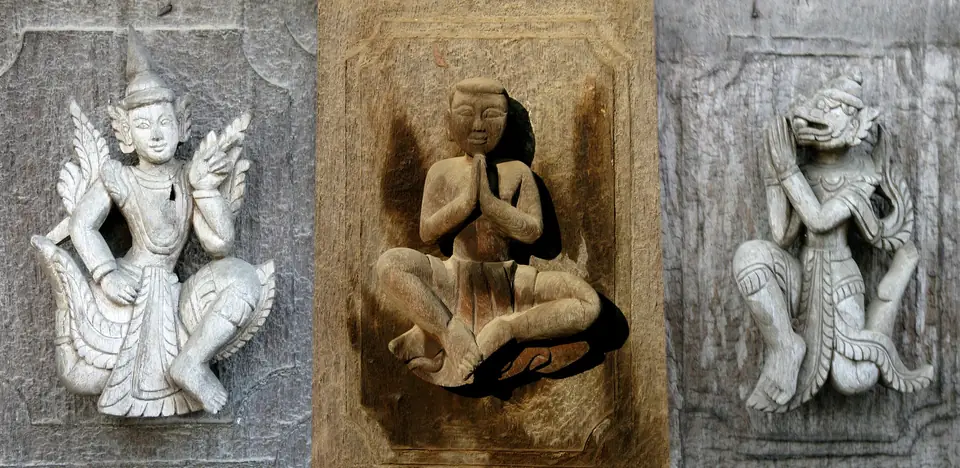
- Stepped teak roofs — Pinnacles, ridges and friezes carved with nagas, mythical creatures, dancers and flowers
- Forest of 150 teak posts — 15 rows by 10, with 54 posts adorned with naya figures
- Golden inner hall — Walls, ceilings and pillars that keep their gold leaf, with a Buddha on a replica of the Lion Throne
- Bases with the Ten Great Jatakas — Carved reliefs, with the Vessantara on the central pillar of the altar
- Perimeter veranda — High-relief panels, some new in pale wood, facing the neighbouring Atumashi Monastery
Outside the walls of the old Mandalay palace, the Shwenandaw Monastery (also called Shwe Kyaung) is a pavilion of carved teak that was born for another purpose. It was part of the royal palace of Amarapura and, moved to Mandalay, formed the northern section of the Hmannan, the Glass Palace, within the apartments of King Mindon. From 26 August 1878, the king was treated for his final illness in a golden chamber on that north side, and he died there on 1 October 1878.
The history of the Shwenandaw Monastery truly begins with that death. A few days later, his son and successor, Thibaw, ordered the pavilion and its adjoining hall dismantled and taken out of the royal compound, convinced, according to the most repeated version, that his father’s spirit lived in it; other sources treat that fear as mere rumour. He rebuilt it on a plot next to the Atumashi Monastery, dedicated it to Mindon’s memory, meditated in it for a brief period and donated it to the monks, in 1879 according to the most cited date, although sources disagree. The change of use was simple: in Konbaung architecture, a throne hall so resembled the main hall of a monastery that the royal chamber went on serving as a monastic building.
To know what to see at the Shwenandaw Monastery, the figure that holds it up is enough: 150 teak posts, in 15 rows from east to west by 10 from north to south, of which 54 carry attached naya figures. Above them the roofs step upward with pinnacles and carved friezes, and inside, the central hall keeps a good part of the gold leaf that once covered the exterior as well. On the bases of the altar pillars the Ten Great Jatakas are carved. In 1996 Burma’s Department of Archaeology proposed the monastery for UNESCO’s World Heritage List, and since 2014 the World Monuments Fund has led its restoration.
The audio guide walks the building in four stops and 40 minutes, from the garden to the veranda, with a thread that explains everything: this pavilion still stands by a miracle and for a bad reason, because a son’s fear took it out of the palace just in time to spare it from fire and bombs.
The pavilion was part of the Mandalay Palace before its move, and a short walk away stretch the marble slabs of the Kuthodaw Pagoda, another work of Mindon’s.
A golden palace dressed in grey
Shwenandaw Monastery
Summary of this stop
From the garden, the silhouette gives away its origin. The stepped teak roofs shrink level by level and end in ridges, pinnacles and friezes carved with nagas, mythical creatures, dancers and flowers: the image of a palace pavilion rather than a monastery. It is no accident, because the building was part of the royal palace of Amarapura and later of the northern section of the Mandalay Glass Palace, within the royal apartments.
The first contrast is in the colour. The facade that now looks silvery grey or dark was covered in gold leaf inside and out, with glass mosaics in the interior, and from that total gilding comes its popular name, Shwe Kyaung, the golden monastery. The outer gold has almost entirely disappeared and the untreated teak has darkened in the sun; what remains is kept inside.
In front of that bare wood, the narration reconstructs what the building was like when it still shone at the heart of the palace, and which details of the carving still speak of the court that raised it.
One hundred and fifty posts to move a king
Brick stairway and naya posts
Summary of this stop
At the foot of the brick stairway, the architecture of the Shwenandaw Monastery is laid bare: a forest of 150 teak posts, 15 rows from east to west by 10 from north to south, with 54 posts adorned with naya figures, dragon-like creatures. Five brick stairways climb to the raised floor, and a balustrade runs around the base. That structure of posts and interlocking pieces is what allowed the pavilion to be dismantled and reassembled outside the walls.
The move had a decidedly unarchitectural motive. Mindon died on 1 October 1878 and, a few days later, Thibaw ordered the pavilion where he had died dismantled, together with its adjoining hall, convinced that his father’s spirit lived in it. That chamber already carried a supernatural reputation: according to a documented tradition, in the days before the death the court recorded vultures perched on the palace roofs, continual earthquakes, wall turrets that collapsed all at once, a tiger that entered a monastery, a celestial music that sounded over the king’s chamber from six in the evening and nat spirits weeping in the Glass Palace.
Among those omens there is an image the audio guide reserves for this spot, beside the posts that served to send away a dead king: that of a female spirit lying on the throne.
The golden hall where Mindon passed away
Golden hall and Jataka pillars
Summary of this stop
Inside, the light changes. The central hall keeps on its walls, ceilings and great posts a good part of the gold leaf and lacquer, and at the back a golden image of the Buddha presides over the space. It was in a golden chamber like this one, on the north side of the Glass Palace, that Mindon spent his last illness from August 1878, under the watch of Queen Hsinbyumashin, who let only a handful of consorts in.
That agony was surrounded by intrigue. According to a documented tradition, the queen spread word that the king wanted to say farewell to his children; on 11 September 1878 the princes and princesses who could aspire to the throne came unarmed and, while they waited, an armed group arrested them. On 19 September Thibaw was proclaimed heir without informing the king. After Mindon’s death, over a hundred members of the royal family were executed, many in February 1879. Thibaw, for his part, used the building to meditate for a brief period before donating it to the monks, and tradition points to an interior divan as his meditation seat.
On the bases of the pillars supporting the altar platform the Ten Great Jatakas are carved, one per base. On the central pillar the Vessantara is told, the prince who gives away his white elephant and later his own children. In front of that carving, the audio guide tells what the dying king did when he learned of the trap, and why a story of giving up one’s children is so eloquent in this place.
The neighbour that burned and the new carvings
Perimeter veranda
Summary of this stop
The perimeter veranda surrounds the building on the raised floor, with doors and panels of figures in high relief. Some panels, of paler wood, replace lost originals: they are the result of the restoration the World Monuments Fund has led since 2014, the first internationally led conservation project on a wooden building in Myanmar. In 2019 a campaign of replacement carvings was still under way with the master carver U Kan Khyunt, who trains young carvers.
From here the Atumashi Monastery can be seen, on the adjoining plot where Thibaw rebuilt the pavilion. The original was raised by Mindon in 1857 and burned in the city fire of 1890 together with its 9-metre Buddha, while the Shwenandaw stood a few steps away; what is seen today is the 1996 reconstruction. Luck turned its way again in the Second World War: the Japanese made the palace citadel a supply depot and the bombing razed it. The pavilion Thibaw had removed is today the only great original wooden pavilion of that palace.
One final irony remains. Thibaw dismantled the house to drive away his father’s spirit, but popular belief holds that the ghost moved along with it. On the veranda, in front of the neighbour that was not so lucky, the audio guide closes the tour with that story.