Historic bazaar
Zegyo Market Audio Guide (Zay Cho Market)
The bazaar born with King Mindon's capital has seen boats arrive along its streets, has burned twice and lost its Italian building to the wrecking ball; today, facing a colonial clock, it holds Upper Burma's largest gold market.
- 50 min of audio
- Gold and textile market
The Zegyo or Zay Cho market was founded in the 1860s, during the reign of King Mindon, on 12 acres (4.86 hectares) in the centre of the new capital. It was Mandalay's great warehouse for rice, cotton, tobacco, wheat and pulses, and at the same time its market for jewellery and gold and silver thread embroidery. Today it occupies eight four-storey blocks, one of them of six, built in the 1990s.
Where those blocks now stand there was once a masonry bazaar of 1903 designed by an Italian, Count Calderari, built after a fire and gone when the government demolished it in the 1990s. Nothing visible remains of it, just as no rails remain of the electric tram that, between 1904 and 1942, had its hub right at its doors.
Highlights
- Jubilee clock tower — Built for Queen Victoria's diamond jubilee, at the crossing of 26th and 84th streets
- Gold floor — An entire floor with Upper Burma's largest gold and jewellery market
- Street market — Fruit, vegetables, fish, grains and pulses on the pavements of 84th to 86th streets
- Longyi and acheik stalls — Cotton, Mandalay's wavy silk, velvet slippers, lacquer and silverwork
- Tram hub — The streets from which the three branches of the electric tram left, from 1904 to 1942
In the very centre of Mandalay, the Zegyo Market, called Zay Cho (ဈေးချို) in Burmese, is the city’s bazaar with the most history. Sources date it to the 1860s, in the time of King Mindon, when it occupied 12 acres (4.86 hectares) in the heart of the new capital; one version moves it back to 1853, the year Mindon took the throne, although that date is earlier than the founding of Mandalay itself, in 1856-1857. Its name is glossed as “cheap price” or “sweet price”, and some translate it as “cheap rice”.
The history of the Zegyo Market is a series of blows and reopenings. In 1886 the dyke protecting the lower part of the city gave way and boats sailed through the streets to the great bazaar. At the start of the 20th century it was the main one of Mandalay’s twenty bazaars and it burned in 1897; in 1903 a masonry building designed by the Italian Count Calderari was raised, and another source records a new fire in 1906 followed by another reconstruction, a chronology that never quite fits. Between 1904 and 1942 it was the hub of the city’s electric tram, and in the 1990s the government demolished the colonial building to replace it with a Chinese-style shopping centre.
The architecture of the Zegyo Market is today that of those 1990s: eight blocks of four floors, one of them of six, with goods from all over Burma and from India, China and Thailand, wholesale and retail. In one of the blocks, an entire floor is occupied by Upper Burma’s largest gold and jewellery market. Outside, trade spills out of the buildings into 84th to 86th streets, and facing the market rises the clock tower of Queen Victoria’s diamond jubilee.
To know what to see at the Zegyo Market, the audio guide walks it in four stops and 50 minutes, from the clock tower to the gold aisles. The thread that binds them is the way this noisy bazaar resists, having survived water, fire, the wrecking ball and bombs almost always in the same way: by opening again.
The bazaar was born with the capital laid out around the Mandalay Palace; to the south, the Mahamuni Pagoda receives pilgrims daily, and beyond, already in Amarapura, the U Bein Bridge crosses Taungthaman Lake.
Victoria’s clock facing Mindon’s bazaar
Jubilee clock tower
Summary of this stop
At the crossing of 26th and 84th streets, facing the market, rises the clock tower built to commemorate Queen Victoria’s diamond jubilee, that of 1897. It is the first image of the Zegyo and also its first paradox: a monument to the British sovereign planted before the bazaar founded by Mindon, the penultimate king of Burma, in the centre of his capital. One review, however, dates the tower to 1909 and presents it as a symbol of the city, so its exact year remains open.
The dial is not the original either. According to the story, the original English clock was replaced in 1985 by a Japanese one of the Seiko brand, and in December 2014 the Mandalay City Development Committee installed another new one, with a dial three feet in diameter. Even time, at this crossing, has been replaced.
At the foot of the tower, the audio guide opens the tour with the contrast between an empire’s clock and a king’s market, and with what that contrast says about the city that grew up around it.
Water, fire and wrecking ball over Calderari’s bazaar
Zay Cho Market
Summary of this stop
In front of the 26th Street facade, the market blocks seem to have no history. They do, and it is made above all of absences. In 1886, in the midst of the rainy season, the dyke of lower Mandalay gave way and boats and launches reached the Zegyo along the flooded streets. Then came fire: the bazaar burned in 1897 and, according to another source, again in 1906, and it was rebuilt after each blaze. In 1903 a masonry building designed by an Italian, Count Calderari, was raised here, which the government had demolished in the 1990s. Nothing visible remains of that bazaar.
This same street holds a recent dark episode. On the night of 1 July 2014, 26th Street, between the southwest corner of the palace moat and the market, became a battlefield between Buddhists and Muslims, after an accusation spread on Facebook, never independently verified, that two Muslim brothers who owned teahouses had raped their Buddhist maid; the family said they did not even have a maid. Stones and bricks flew until the early hours, a monk, Galoneni Sayadaw, tried in vain to calm the crowd, and the violence left at least two dead and a curfew in the city.
In front of these blocks, the audio guide reconstructs the bazaar that is no longer there and tells how a market street went in one night from stalls to barricades.
Fruit on the road where the tram ran
Street market of fruit, vegetables and fish
Summary of this stop
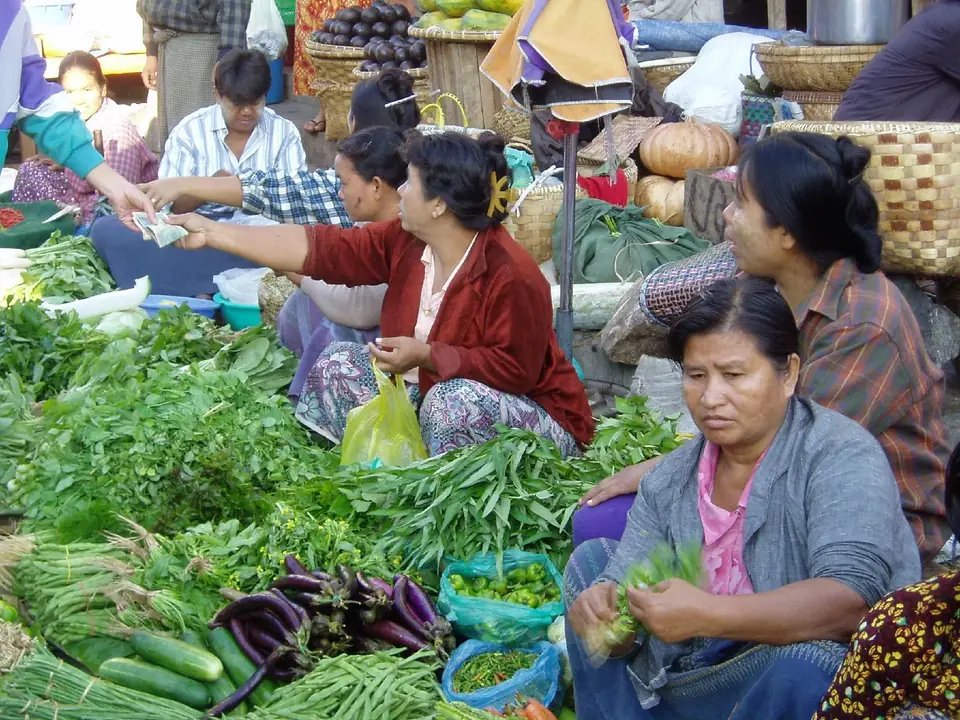
Between 84th and 86th streets, and between 26th and 28th, the market goes out into the street. Fruit, vegetables, fish, meat, grains and pulses are piled on pavements and roadways, tended almost always by women. It is the ground-level version of the Zegyo that Mindon founded, Mandalay’s great distribution centre for beans, citrus, cotton, nuts, onions, rice, tobacco and wheat.
Beneath those stalls was the hub of the electric tram. It was built from December 1902 by the firm Dick, Kerr & Co. for the Mandalay Electric Company, its first car set off on 17 June 1904 and three branches left from the bazaar: to the Irrawaddy steamer wharf, to the Arakan pagoda and to the Law Courts. The air raid of 3 April 1942 badly damaged track and overhead lines, which were later dismantled; Mandalay thus lost its 7 miles (11 km) of electrified double track, and today not a single rail remains.
Above the stalls loom the 25-storey twin towers of the Mann Myanmar Zegyo Plaza, on 84th Street. They were born with the promise of dominating the neighbouring market and, according to their builder, of withstanding an 8.5 earthquake; from 2014 to 2019 they were the tallest buildings in Burma outside Yangon. Among the fruit crates, the audio guide tells how that plaza’s business took off thanks to the fire of another market in the city.
Gold, longyi and a Friday of lowered shutters
Longyi stalls and gold floor
Summary of this stop
Inside, the aisles fill with textiles: cotton longyi and acheik, Mandalay’s silk with wavy patterns, along with velvet slippers, lacquer and silverwork. It is the continuation of the covered bazaar that at the start of the 20th century displayed silks and jewels in abundance, in a city that lived off crafts such as carving sacred images in marble and soapstone. In one of the blocks, an entire floor is occupied by Upper Burma’s largest gold and jewellery market.
These aisles also bear wounds. On 26 April 2005, in the late afternoon, a bomb hidden in a plastic bag inside a bin exploded between two shops on the first floor: two shop assistants died and more than a dozen people were injured. In 2001, another bomb in the same market had wounded eight.
And they keep the memory of a silence. On Friday 10 December 2021, the whole of Burma shut itself indoors from ten in the morning to four in the afternoon in a “silent strike” against the military junta. Despite the regime’s orders, almost all of Mandalay lowered its shutters, including the Zay Cho, the busiest market in the city. Among the gold display cases, the audio guide closes the tour with what happened at four o’clock sharp.