Mughal bazaar of Old Delhi
Chandni Chowk Audio Guide
A Mughal princess laid it out in 1650 with a canal and a pool to reflect the moon. No water or clock tower remains, but over 1.3 km come a temple that heals birds, a golden mosque and the pavement of a Sikh martyrdom.
- 60 min of audio
- Mughal and Sikh history
Chandni Chowk was laid out in 1650 as the axis of Shahjahanabad, the new capital of Emperor Shah Jahan, and most sources attribute the design to his daughter, Princess Jahanara Begum. It was a bazaar of 1,560 shops, 40 yards wide and 1,520 long, between the Lahore Gate of the Red Fort and the Fatehpuri mosque, with the Faiz Nahar canal running down the middle between banyans and sacred figs. Its name, “moonlight square”, at first designated only the octagonal pool where the canal widened and reflected the moon.
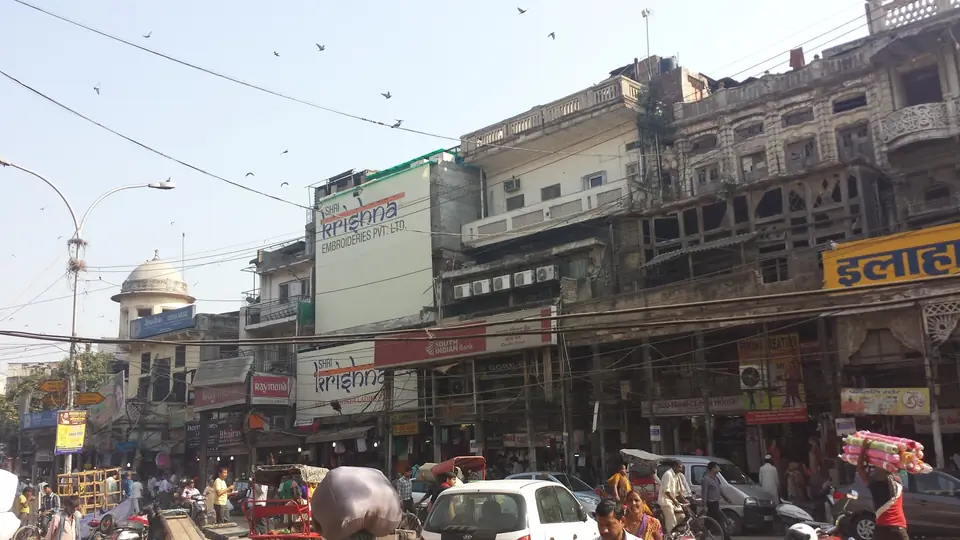
Nothing of that avenue of water is left in view. The British filled in the canal, swapped Jahanara's great caravanserai for a town hall in 1863 and raised over the pool a clock tower that collapsed in the 20th century and that nobody wanted to rebuild. Even so, over 1.3 km a Jain temple, a Hindu temple, a mosque with golden domes and a Sikh gurdwara stand side by side, and since 2021 the red sandstone ground has belonged to pedestrians again during the day.
Highlights
- Shri Digambar Jain Lal Mandir — a Jain temple of 1656 with a hospital exclusively for birds since 1930
- Gurdwara Sis Ganj Sahib — the site of Guru Tegh Bahadur's execution in 1675, with the tree trunk
- Sunehri Masjid — the golden-domed mosque from which Nadir Shah ordered the sack of 1739
- Bhagirath Palace — the palace of Begum Samru, a former dancer, now an electrical goods market
- Ghantaghar — the crossing where the moon pool and the clock tower of 1870 once stood
The history of Chandni Chowk is that of a bazaar that every empire has tried to bury and that has always filled up again. The Mughals laid it out with water and moonlight; the Persian Nadir Shah sacked it in 1739; Aurangzeb had the ninth Sikh guru beheaded here in 1675; and, according to documented tradition, when the British retook Delhi after the 1857 rebellion they raised improvised gallows in front of what is now Gurdwara Sis Ganj and hanged a great number of men there, Hindus and Muslims, accused of complicity with the uprising. Almost two centuries after the guru’s execution, the same stretch of pavement became a place of public executions again.
The night of 1675 also left one of the boldest stories of Delhi, as Sikh tradition preserves it. The guru’s body was left mutilated on the avenue and that night a storm broke. His disciple Bhai Jaita carried the head to Anandpur, where it was cremated by the future Guru Gobind Singh, then a boy of nine. The body was rescued by Lakhi Shah, a contractor and cotton merchant who had left his empty lime carts beside the Red Fort: with his sons he loaded it, took it out of the walled city and, since an open cremation was too dangerous, brought it into his own house on Raisina Hill and set it on fire. The family mourned the blaze as if it were an accident. Where that house burned stands today Gurdwara Rakab Ganj, opposite the Parliament of India.
What to see in Chandni Chowk depends on knowing how to read what is missing: a canal under the median, a caravanserai under a town hall, a tower that is no longer there. The architecture and history of Chandni Chowk are best understood by walking the avenue from east to west, from the Red Fort to the Fatehpuri mosque, which is exactly the route the audio guide follows.
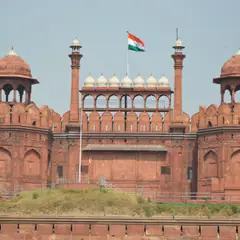
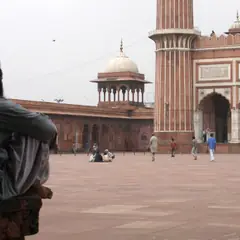
The avenue starts opposite the Lahore Gate of the Red Fort and a few minutes’ walk away rises the Jama Masjid. The other great house of the Sikh faith in the city is in New Delhi: Gurdwara Bangla Sahib.
A camp temple facing the Red Fort
Shri Digambar Jain Lal Mandir
Summary of this stop
The route starts at the eastern end, right opposite the Red Fort, before a red sandstone Jain temple with a votive column, the manastambha, in front of the entrance. It is the Shri Digambar Jain Lal Mandir, and its origin is almost as old as the avenue: it was built in 1656 on the spot where a Jain officer of the Mughal army kept a cult image in his tent. Hence its nickname, Lashkari Mandir, “the camp temple”. The present buildings date from 1878.
In a rear building there has operated since 1930 something few expect in the middle of a bazaar: a hospital exclusively for birds, with cages and a roof terrace from which cured birds are released. Attached to the Lal Mandir, the small Hindu temple of Gauri Shankar, dedicated to Shiva and Parvati, was built in 1761 by the Maratha soldier Appa Gangadhar to fulfil a vow; in one version he arrived wounded from a battle, in another he was gravely ill and swore a temple if he recovered.
It is said that its Shiva lingam, among five peepal trees and beneath a silver vessel that drips water without pause, is about 800 years old and grants devotees’ wishes; in the month of Shravan the queues begin at five in the morning. The soldier’s name is still written on the building itself, at a spot almost everyone walks past, and the narration points it out right there.
A dancer’s palace, now full of lamps
Bhagirath Palace
Summary of this stop
On the north side, near the eastern end, a facade of classical columns barely peers out between the signs and lights of electrical goods shops. Up above an old sign can still be read: “Lloyd’s Bank Limited”. It is Bhagirath Palace, and its first owner was Begum Samru, a former dancer who came to rule the principality of Sardhana. In 1806 Emperor Akbar Shah II gave her this plot opposite the Red Fort, and she built her palace here.
Afterwards the house changed hands the way a shop changes its sign: in 1847 it passed to the Delhi Bank, in 1940 to Lala Bhagirath Mal, who left it his name, and since around 1950 it has been a wholesale market for cables, lamps and switches.
In front, down the centre of the avenue, where the sandstone median runs today, passed the Faiz Nahar canal, which brought water from the Najafgarh pool to the pavilions and gardens of the Red Fort, flanked by banyans and sacred figs; the British filled it in. How a dancer ended up at the head of a principality is the twist the audio guide reserves for this spot.
Golden domes over the pavement of martyrdom
Gurdwara Sis Ganj Sahib
Summary of this stop
Two imperial violences meet within a few metres. On a plinth with a stairway stands a small mosque of three golden domes and slender minarets, the Sunehri Masjid, built by the nobleman Roshan-ud-Daula in 1721-1722. From it, in 1739, the Persian invader Nadir Shah ordered the sack of Delhi, which also reached the jewellers of Dariba Kalan; the exact date and the death toll of that massacre vary by source.
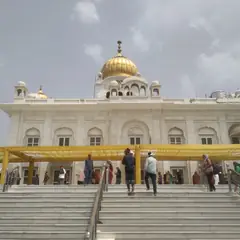
Attached to it shines Gurdwara Sis Ganj Sahib. Here, beside the Kotwali, the Mughal police station and jail whose building still stands next door, the ninth Sikh guru, Guru Tegh Bahadur, was beheaded on Aurangzeb’s orders in November 1675; sources hesitate between the 11th and the 24th of that month, probably because of a calendar difference. The present building dates from 1930 and keeps the trunk of the tree under which he was executed and a well linked to the guru. The exact spot was nearly lost: in 1783, when the Sikh chief Baghel Singh occupied Delhi and wrung from Shah Alam II permission to build shrines, nobody remembered it. It was revealed to him by an elderly Muslim woman of the water-carrier caste, whose father had been a witness and had cleaned the place, and to build the shrine part of a mosque wall was pulled down.
Across from the gurdwara, a museum remembers the brothers Mati Das and Sati Das, at the site of their martyrdom. According to Sikh tradition, before the beheading the executioners put to death his three companions before the eyes of the guru, shut in an iron cage. What Bhai Mati Das asked for as a last wish, and what the faithful believe happened to his prayer, is told in front of these domes.
Frying shops where silver once gleamed
Paranthe Wali Gali
Summary of this stop
South of the avenue open the mouths of two alleys: Dariba Kalan, the street of jewellers and silversmiths, and Paranthe Wali Gali. The latter was also a street of silversmiths until, from the 1870s, parathas frying shops began to settle in; the oldest survivor, Pt Kanhaiyalal Durgaprasad Dixit, dates from 1875, and by around 1911 the street had already taken the name of the breads. Silver is no minor detail: some link the very name of Chandni Chowk with “chandi”, silver, because of the trade that earned it the nickname Silver Street, as against the more widespread explanation of the moon’s reflection.
The avenue also had its legendary confectioner, Ghantewala, founded in 1790 by Lala Sukh Lal Jain. Its fame reached the press in the midst of the rebellion: the newspaper Dihli Urdu Akhbar of 23 August 1857 wrote that the rebels arriving in Delhi lost their appetite for fighting after tasting its sweets. It closed in July 2015.
Its name, “the one with the bell”, has two explanations and neither wins. One passes through Emperor Shah Alam II and the Red Fort; the other, through a street vendor who walked the streets before having a shop. Both full versions are heard at the mouth of the alley.
The moon square, with no water and no clock
Delhi Town Hall
Summary of this stop
In front of the Delhi Town Hall, a colonial building of 1863, opens a congested crossing that is, in fact, the heart of the name. Here the canal widened into an octagonal pool that reflected the moon: the original “moonlight square”, which in time gave its name to the whole avenue. On the site of the town hall stood Jahanara’s great caravanserai, which the traveller François Bernier judged the most imposing building in the city after the Jama Masjid. The British covered the canal and replaced the caravanserai with the Town Hall.
Over the old pool the Northbrook Clocktower was raised in 1870, a Gothic tower with four dials to which one source gives 128 feet and another 110. Its upper part collapsed in 1950, or in 1951 by the other version, and caused deaths. In 1957 the municipality set aside 2 lakh to rebuild it, but it was seen as an English relic and was never reconstructed. No trace remains, although the place is still called Ghantaghar. A jibe from the neighbourhood survives too: it is said that pigeons perched on the spires and that the clock never told the right time.
Along this same avenue, on 23 December 1912, Viceroy Lord Hardinge advanced on the back of an elephant in the ceremonial entry into the new capital, when a homemade bomb hit his howdah: it wounded him and killed the attendant holding his parasol. The plot was led by Rash Behari Bose, although sources do not agree on who threw the device. What that attack says about the empty square is left for the narration at the crossing.
The mosque sold at auction that closes the avenue
Fatehpuri Masjid
Summary of this stop
At the western end, the perspective is closed by a red sandstone mosque with a single dome and slender minarets: the Fatehpuri Masjid, built in 1650 by Fatehpuri Begum, wife of Shah Jahan. It is the other pole of the axis that began at the Red Fort.
Its history has an unusual parenthesis. After 1857 the British auctioned parts of the mosque to a Hindu family, and it did not return to Muslim hands until the Delhi Durbar of 1877, twenty years later.
Underfoot lies the last layer of the palimpsest: in September 2021 the first phase of the redevelopment was completed, which repaved in red sandstone and granite the 1.3 km between the Red Fort and the Fatehpuri mosque, with pedestrian priority and a daytime ban on motor traffic. With no canal and no trees, the avenue belongs again to those who walk it, and how the mosque returned to its worshippers is the last twist of the route.