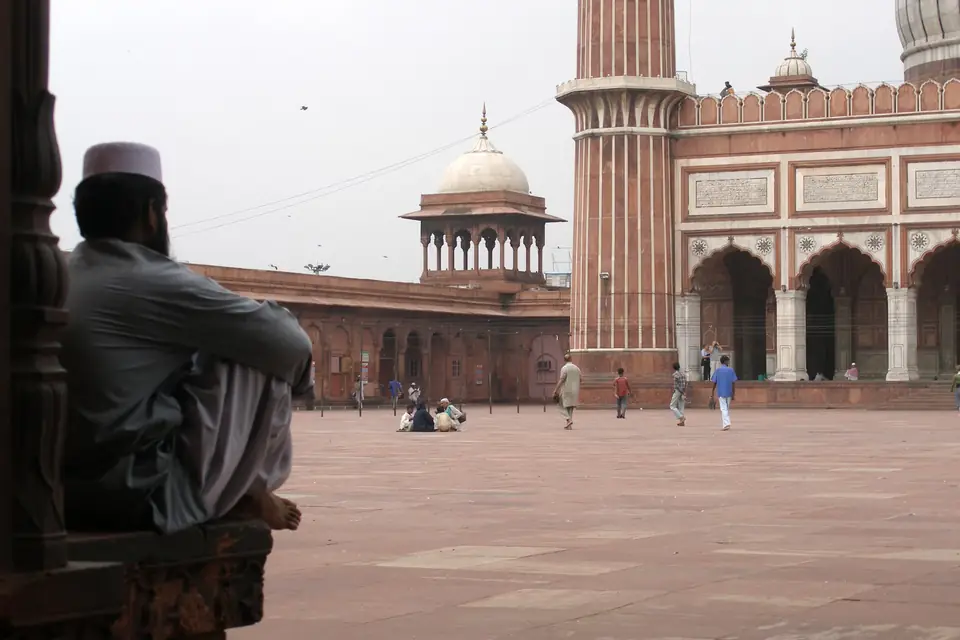
Great Mughal mosque
Jama Masjid Audio Guide
Shah Jahan raised it on the highest hill of his new city, facing the Red Fort: from its pulpit the emperor was legitimised, the British turned it into barracks, and every Friday the crowd fills it again.
- 45 min of audio
- Mughal architecture
The Masjid-i-Jahan Numa, “the mosque that displays the world”, occupies the whole of the hill of Pahari Bhojala, the highest point of Shahjahanabad. Shah Jahan himself laid the first stone on 6 October 1650, by the most quoted date, and the works, directed by the prime minister Sa'dullah Khan and by Fazil Khan, lasted six years and cost 10 lakh rupees, not counting the stone, a gift from rajas and nawabs. It was inaugurated on 23 July 1656 by Syed Abdul Ghafoor Shah Bukhari, a cleric from Bukhara invited to be its royal imam.
After retaking Delhi in 1857, the British banned worship, filled it with soldiers and weighed selling it, demolishing it or turning it into a church: the officer Charles Raikes proposed dedicating each of its stones to a Christian martyr. It returned to the Muslims of Delhi in 1862, with conditions, and the Bukhari family, which has held the post of imam since 1656, still speaks from its pulpit.
Highlights
- East Gate — a three-storey portal reserved for the emperor, with a 35-step stairway facing the Red Fort
- Great courtyard — a red sandstone esplanade at least 99 metres on a side, with room for 25,000 worshippers
- Prayer hall — a white and black marble floor that outlines 899 prayer rugs
- Minarets — two towers of about 41 metres with white marble stripes; the south one can be climbed
- Dargah of Sarmad — the red and green shrine of the fakir who, according to tradition, was beheaded before the east gate
The history of the Jama Masjid begins on a hill. Pahari Bhojala was the highest point of Shahjahanabad, the city Shah Jahan was building in the mid-17th century, and the mosque occupies all of it, about a thousand yards from the Red Fort. The emperor laid the first stone on 6 October 1650, by the most quoted version, although other sources move the start of works back to 1644; the number of workers usually repeated is around 5,000, and some speak of 6,000. Six years later, on 23 July 1656, a cleric from Bukhara inaugurated it as its first Shahi Imam, the “royal imam”.
Since then, this red sandstone esplanade has been throne, scaffold, barracks and refuge. During the Mughal period, its Friday sermon legitimised the sovereign; after 1857 the British closed it to worship; in 1947, in the midst of Partition, Muslims in Delhi were urged from here not to leave for Pakistan. Today it is in the care of the Delhi Waqf Board and is not among the monuments protected by the ASI. The architecture and history of the Jama Masjid are best understood by climbing its stairway, crossing the courtyard and ending at the foot of the south minaret, which is exactly the route the audio guide follows.
The mosque looks across to the Red Fort, a kilometre away, and sits a few steps from Chandni Chowk, the avenue of bazaars of Shah Jahan’s same city.
The emperor’s gate and the beheaded fakir
East Gate stairway
Summary of this stop
The route starts at the foot of the east stairway, the one facing the Red Fort. Because the mosque crowns the highest hill of the old city, it rests on a plinth some ten metres above the streets, and each of its three gates has its own red sandstone stairway: 35 steps on the east, 39 on the north and 33 on the south. The eastern one, three storeys high and the tallest, was the royal entrance, reserved for the emperor and his retinue; the north and south ones, of two storeys, were for the people.
These steps were never a solemn, empty backdrop. Stalls, shops and street performers occupied them, and at dusk the east side turned into a market of hens and birds. Opposite the gate, in a small dargah split in two colours, a tomb covered in red still receives threads and slips of paper with the name of a beloved.
It is that of Sarmad Kashani, poet and fakir, spiritual teacher of Prince Dara Shikoh. According to a documented tradition, around 1660 or 1661, in the time of Aurangzeb, he was beheaded before this gate for reciting only the first half of the creed, “there is no god”, and a court chronicler noted the verses he spoke on the scaffold. Legend adds an impossible ending on these same steps, and what his severed head is said to have done is left for the narration right there.
North Gate: the mosque turned into barracks
North Gate
Summary of this stop
The north gate, of two storeys, was one of the people’s thresholds. Popular guides and encyclopaedias repeat that a cupboard in this portal holds relics attributed to the Prophet, among them a Qur’an on deer skin, a hair of his beard and his sandals, although neither their presence nor their authenticity has academic or official backing.
What is documented is what happened here after the revolt of 1857. On retaking Delhi, the British confiscated the mosque, banned worship in it and used it as a barracks for Sikh and European soldiers; the imperial college, the dispensary and the madrasa attached to the compound were destroyed in those upheavals. They even weighed selling it, demolishing it or turning it into a church, and the officer Charles Raikes proposed keeping it as a Christian temple with each stone dedicated to a martyr.
The mosque went back to the Muslims of Delhi in 1862, with a list of conditions: strictly religious use, British supervision and a third clause that touched squarely on a gesture every visitor repeats on crossing this threshold. To enforce them the Jama Masjid Managing Committee was created. What that clause was, and why it stung so much, is revealed right under the gate.
The pool where the crowd always returns
Ablution pool
Summary of this stop
On the other side opens the great courtyard, the sahn: a square esplanade of red sandstone at least 99 metres on a side, ringed by open arcades and with chhatris at the four corners, able to hold 25,000 worshippers. In the centre, a marble pool of about 17 by 15 metres serves for ablutions before prayer.
That crowd was given up for lost. In a letter of December 1859, the poet Mirza Ghalib counted “the daily crowds of the Jama Masjid” among the things that kept Delhi alive and lamented that they no longer existed. They returned, and with them the repairs: in 1948 the last Nizam of Hyderabad was asked for 75,000 rupees to repair a quarter of the floor, and he granted 300,000 so that the other three quarters would not look old.
Beside this same pool two bombs exploded on Friday 14 April 2006, minutes before the afternoon prayer, with thirteen or fourteen injured; nobody claimed the attack and its authorship was never clarified. What the worshippers did in the following hour and a half is the courtyard’s best answer, and the audio guide tells it from its edge.
Where the sermon crowned the emperor
Prayer hall
Summary of this stop
The prayer hall presents a great central pishtaq flanked by five lobed arches on each side, with white marble panels inscribed in black marble; behind, three marble domes with black bands and golden finials peek out. During the Mughal period the khutba was recited here, the Friday sermon that named the sovereign and legitimised him. In 1757 it was read in the name of an Afghan conqueror, Ahmad Shah Durrani, invited to Delhi by Emperor Alamgir II himself.
The voice that speaks from this pulpit has belonged to the same family since 1656: all the imams bear the surname Bukhari, and on 25 February 2024 Syed Ahmed Bukhari proclaimed his son Shaban as successor in an investiture ceremony at the mosque, an inheritance that court petitions in 2014 went as far as to challenge. It is also the place where the moon is awaited: the sighting committee meets here and the imam announces the date of Eid, while in Ramadan, at sunset, the courtyard is covered with the tablecloths of families breaking the fast together.
Inside, the white and black marble floor holds the building’s finest detail: black marble borders that outline 899 individual spaces of about 90 by 45 centimetres, like prayer rugs made of stone. What that pattern says about who prays and how is revealed in front of the hall.
The minarets that asked a question
South minaret
Summary of this stop
The south minaret, of about 41 metres, alternates vertical stripes of white marble and red sandstone, has 130 steps and three galleries, and is crowned by a marble chhatri; it is the only one of the two that can be climbed. From the top, and from the courtyard too, the Red Fort can be seen. The open ground between them is the gap left by the houses and shops the British demolished after 1857.
From here the whole work can be taken in: six years of labour and a million rupees, not counting the stone, which various rajas and nawabs gave. And to these same minarets a voice appealed in 1947, asking the city not to empty itself.
On 23 October 1947, in the midst of Partition, Maulana Abul Kalam Azad spoke at the Jama Masjid before a congregation of Muslims to ask them not to emigrate to Pakistan: “Raise your eyes. The minarets of the Jama Masjid want to ask you a question.” What question that was closes the route at the foot of the tower.