Lutyens war memorial
India Gate Audio Guide
A 42-metre triumphal arch that the British Empire raised for its Indian soldiers and that free India has kept filling and emptying: a flame that burned half a century under the vault and a marble king who gave up his place to Netaji.
- 40 min of audio
- Memorial and imperial axis
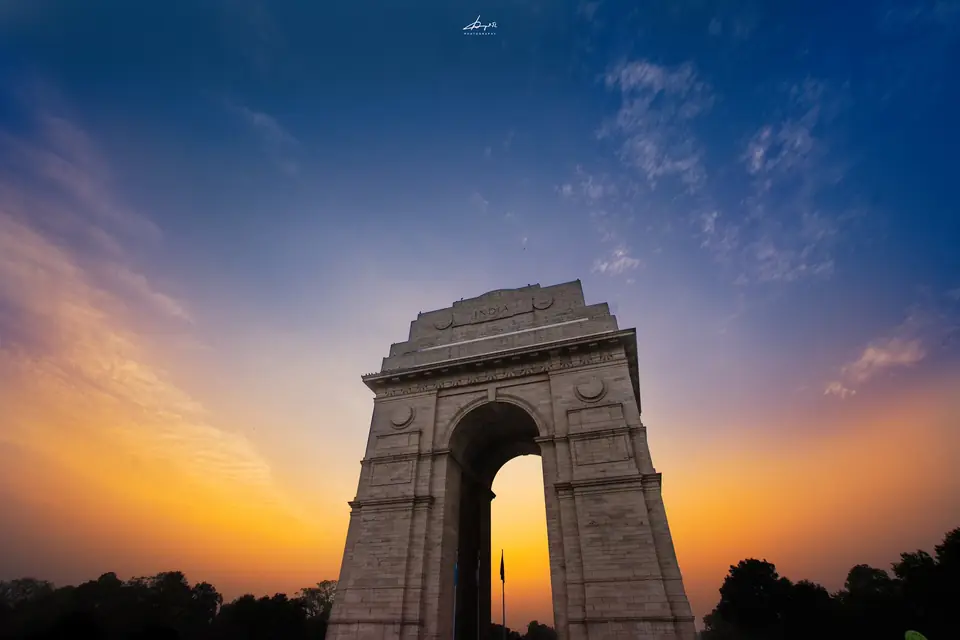
India Gate was born as the All India War Memorial: the Duke of Connaught laid its foundation stone on 10 February 1921 and the Viceroy Lord Irwin inaugurated it on 12 February 1931. It was designed by Edwin Lutyens, chief architect of New Delhi and author of the Cenotaph in London, as a secular memorial, with no crosses or religious iconography. The arch, 42 metres high with a main span of 9.1 metres, rises from a plinth of red Bharatpur stone and closes at the east the great ceremonial axis now called Kartavya Path.
Its walls honour tens of thousands of soldiers of the British Indian Army who died between 1914 and 1921, but they bear only about thirteen thousand names engraved, and these are not independence fighters, as a viral hoax has repeated since 2019. About 150 metres away, the canopy Lutyens raised for a statue of George V stood empty for more than half a century, until in 2022 a figure of black granite of Subhas Chandra Bose took its place.
Highlights
- INDIA inscription between MCMXIV and MCMXIX — a dedication to the dead of Flanders, Mesopotamia, Gallipoli and the North-West Frontier
- Walls of names — thousands of soldiers engraved in the stone, among them 959 servicemen from the United Kingdom
- Bowl at the top — meant to burn with oil on anniversaries and almost never lit
- Amar Jawan Jyoti — the flame for the 1971 war that burned under the vault from 1972 to 2022
- Lutyens canopy — a 22-metre dome where George V gave up his place to a black granite Netaji
The history of India Gate begins with a train. Until the 1920s, the railway line from Agra to Delhi crossed the site where the arch now stands and the route of the future Kingsway, the great imperial avenue. In the decade between the foundation stone, laid on 10 February 1921 at 4:30 pm by the Duke of Connaught before Viceroy Chelmsford and eight Indian regiments on parade, and the inauguration of 1931, the tracks were diverted next to the Yamuna river and in 1926 New Delhi station opened. Only then could Edwin Lutyens’s arch become the eastern terminus of the ceremonial axis that climbs to Raisina Hill.
Since then, the monument has never stopped changing meaning. It was conceived as a cenotaph for the Indian soldiers of the British army; independent India added in 1972 a flame for the fallen of the 1971 war, which left in 2022, and emptied and refilled the canopy that accompanies it. Each change has had its controversy, and none is entirely closed. Meanwhile, the esplanade remains Delhi’s backyard: on summer nights, with days of 38 degrees, thousands of families spread sheets on the lawn, ice-cream carts line up on Mansingh Road and vendors throw into the air plastic helicopters with little blue lights that come fluttering down like fireflies.
The history of India Gate, its architecture and what India has done with it are best understood by walking the esplanade from west to east, from the lawns of Kartavya Path to Netaji’s canopy, which is the route the audio guide follows.
Two and a half kilometres away, Gurdwara Bangla Sahib brings worshippers and visitors together beside its pool; the other great stage of Independence Day is the Red Fort, and further south, in Mehrauli, the Qutub Minar recalls the Delhi of the first sultans.
An arch with no crosses at the end of the axis
Kartavya Path lawns
Summary of this stop
From the lawns of Kartavya Path, the pale silhouette of the arch stands out against a low plinth of red Bharatpur stone. It is 42 metres high, with a main span of 9.1 metres, and rises to a great cornice resting on a frieze of radiant suns. Its four arches make it, strictly, a tetrapylon. At first glance it looks like one more imperial triumphal arch.
It is not. Lutyens, chief architect of New Delhi, was also a member of the Imperial War Graves Commission and designed sixty-six war memorials in Europe, among them the Cenotaph in London of 1919. Here he repeated his idea of a secular monument: no crosses or religious iconography, for an army of many faiths. The Duke of Connaught laid the foundation stone in 1921 and Viceroy Lord Irwin inaugurated it ten years later, on 12 February 1931.
This esplanade, which was then called Princes Park, also holds one of the most overflowing episodes of the birth of India: on the afternoon of 15 August 1947 an orderly ceremony was planned here, with stands, numbered seats and a parade, before the new flag. What happened with the half a million people who turned up, with Nehru, with the last viceroy and with a downpour at just the right moment, is told by the narration in front of the arch.
Thirteen thousand names for seventy thousand dead
India Gate name walls
Summary of this stop
On top of the two long faces of the arch, INDIA can be read between two dates in Roman numerals, MCMXIV and MCMXIX, 1914 and 1919. Below, a dedication in capitals remembers the dead of the Indian armies in France and Flanders, Mesopotamia and Persia, East Africa, Gallipoli, the North-West Frontier and the Third Anglo-Afghan War. Lower down, the walls are covered with carved names, although access to read them up close is restricted.
The numbers do not add up, and that is deliberate. The arch honours tens of thousands of soldiers of the British Indian Army who died between 1914 and 1921, some 74,187 by one of the most quoted figures, although other sources speak of 60,000, 70,000 or 82,000. On the stone there are only about thirteen thousand names, with counts that vary slightly by source: most of those who fell overseas are named on memorials outside India, so what remains here are mainly those who died in India, on the North-West Frontier and in the Third Afghan War. Among them are 959 servicemen from the United Kingdom and one from Australia. The figure of 95,300 “freedom fighters” inscribed, which has circulated on social media since 2019, is false.
The arch of the fallen also has a dead man of its own, never explained. In December 2012, during the protests over a gang rape on a Delhi bus, a police officer deployed at India Gate collapsed near the monument and died two days later. The official version and that of witnesses never matched, and what became of the murder charge against eight young men is heard beside these walls.
A vault made to burn
India Gate
Summary of this stop
Under the main span, looking up, the spaced coffers of the vault appear. And higher still, invisible from the ground, the arch hides a detail of Lutyens: the shallow domed bowl that crowns it was designed to be filled with burning oil on anniversaries. It is a ceremony that is almost never held.
The fire that did burn here came later. On 26 January 1972 Indira Gandhi inaugurated under the arch the Amar Jawan Jyoti for the fallen of the 1971 war: a black marble cenotaph with an inverted rifle topped by a helmet and four urns with flame. Until 2006 it was fed by gas cylinders, each enough for about 36 hours of one urn, and Chander Singh Bisht tended it for four decades. On 21 January 2022, after fifty years lit, part of the flame was moved to the National War Memorial, 400 metres away, inaugurated in 2019 with 25,942 names of soldiers of independent India. The government argued that the flame was not being put out but merged with that of the new memorial; the opposition and some retired military men saw it as erasing history.
Under this same vault, in 2006, cinema and the street crossed. A film released that year showed a candlelight vigil at India Gate that in fact could not be shot beside the arch, and weeks later someone decided to copy it. Whom justice was being asked from, and how that protest ended, is left for the narration under the span.
The canopy that lost its king
Netaji statue
Summary of this stop
About 150 metres east of the arch, at a six-way crossing, rises a 22-metre canopy dome inspired by a 6th-century pavilion at Mahabalipuram, held up by four columns of Lutyens’s “Delhi order” and topped by a chhajja. Inside, in uniform and saluting, stands the black granite statue of Subhas Chandra Bose, Netaji. But the canopy was not made for him.
In autumn 1930 Maharaja Jagatjit Singh of Kapurthala gathered the Indian princes to pay for a statue of George V in honour of his recovery from sepsis. The first project showed the king in marble on a howdah on the back of a red stone elephant; the final one was a 5.72-metre marble figure by Charles Sargeant Jagger, in the coronation robe of the Delhi Durbar, on a 10.52-metre pedestal. The date of its installation varies by source: autumn 1936 in some, an inauguration on 14 November 1939 in others. On the night of 3 January 1943, in the midst of the Quit India movement, two young men climbed the statue, broke its nose and covered it with a black cloth that read “Death to the Tyrant”.
After independence, the king kept losing pieces: in August 1958 the gilded Tudor crown and the royal insignia were removed, in 1965 activists tarred the statue and at the end of 1968 George V was dismantled and taken to Coronation Park. The canopy stayed empty until 2022, amid proposals to put Gandhi there that never prospered and voices that argued for leaving it so, as a symbol of the end of the Raj. On 8 September 2022, the day Rajpath was renamed Kartavya Path, the statue of Netaji was dedicated: about 8.5 metres and 65 tonnes carved in 26,000 hours of work by the team of Arun Yogiraj. Where the block of stone came from, how it reached Delhi and what occupied the dome in the preceding months is the last twist of the route.