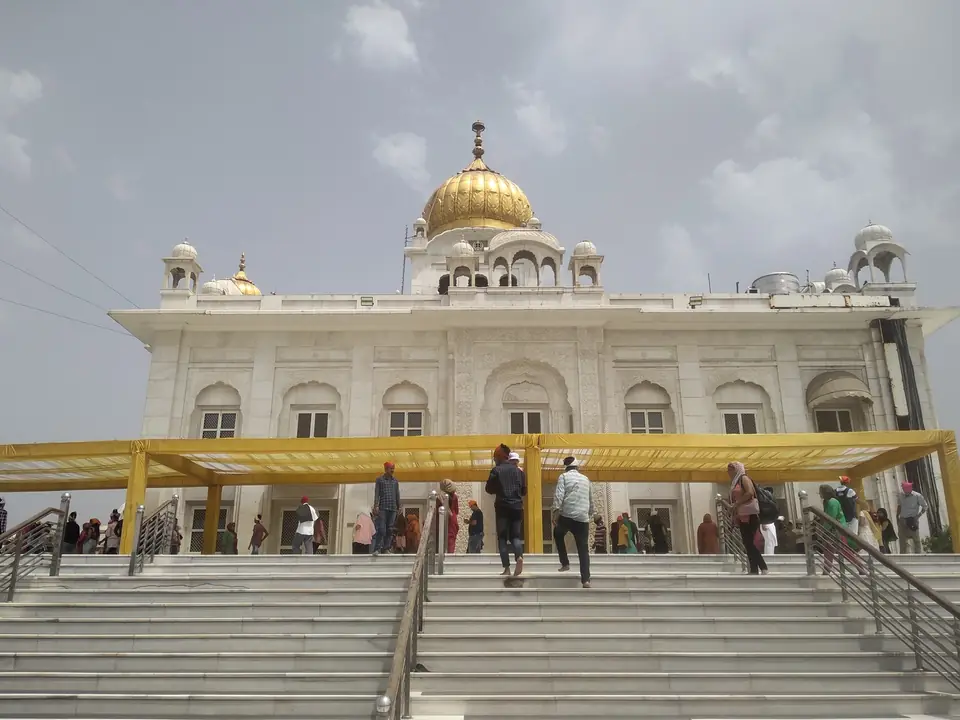
Sikh temple of New Delhi
Gurdwara Bangla Sahib Audio Guide
Beneath the white marble and the golden dome beats a house of 1664 where a seven-year-old guru said no to an emperor and handed out water to a sick city. His gesture still works every day in a pool, a kitchen and a hospital.
- 45 min of audio
- Sikh history and life
The name says it all to those who can read it: “bangla” is the bungalow of Raja Jai Singh I of Amber, where in 1664 the eighth Sikh guru, Har Krishan, stayed, summoned to Delhi by Emperor Aurangzeb. On that plot the Sikh chief Baghel Singh built a small shrine in 1783, and the white marble temple with golden domes that stands on the site today dates, for the most part, from after 1947. Prayer hall, sacred pool, community kitchen, museum and polyclinic form a single compound in which the history of Gurdwara Bangla Sahib is not displayed: it is practised.
What surprises most is not the shine but the scale of the everyday. The langar kitchen, open 24 hours, feeds more than 35,000 people a day for free and up to 100,000 on festivals, with 1,700 kilos of flour a day for the chapatis. During the 2020 lockdown it did not close a single day, and under the same roof a diagnostic centre offers MRI scans for 50 rupees to those who cannot pay for them.
Highlights
- Sarovar — a sacred pool of about 69 by 72 metres, heir to the well of the 1664 bungalow
- Langar — a community kitchen open 24 hours that feeds more than 35,000 people a day for free
- Darbar Sahib — a prayer hall with chandeliers and frescoes where kirtan is sung
- Golden dome and Nishan Sahib — the temple's hallmarks, visible from Baba Kharak Singh Marg
- Baba Baghel Singh Museum — Sikh history, named for the general who founded the shrine in 1783
The history of Gurdwara Bangla Sahib begins with a child. In 1664 Emperor Aurangzeb summoned to Delhi Har Krishan, guru of the Sikhs since the age of five, with the apparent purpose of replacing him with his elder brother, Ram Rai. The man charged with bringing him was Raja Jai Singh I of Amber, who lodged him in his bungalow. That stay coincided with a smallpox and cholera epidemic that was ravaging the city, and the boy helped the sick with fresh water from the house’s well. He himself caught smallpox and died on 30 March 1664, before turning eight, after the shortest reign of a Sikh guru: two years, five months and 24 days.
What came afterwards is a chain of layers on the same plot. On 15 July 1775 a Sikh raid razed Paharganj and Jaisinghpura, Jai Singh’s quarter in Delhi; on 12 March 1783, after the Sikh capture of the city, the chief Baghel Singh agreed with Begam Samru, in the name of Emperor Shah Alam II, a garrison of 4,000 men and permission to build gurdwaras at Sikh holy places. Bangla Sahib was one of them. More than two centuries later, in 1984, its walls protected some 150 Sikhs during the anti-Sikh riots. What to see at Gurdwara Bangla Sahib, and why every corner points back to that child, is best understood by walking the compound from the gate to the langar, the same order the audio guide follows.
Two and a half kilometres away stands India Gate, Lutyens’s arch at the end of the great axis of New Delhi, and in Old Delhi, in Chandni Chowk, Gurdwara Sis Ganj Sahib keeps the site of Guru Tegh Bahadur’s martyrdom.
A golden dome over a raja’s bungalow
Gurdwara Bangla Sahib
Summary of this stop
The visit starts at the main gate on Ashoka Road, where shoes are left at the cloakroom and the foot-washing channels are crossed before stepping onto the marble. From here the image that identifies the temple imposes itself: the white building, the golden dome seen from Baba Kharak Singh Marg and, beside it, the tall mast of the Nishan Sahib with the Sikh flag.
That first impression is a little deceptive. The architecture of Gurdwara Bangla Sahib that shines today is mostly from after 1947: it replaced the small shrine of 1783, which in turn occupied the bungalow where the guru stayed in 1664. The oldest thing in the place is not a stone but a name: “bangla”, the house of Raja Jai Singh.
And this same entrance has a recent history that few visitors know. In 1984, while anti-Sikh riots shook Delhi, some 150 Sikhs sought refuge inside the compound and a mob with cans of petrol tried to storm it. It was repelled. How that marble frontier defended itself is told in the narration, in front of the gate.
The boy who would not see the emperor
Darbar Sahib
Summary of this stop
Inside the Darbar Sahib, the main prayer hall, the Guru Granth Sahib, the Sikhs’ sacred scripture, rests under rich cloths among chandeliers and frescoes, and kirtan, the singing of hymns, fills the space. It is the spiritual heart of the gurdwara and the place where the tension that gave rise to it is best understood: that of an emperor who wanted to set aside a seven-year-old guru.
According to Sikh tradition, Raja Jai Singh came out barefoot to receive the boy, but Har Krishan refused to appear before Aurangzeb, because his father had forbidden him to see the emperor. Gifts arrived, the invitation was declined and the next day Prince Muazzam came to the bungalow to repeat his father’s wish. Instead of the audience, the boy dictated to him a hymn of Guru Nanak: without the true God in the heart, armies, servants and palaces are worth nothing.
Sikh historiography places his end in this house, on 30 March 1664, although the question of the exact place of his death is not entirely settled. Before dying he uttered two words, “Baba Bakale”, which pointed to his great-uncle Tegh Bahadur as successor. What exactly they meant is left for the audio guide, inside the hall.
The 1664 well turned into a pool
Sarovar
Summary of this stop
Beside the temple opens the sarovar, the sacred pool: about 69 by 72 metres of water with goldfish, ringed by the parikrama, a marble walkway about 5.5 metres wide with a veranda on three sides. Devotees walk around it, bathe and collect the water, which is held to be healing and which Sikhs from all over the world take home.
That immensity is heir to something much smaller: the well of the bungalow from which the boy drew water for the sick. In 1783 a small tank was built over it to protect the sacred water; sources do not agree on whether it was built by Baghel Singh together with the first shrine or whether Jai Singh had already done so after the guru’s death. Tradition has it that the boy dipped his feet in a small basin in the house and that whoever drank or bathed in that water, the “charan amrit”, was cured.
The same tradition adds a harsher ending: that Har Krishan took the city’s sickness upon himself, and that is why he died of smallpox. On the nights of Gurpurab, with the pool lit up, some families dip handkerchiefs in the water to take them to relatives too ill to come. What that tiny gesture beside the water conceals is revealed by listening to the narration on the parikrama.
Thirty-five thousand meals with no questions asked
Langar hall
Summary of this stop
The route ends in the langar hall, a high-ceilinged space where everyone eats seated on the floor, regardless of origin or creed. Next door the kitchen works, with its great cauldrons and the chapati machine: open 24 hours, it feeds more than 35,000 people a day and up to 100,000 on festivals, although the figures vary widely by year and source. 1,700 kilos of atta flour are used each day, and some of the chapatis are still made by hand by Sikh families.
In the 2020 lockdown the kitchen did not stop: head cook Balbir Singh and six cooks went from 40,000 servings at the start to nearly 100,000 a day for Delhi and its metropolitan area. And the idea of caring goes beyond food. In the complex there has operated for more than 50 years a hospital with free dialysis, and in March 2021 the managing committee opened a diagnostic centre with MRI scans at 50 rupees for the poor.
It is the healing of 1664 turned into daily routine. And it is also the end of a paradox: the Muslim emperor had summoned the boy to displace him, but tradition recalls that it was the Muslims of Delhi, moved by how he tended the sick, who gave him his tenderest nickname. What that name was, and what the guru asked before dying, closes the audio guide among the cauldrons.