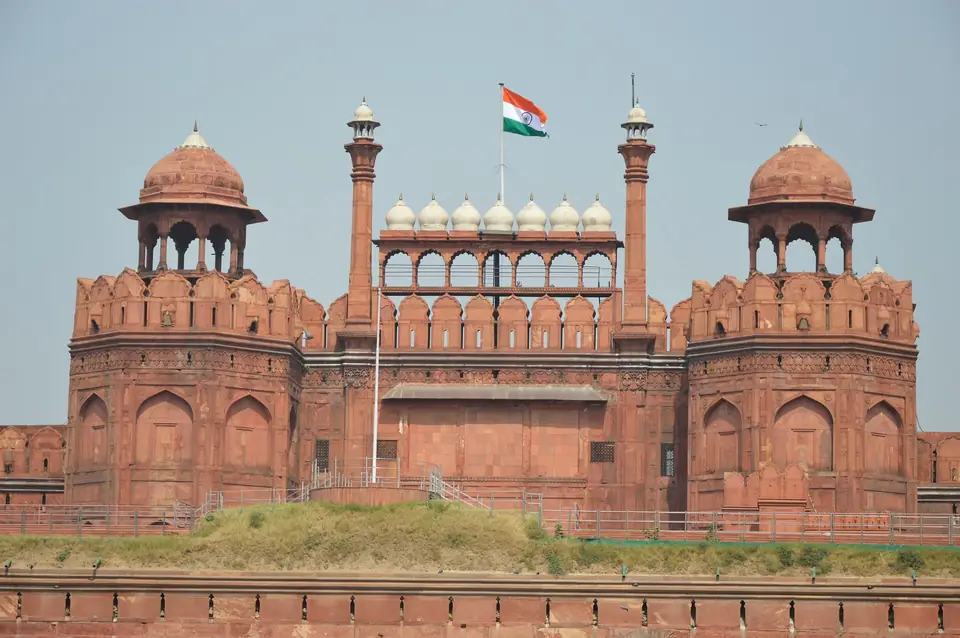
Mughal citadel
Red Fort Audio Guide (Lal Qila)
Court of the Peacock Throne, tribunal of the last Mughal emperor, British barracks and balcony of independent India: a citadel that is red only on the outside and that every empire plundered, occupied or imitated.
- 90 min of audio
- Mughal architecture
The history of the Red Fort begins in 1639, when ground was broken beside the Yamuna on a plan by the architects Ustad Ahmad and Ustad Hamid, fitted to the scheme approved by Shah Jahan; the emperor made his formal entry on 18 April 1648. Its court name was Qila-e-Mubarak, the Fortunate Citadel. The red sandstone wall runs for 2.41 kilometres and rises from 18 metres on the river side to 33 on the side facing the city, with an asymmetrical outline because it was drawn to enclose the fort of Salimgarh, built in 1546 by the son of Sher Shah Suri.
Inside, the colour changes. The emperors' private palaces were white, of marble or of lime plaster mixed with marble dust, and even the public audience hall was faced in polished white stucco. What cannot be seen weighs as much as what remains: after the 1857 rebellion the British demolished more than two thirds of the interior buildings and planted barracks over the harem and the gardens.
Highlights
- Lahore Gate — behind Aurangzeb's barbican, the rampart where the flag is raised every 15 August
- Diwan-i-Aam — a white marble throne before pietra dura panels of birds, flowers and an Orpheus
- Diwan-i-Khas — the pedestal of the substitute Peacock Throne and the verse that calls this paradise
- Naubat Khana — the drum house where nobles dismounted from their elephants
- Baoli — a stepwell that was a prison for Indian National Army officers in 1945-46
Seen from outside, the Red Fort of Delhi looks like a single block of sandstone, but its history is a palimpsest of empires. Shah Jahan had it built as the seat of his court; the official chronicle of Muhammad Waris names Ustad Ahmad and Ustad Hamid working on a scheme approved by the emperor himself, although popular attribution leaves everything in the hands of Ustad Ahmad Lahori. Even the starting year is disputed: some sources give 1639, with the ground opened on 29 April and the foundations laid on 12 May, and others move the date back to 1638. What is certain is that in 1648 the emperor entered a palace that looked onto the Yamuna, the river that then ran at its feet and filled the moat, and that has since drifted away from its old course.
Then came the plunderers. In 1739 the troops of Nader Shah carried the Peacock Throne off to Persia; in 1760 the Marathas melted down the silver ceiling of a hall to pay for a war. And on 18 July 1788, according to accounts of the time, the Rohilla chieftain Ghulam Qadir entered the fort, blew his pipe smoke in the face of Emperor Shah Alam II and weeks later had him blinded; tradition places the origin of that cruelty in the executioner’s childhood, when he had been a hostage of Shah Alam himself. How vengeance came back to the fort months later is one of those stories that ask to be told among these marbles.
At the Delhi Gate, the southern entrance, two riderless stone elephants wait between the arches: they are copies, a gift from Lord Curzon in 1903, because the originals, which Aurangzeb is said to have ordered destroyed, turned up smashed to pieces in 1863. And every autumn, at Dussehra, the field that opens out in front of the wall fills for the Ramlila and the burning of the Ravana effigies. The architecture and history of the Red Fort are best understood by walking it from the Lahore Gate to the stepwell, which is exactly the route the audio guide follows.
From the Lahore Gate starts Chandni Chowk, the avenue of bazaars of the same city, and a kilometre away rises the Jama Masjid, Shah Jahan’s great mosque. The story of 1857 has another stage far from here: Humayun’s Tomb, where the last Mughal emperor surrendered.
An Aurangzeb veil over the gate
Lahore Gate
Summary of this stop
The visit begins before the face of the wall that looks onto the city, the tallest, with its 33 metres of red sandstone. But the Lahore Gate, three storeys high, with semi-octagonal towers and a row of small white marble-domed chhatris, cannot be seen head-on: in front of it stands a 10.5-metre barbican that Aurangzeb, son and successor of Shah Jahan, added to force visitors to enter at a right angle. The access bridge is later, from the reign of Akbar II in the early 19th century.
A line circulates about this wall that history has never quite pinned down. It is told that Shah Jahan, a prisoner in the fort of Agra, wrote to his son: “You have turned the fort into a bride and put a veil over her face.” For some it was the last sarcasm of a dethroned emperor; another version ties the line to a different wall, raised in front of the audience hall, and reads it as a moved expression of thanks.
It is also the wall of independent India. On 16 August 1947, the day after raising the flag at Princess Park, beside India Gate, Jawaharlal Nehru raised it here and spoke from the top, although another version places that first flag over the Lahore Gate on 15 August itself. Since then every prime minister has delivered the Independence Day speech from this spot. What that stone veil says about the relationship between father and son becomes clear with the narration, in front of the gate.
Drums, elephants and a tree from 1857
Naubat Khana
Summary of this stop
Beyond the gate begins the Chhatta Chowk, a vaulted gallery of shops that copies a covered bazaar in Peshawar that Shah Jahan saw in 1646 and whose plans he had sent to Makramat Khan, the supervisor of the works. In the 17th century it sold jewels and brocades for the imperial household; today it is still an arcade of shops, now selling souvenirs, and in its octagonal courtyard open to the sky remains of the original incised plaster survive.
On leaving, the Naubat Khana rises, the drum house, three storeys of red sandstone with floral carvings and traces of paint. Its musicians played five times a day if the emperor was in the fort and three if he was travelling, and here everyone except princes of the blood had to dismount from their elephants: hence its nickname Hathi Pol, the Elephant Gate. Today it stands isolated on the lawn because the courtyard and galleries that surrounded it were demolished after 1857.
That emptiness hides the darkest episode of the threshold. On 16 May 1857, according to documented accounts, rebel sepoys took the European prisoners that Bahadur Shah Zafar was holding in the palace and killed them beside a tree in front of the drum house, despite the emperor’s protests; the figures vary from one account to another. That massacre weighed on the trial the British held against Zafar in this same fort in 1858, before exiling him to Rangoon. What became of the tree and who portrayed it as the scene of the crime is reserved for the audio guide.
The marble throne where justice was sought
Diwan-i-Aam
Summary of this stop
The Diwan-i-Aam, the public audience hall, is the fort’s reason for being: nine arches of red sandstone that were once faced in polished white stucco, open to a courtyard where subjects crowded in. In the middle of the east wall, under a curved canopy, stands the white marble throne from which the emperor heard petitions, the stage for which work went on from 1639 to 1648.
Behind the throne, pietra dura panels unfold trees, flowers and birds, and among them a figure of Orpheus of European inspiration. After 1857 part of them was torn out and taken to England, and in the early 20th century the Italian craftsman Menegatti restored them. The wall thus bears the mark of a plunder and of a repair, and the presence of an Orpheus behind the throne of a Mughal emperor is one of the details the narration unpacks in front of the throne.
A paradise with no throne and no silver ceiling
Diwan-i-Khas
Summary of this stop
Further on, beside what was once the riverbank, the red fort turns white. The Diwan-i-Khas, the private audience hall, is a marble pavilion with pillars of floral inlay and gilding, and above the corner arches runs the verse attributed to Amir Khusrow: “If there is a paradise on earth, it is this, it is this, it is this.” The Peacock Throne stood here, unveiled on 22 March 1635 after seven years of work and a cost of 100 lakhs of rupees, until in 1739 the troops of Nader Shah, victor at Karnal, carried it off to Persia as a trophy.
What remains are absences. On the eastern platform survives the marble pedestal of the substitute throne, which disappeared around 1857. The silver ceiling was torn out and melted down by the Marathas in 1760 to pay for the defence of Delhi against Ahmad Shah Durrani; the wooden one seen today dates from 1911. Next door, the Khas Mahal holds the emperor’s private chambers, with latticework and the scales of justice carved in marble.
From the semi-octagonal tower of the Musamman Burj, the emperor showed himself to his subjects at dawn. On 13 December 1911, the day after the great coronation Durbar, George V and Queen Mary appeared at that balcony before a crowd that accounts put at half a million people or more, repeating the Mughal gesture half a century after the exile of the last of them. Who sat beside the thrones that day, and why, completes the scene in the audio guide.
Barracks over the harem, prisoners in the well
Baoli
Summary of this stop
The last stop is devoted to what is missing. After crushing the 1857 rebellion, the British tore down the harem quarters, the servants’ quarters and the gardens, and in their place built a row of stone barracks; the Diwan-i-Aam served as a hospital and the Rang Mahal as the regiment’s mess. The scale is disputed: some figures speak of more than two thirds of the interior buildings and others of 80% of the fort’s structures. Only the marble pavilions beside the river escaped complete destruction.
The fort remained a garrison long after independence: a good part stayed under Indian Army control until 22 December 2003, when it passed to the Archaeological Survey of India. In 2019 the colonial barracks became four museums, devoted to 1857, to the Jallianwala Bagh massacre, to Subhas Chandra Bose and to Indian art.
Among them survives the baoli, a stepwell with two flights of stairs descending to the water. Its chambers served as a prison during the Red Fort trials of 1945-46: there the Indian National Army officers Shah Nawaz Khan, Prem Kumar Sahgal and Gurbaksh Singh Dhillon were held, and their trial set off a national campaign for their release. Why the British chose precisely the Mughals’ fort for that trial, and what it meant for India, closes the route.