First capital of the sultanate
Qutub Minar Audio Guide
A 72.5-metre victory tower commissioned by a sultan and carved by stonemasons who invoked their own god, beside a mosque made from temple columns and a 1,600-year-old iron pillar that barely rusts.
- 75 min of audio
- Sultanate architecture
Qutb ud-Din Aibak, founder of the Delhi Sultanate, began the first storey of the minar in 1199 over the old Tomara citadel of Lal Kot, and his son-in-law and successor Iltutmish added three more around 1220. The result, the Qutub Minar (also spelled Qutb Minar), is 72.5 metres tall, narrows from 14.3 metres in diameter at the base to 2.7 at the top and encloses a spiral staircase of 379 steps. Around it, in Mehrauli, grew the first great mosque of Delhi, the Alai Darwaza, the unfinished Alai Minar and the tomb of Iltutmish.
The tower that looks perfect is a patchwork of centuries. A lightning bolt wrecked its top storey in the 14th century and Firuz Shah Tughlaq rebuilt it in two tiers with white marble bands; another bolt forced Sikandar Lodi to repair it in 1503; after an earthquake in the early 19th century, a British officer gave it a cupola that ended up dismantled on the lawn. And among the Arabic inscriptions of the minar appears one in Sanskrit dedicated to Vishwakarma, the Hindu god of construction.
Highlights
- Aibak's first storey — reed-bundle fluting and six bands of Qur'anic inscriptions in naskh
- Vishwakarma inscription — the Sanskrit signature of the local stonemasons on the sultan's tower
- Alai Darwaza (1311) — the first gate in India with true arches and dome
- Mosque cloisters — columns from 27 Hindu and Jain temples, with kirtimukha masks still visible
- Gupta iron pillar — 7.21 metres and more than six tonnes of iron that barely rusts
The history of the Qutub Minar begins with a conquest. Qutb ud-Din Aibak, lieutenant of Muhammad of Ghor, laid in 1199 the first stone of a victory tower over the citadel of Lal Kot, in Mehrauli, the heart of the first capital of the Delhi Sultanate. Whom it is named after remains debated: the usual attribution is to Aibak himself, but another current links it to the Sufi saint Qutbuddin Bakhtiar Kaki, to whom Iltutmish was devoted. When the Tangier-born traveller Ibn Battuta passed through in 1333, he described the minar as without equal in the lands of Islam, with an interior passage so wide that elephants went up it, and noted the account of a witness who saw one carry stones to the top during construction.
The architecture of the Qutub Minar follows the model of the Ghaznavid minarets of Jam and Ghazni, but in Delhi another story runs: that the tower was begun by the Rajput king Prithviraj Chauhan so that his daughter could gaze each morning at the Yamuna river. It is probably the prettiest version in the compound, and the least true: before the Turks the concept of a minar did not exist in India, and the river could not be seen from the first storey. That mix of sultans, stonemasons, lightning, restorers and legends is what the audio guide unpacks in a route of five stops, from the lawn to the mosque courtyard.
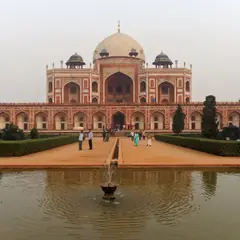
Centuries later, the Mughals built their first great garden mausoleum some ten kilometres from here, Humayun’s Tomb, and the British capital closed its great axis with a triumphal arch, India Gate.
A British crown planted on the lawn
Smith's Folly
Summary of this stop
From the lawn east of the minar, the tower shows its two skins: red sandstone on the lower storeys and white marble bands on the two upper tiers. That change of colour is a scar. Lightning damaged in the 14th century what was then the top storey (sources hesitate between 1368 and 1369), and Sultan Firuz Shah Tughlaq rebuilt it smaller and split in two; in 1503 Sikandar Lodi had to repair it again after another lightning strike.
At grass level waits a curiosity: a cupola of columns in chhatri style, with no tower beneath. After the earthquake of the early 19th century, dated to 1802 or 1803 depending on the source, Major Robert Smith restored the minar and crowned it with this as a sixth storey. Governor-General Hardinge was not convinced and had it dismantled in 1848; since then it has rested here under the nickname “Smith’s Folly”.
Very close, a sundial with a Latin motto remembers Gordon Sanderson, the archaeological superintendent who in 1914 found the true crypt of Iltutmish’s tomb, twenty steps underground, and who forbade in writing the prettifying of ruins. He died in the First World War at 28. Why these two objects, side by side, tell two opposite ways of treating a monument is the first thread the narration pulls.
Vishwakarma’s signature and a closed door
Qutub Minar
Summary of this stop
At the foot of the tower, Aibak’s first storey is read with the neck bent back: alternating semicircular and angular flutes, like a bundle of reeds, girdled by six bands of inscriptions in naskh with Qur’anic verses and titles of the Ghurid sultans. Above, projecting rings on brackets with muqarnas separate each storey. The tower narrows from 14.3 metres in diameter to 2.7 at the top and leans slightly more than 65 centimetres from the vertical.
Among the Arabic and Nagari inscriptions there is one in Sanskrit: “Shri Vishwakarma prasade rachita”, made with the blessing of Vishwakarma, the Hindu god of construction. It is the trace of the local stonemasons who carved the Turkish sultan’s tower and left, in stone, the name of their own deity.
In front of the base there is also a door that does not open. Through it the 379-step spiral was entered until 4 December 1981, a free-entry Friday when the light went out with some 300 people inside; the crush on the staircase killed 45, among them 20 schoolchildren. Since then nobody climbs, and that absence is as much a part of the monument as its inscriptions.
Alai Darwaza, the first true arch
Alai Darwaza
Summary of this stop
The south gate of the mosque is a cube of red sandstone with white marble inlays, lattice screens, pointed arches fringed with lance-point motifs and a low dome. It was built by Alauddin Khalji in 1311, and its importance goes beyond beauty: it is the first example in India of true arches and dome.
Until then, the builders of the compound faked the arch by corbelling courses of stone closer until they closed it, as in the original mosque. At the Alai Darwaza the stone truly curves. That technical leap changes how everything that comes after is seen, and the audio guide uses it as a key for reading the mosque’s arches.
The same sultan dreamed of something bigger. North of the mosque stands the Alai Minar, a tower with twice the diameter of the Qutub Minar meant to double its height; after Alauddin’s death in 1316 the work was abandoned, and today it is a 25-metre stump of unclad masonry.
Cloisters of 27 temples and a caged Ganesha
Temple columns in the cloisters
Summary of this stop
The eastern entrance of the mosque preserves the inscription of Aibak that says it bluntly: the cloisters, begun around 1193-1199, were built with columns and carved pieces from 27 demolished Hindu and Jain temples. In the shade of the galleries, the stacked columns of two or three pieces still show kirtimukha masks. In front of the ruined prayer hall rises a great screen of pointed arches carved with calligraphy and arabesques. Historiography still debates whether that destruction of temples was a political or a religious act, and readings of the site have been the subject of claims without support in the sources.
Even the mosque’s name holds a surprise. “Quwwat ul-Islam”, Might of Islam, appears in no surviving inscription or sultanate chronicle: Syed Ahmad Khan recorded it in 1847 alongside two other names and 20th-century guidebooks fixed it. The chronicler Juzjani called the Delhi of Iltutmish “Qubbat al-Islam”, Dome of Islam.
Among those stones are hidden two small figures of Ganesha that popular speech christened the “upside-down Ganesha” and the “Ganesha in the cage”. In 2022 it was requested to move them to a museum, a court ordered them left in place, and priests of a nearby temple maintain they were worshipped there until 2000, while the Archaeological Survey argued before the judge that the compound is not a place of worship. What appeared when the grille was finally removed is one of the twists the narration reserves for this cloister.
The iron pillar and Delhi’s nail
Iron pillar
Summary of this stop
In the courtyard rises a dark column older than the sultanate: the iron pillar, 7.21 metres tall (1.12 of them underground) and more than six tonnes, from the reign of Chandragupta II, around 375-415. Its Sanskrit inscription presents it as a standard of Vishnu raised on the Vishnupada hill, and its phosphorus-rich iron explains why it has barely rusted in 1,600 years. Who brought it to Delhi is debated: Cunningham attributed it to the Tomara king Anangpal in the 11th century; Finbarr Barry Flood proposes it was Iltutmish, as a trophy after sacking Vidisha.
About 4 metres above the ground a dent can be made out, caused by a cannonball fired at close range, which cracked the opposite side without toppling the column. There is no contemporary record of the shot; the attribution to Nadir Shah in 1739 is a reconstruction by historians. A barrier now surrounds the pillar, because the custom of hugging it for luck was corroding its surface.
And then there is the legend, a documented tradition: a Brahmin assured King Anangpal that the base of the pillar rested on the head of Vasuki, the king of serpents, and that as long as it stayed planted there the kingdom would remain in his lineage. The king doubted and had it dug up. What came out stuck to the foot of the column, and how a loose nail ended up giving its name to the city, is the ending the audio guide keeps for the courtyard.