Newar temple
Rato Machindranath Temple Audio Guide
Behind a whitewashed arch almost nobody sees opens the square of Ta Baha and, in it, the second home of Patan's rain god: a red clay figure who lives here half the year and spends the other half away, riding the chariot of Nepal's longest jatra.
- 30-min audio
- Newar pagoda and chariot jatra
The cult of Bunga Lokeshvara goes back to at least 1071, when a Buddhist manuscript now kept at the Asiatic Society of Calcutta labelled a miniature «Bugama Lokeshvara of Nepal». He is the only god in the country with two home temples: the main one is in Bungamati, about 6 km to the south, and this one in Ta Baha, later, receives him each autumn. The present three-roof pagoda dates to 1673, although on the same site there was some temple at least from 1408.
One god, three names: Bunga Dyah for the Newars, Avalokiteshvara for Buddhists, Matsyendranath for Hindus. The name Rato Machhindranath that guides use today took shape in the 17th century, and the stele King Śrīnivāsa Malla had engraved in 1673 on the shrine wall invokes him as Āryāvalokiteśvara, Trailokyanātha and Buṅga Iṣṭadevatā, but never as Matsyendranātha.
Highlights
- Three-roof pagoda of 1673 on the Ta Baha square, with a temple on the same site at least since 1408
- Stele of Śrīnivāsa Malla (1673): the rules of the chariot, no footwear and music even during royal mourning
- Painted struts with Avalokiteshvara above the damned, snow lions and kyah demons on the plinth
- Caged metal animals on columns: peacock, Garuda, horse, buffalo, elephant, fish and serpent
- A red clay image of just over 90 cm, repaired and repainted every year before the jatra
Few temples in Patan depend so much on someone who is not always at home. For six months a year the Rato Machindranath Temple keeps the image of Bunga Dyah, the rain god of the valley; for the other six the image resides in Bungamati, about 6 km to the south. The autumn transfer is repeated every year, as on 10 Mangsir 2082, 26 November 2025, and in spring the god leaves here for the great chariot that travels the city for about a month.
The history of the Rato Machindranath Temple is longer than its building. The cult is documented since at least 1071, and the Gopalarajavamsavali, a 14th-century chronicle, attributes the founding of its festival to the Licchavi king Narendradeva and the master Bandhudatta. It is an attribution: in 2017 the 1,350th year of the jatra was celebrated, but the Nepali press itself recalls that no text fixes when it began. The architecture of the Rato Machindranath Temple, for its part, dates to 1673, although some guides take it back to the 16th century. Walking the square with the audio guide lets you read every lion, every strut and every stone as part of the life of a divine guest whom a whole city obeys, repaints and pulls.
The square of Ta Baha lies about 400 metres southwest of Patan Durbar Square, and a little under half a kilometre to the east, through the alleys of Okubahal, hides the terracotta tower of the Mahabuddha Temple.
The white arch opposite the Minnath temple
Whitewashed arch of Ta Baha
Summary of this stop
The entrance is a white gateway with columns at the end of an alley, so discreet that it is easy to walk past. It is almost opposite the temple of Minnath, the ancestral god of Patan, and that neighbourliness is no accident: on the first day of the procession, Minnath’s small chariot leads the march to welcome the guest god as far as Gabahal, and from there gives way and courteously follows the large chariot through Mangal Bazar, Lagankhel and Jawalakhel.
A Newar tale explains that host’s etiquette. When Patan had 32 chariot festivals, Bungdyo proposed to the assembly of the gods replacing them with a single chariot carrying him; Minnath, who presided, furiously hurled a vajra at him that missed, and the next day accepted. According to the legend, the large chariot does not move until the small one clears its way. Each spring that chariot, about 18 metres tall according to some sources and 15 according to others, is raised in Pulchok and advances through Gabahal, Sundhara and Lagankhel to Jawalakhel. Whether Minnath is a son, a daughter or an older god than his guest, as his own priests maintain, is a debate the narration takes up beneath the arch.
Three roofs for a god of three names
Rato Machindranath Temple
Summary of this stop
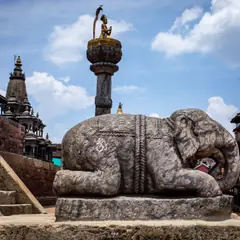
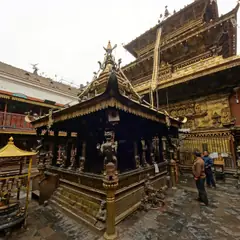
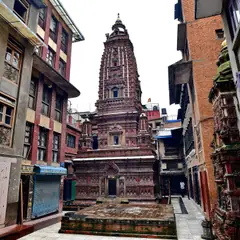
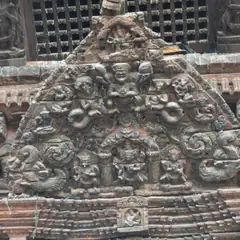
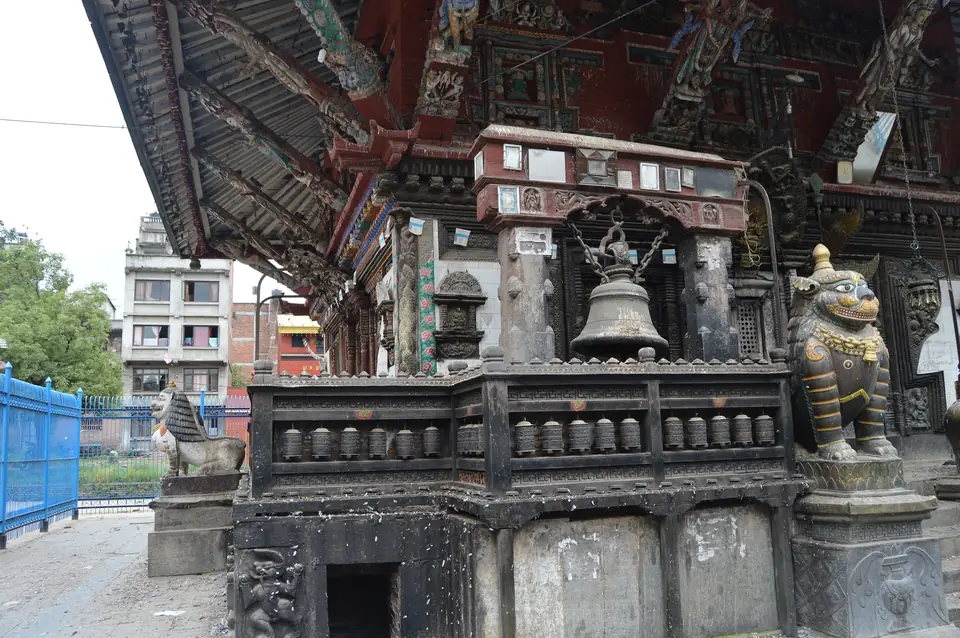
At the centre of the square rises the three-roof pagoda, surrounded by a metal fence and open through four ornate gateways. Stone snow lions guard each one and, on the corners of the plinth, the kyah, hairy demons, peer out. In front, on free-standing columns and protected by cages, a metal peacock, Garuda, a horse, a buffalo, a lion, an elephant, a fish and a serpent wait. Above, under the eaves, the brightly coloured struts show Avalokiteshvara standing over the damned tortured in the hells.
What to see at the Rato Machindranath Temple is also what to read: a cult of almost a thousand years that has changed temple and name without changing god. For Newar Buddhists he is Bunga Dyah or Karunamaya, a form of Avalokiteshvara; for Hindus, Matsyendranath or an incarnation of Shiva. The association with the yogi Matsyendranath dates from the 17th century, although today guides and press present it as his main identity.
The documented tradition tells how he reached the valley: after twelve years of drought caused by the yogi Gorakhnath, who had sat down to meditate on the nine rain nagas, King Narendra Dev, the tantric Bandhudatta and the farmer Lalit went to fetch the god as far as Assam. What they brought back, pursued by a demon king, fitted in a vessel; how the rain returned is the ending the audio guide keeps for this stop.
The stele of the king who banned shoes
Stele of Śrīnivāsa Malla
Summary of this stop
On the outer wall of the east side of the sanctum there is a stone that looks like a simple sign. It is the stele that King Śrīnivāsa Malla had placed on the 10th of the bright fortnight of Phalgun in the year NS 793, in 1673, written in Newar because not everyone understood the verses of the previous year’s inscription. Its content is a regulation: nobody may wear footwear while the god is on the chariot, and kings may not forbid the procession’s music even during royal mourning.
The stele also obliges all the inhabitants of Patan to pull the chariot’s axle in turns, with no favour of the king or ministers freeing anyone, and punishes with a golden spade anyone who starts quarrels in gardens and public spaces during the procession. Behind those rules one glimpses an equally singular organisation: the panejus, priests of Bunga Dyah, form the «32 Pāneju Saṃgha», which has only 31 human members. Who the missing seat belongs to, and what it is called, is told in front of the stone.
A clay god repainted every spring
Red image of Bunga Dyah
Summary of this stop
From the outer steps, unable to enter, the red figure of the god can be made out in the dimness of the shrine. It measures just over 90 cm and is an almost shapeless form of caked clay and paint from which silver arms and feet emerge. The annual jolting of the chariot requires it to be repaired and repainted red every year here, before the jatra. Between the spring festival and the autumn return, the shrine stays empty: the god is in Bungamati.
About fifteen days before the procession, according to a documented tradition, the image is carried out on a palanquin to Lagankhel for the Mahasnan, his great bath in the middle of the street; then a family of Patan painters spends three or four days covering him in crimson and renewing his eyes, and in a corner of the Ta Bahal, the small monastery behind the temple, the god passes again through the ten rites of the life cycle before climbing onto the chariot.
That chariot also drags omens along. On 25 April 2015, at 11:56, the earthquake caught the god inside the chariot in Chyasikot: the Bungamati temple collapsed and the image was saved by being on wheels. In 2000 the chariot overturned, and in 2001 came the royal massacre; its builders hold that if something happens to the chariot, the country will have bad luck. The full list of falls and what followed is heard on these steps.