Malla royal square
Patan Durbar Square Audio Guide
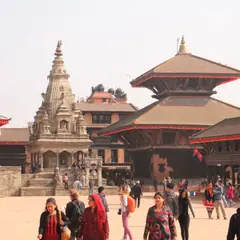
A row of brick-and-timber temples faces the palace of the Malla kings head-on: Patan's royal square, partly brought down by the 2015 earthquake and raised again, piece by piece, by its own neighbours and craftsmen.
- 60-min audio
- Newar architecture
Before it was a royal square, this plot was an ancient crossroads. Most of what you see today dates from the 17th century, built under Siddhi Narsingh Malla and his son Srinivasa Malla, when the palace was both the kings' residence and the seat of government of the kingdom of Patan. On a red-brick pavement edged with stone, the main temples line up in front of the palace's west façade, their entrances turned towards it.
On 25 April 2015 the Char Narayan, the oldest of the square's major temples, fell down to its plinth, and its neighbour the Harishankar collapsed almost entirely. Within a week, volunteers from Patan had rescued and stacked its bricks and carved pieces. Today the Harishankar stands again with 90% of its original material, and in its shrine the god broken at the waist is worshipped beside the replica carved to replace him.
Highlights
- Harishankar, a three-roof temple of 1706 rebuilt with some 2,000 pieces and 90% of its original material
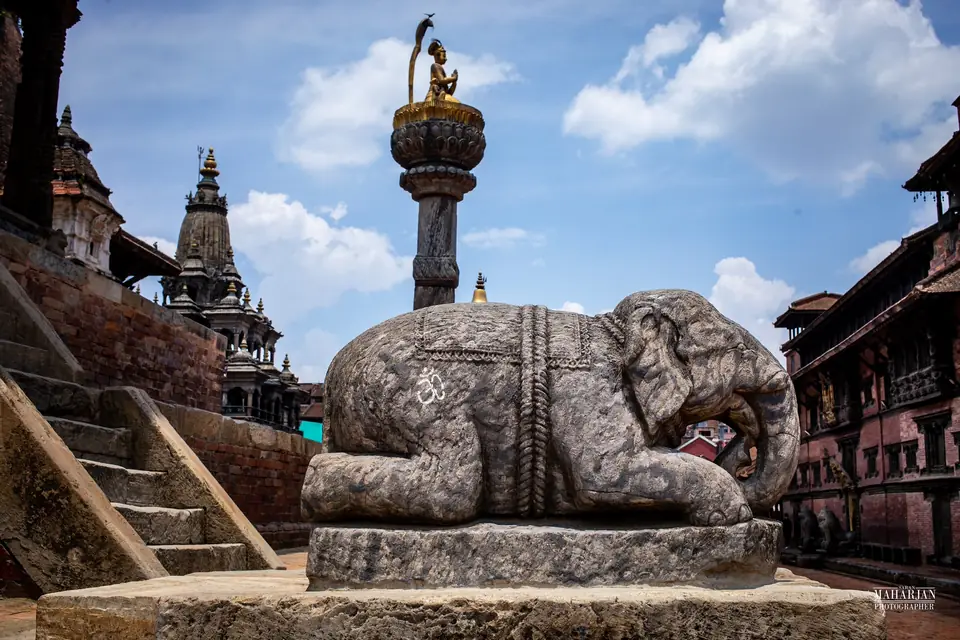
- Yoganarendra Malla's column of 1693: the gilded king between his two wives, under a naga with a metal bird
- Tusha Hiti, the stepped well of Sundari Chowk with 72 stone sculptures and a gilded spout stolen in 2010
- The Taleju bell of 1736, the first of the great bells of the valley's three Durbar Squares
- Manga Hiti, a stone spout dated to the year 570 that neighbours still use
The story of Patan Durbar Square begins long before its temples. The site was an ancient crossroads, and its origin is still obscure: the Mallas are listed as founders of the palace, but some chronicles point to a Thakuri palace, one tradition credits Lakshmikamadeva, and a 14th-century chronicle suggests the Taleju temple predates the Mallas, with no firm proof for any of these attributions. What is documented is that the present architecture is mostly 17th-century, the work of Siddhi Narsingh Malla and his son Srinivasa Malla.
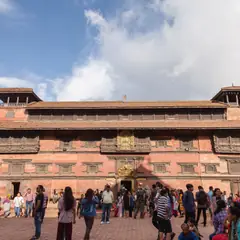
The square’s architecture makes sense with a single idea: the temples face the palace. Char Narayan, Harishankar, Vishveshwara, Bhimsen and the stone Krishna Mandir form a row parallel to the long façade of brick and carved wood, which leads into the courtyards of Mul Chowk, Sundari Chowk and Keshav Narayan Chowk, now home to the Patan Museum. Kings, gods and neighbours have shared the same space, face to face, for centuries.
In 2015 that scene partly came down, and what looks intact today is, in many cases, the fruit of meticulous reconstruction. The audio guide walks the square from south to north along the row of temples and returns beside the palace to the stepped well of Sundari Chowk, following what fell and how it was put back together, with documented narration that keeps its most surprising episode for each stop.
On the square itself stand the Krishna Mandir, the stone temple of the 21 pinnacles, and the palace that now houses the Patan Museum; about 400 metres to the southwest, in the square of Ta Baha, the Rato Machindranath Temple awaits, home of the rain god.
The bell of the wronged
Taleju Bell
Summary of this stop
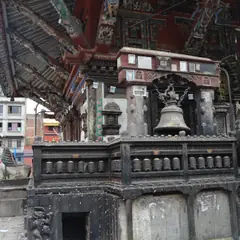
The tour starts at the south entrance, under the great Taleju bell, hung between two thick pillars. King Vishnu Malla and his wife Chandra Lakshmi installed it in 1736, after moving the earlier bell, of 1703, to the Rato Machhindranath temple. It was the first of the great bells of the three Durbar Squares of the Kathmandu Valley.
From here you take in the key to the square: the red-brick pavement with its stone border, the row of temples on one side and, opposite, the façade of the palace that was the royal residence and the centre of the kingdom’s administration. Everything is oriented towards power: the temple doors open to the east, towards the kings.
It is said that, in the days of the kings, any neighbour could ring this bell to alert the monarch to a grievance or an emergency. What it meant for the sound to reach the whole palace, and who answered the call, is revealed by listening to the narration beneath the bell itself.
The broken god and his double
Harishankar Temple
Summary of this stop
In front of the Harishankar’s steps, the scene is deceptive. The three-roof temple, built in 1706, withstood the earthquakes of 1809, 1833 and 1934, but in 2015 it collapsed almost completely. Its reconstruction took four years, required sorting and repairing some 2,000 pieces and reused 90% of the original material recovered. Beside it, the Char Narayan, whose construction began in 1563, fell to its plinth the same day.
The extraordinary part came afterwards: within a week, local volunteers rescued its facing bricks and carved pieces and stacked them around the square. From the rubble of both temples came 162 carved arms of deities from the roof struts; the 102 that could not return to their place are displayed in the Patan Museum.
In the shrine waits the most moving image on the square. The Harishankar, a metre and a half tall with eight arms, broke diagonally at the waist and was repaired with the help of a team from the University of Applied Arts Vienna. Since local custom forbids worshipping a broken image, the master stone carver Amar Shakya carved a replica, and today the two are worshipped together. How a god lives alongside his copy is one of the moments the audio guide keeps for this stop.
A bird that keeps the king alive
Statue of Yoganarendra Malla
Summary of this stop
On a stone column 8.21 metres high, Yoganarendra Malla had himself portrayed in gold in 1693, between his two wives and under the protective hood of a naga. It is the most devout statue on the square and hides its darkest story. The king, who ruled until 1705 (sources put the start of his reign in 1680 or 1685), clashed with the local lords and in 1690 ordered the murder of Bhagirath Bhaiya, a commoner who had gained power in Patan. He died poisoned by an agent from Bhaktapur on 28 October 1705, and at least 21 of his queens and concubines committed sati.
On the western edge of the square still stands the work of his victim: the Bhaidega, built by Bhagirath Bhaiya in 1687, the only temple on the square not commissioned by a king. After the 1934 earthquake the Ranas rebuilt it at less than half its size, with a Mughal-style stucco dome, and its return to the original three-storey form rests on photographs from before 1934 and on Henry Ambrose Oldfield’s drawings of the 1850s.
Above the cobra that covers the king sits a small metal bird. According to the legend, the monarch asked to be considered alive for as long as that bird did not fly away, and tradition adds that the palace keeps a door and a window open for him, a bedchamber and a water pipe in case he returns. In 2015 the statue fell and bent, and the bird disappeared among the rubble. Where it turned up, and what the legend says will happen the day it flies, is told at the foot of the column.
Patches, columns and an angry god
Vishwanath Temple
Summary of this stop
At the northern end, a pair of stone elephants guards the entrance to the Vishveshwara temple, consecrated to Shiva in 1627. In 1989 rain brought down the roofs of its two storeys, and the elephants, badly patched then with cement and sand, still show that episode. In 2015 it was its forest of wooden columns that held the temple up when its brick walls fell.
Very close by, the temple of Bhimsen, god of trade, shows three connected gilded windows and a door frame of embossed copper. Legend has it that when Srinivasa Malla rebuilt it, the sculptors could not find the expression he asked for, and ended up giving the image the angry face of the king himself. Centuries later, to rebuild the temple damaged in 2015 without breaking the rule that a temple is never demolished, the community resorted to a symbolic gesture with a brick and a cow’s tail.
Beyond the north wing of the palace, below street level, flows the Manga Hiti, a stone spout dated to the year 570, among the oldest still in use, which its users clean ritually every year at the festival of Sithinakhah. What that water has to do with the patched-up elephants is a detail revealed by listening to the narration at this stop.
The stolen spout of Sundari Chowk
Tusha Hiti
Summary of this stop
The tour ends in the intimate heart of the palace, in the courtyard of Sundari Chowk. Here sinks the Tusha Hiti, an octagonal stepped well surrounded by two stone serpents, with 72 sculptures of deities on its walls and a miniature of the Krishna Mandir on its axis. It is attributed to Siddhi Narsingh Malla around 1647, although the dates 1626 and 1627 are also given.
Its purpose is not settled either: some historians take it for the king’s ritual bath, while others argue that splashing the images of the gods with water made it unusable as a bath and that it served for water offerings.
In 2010 its gilded copper spout was stolen, and in March 2011 a replica was installed. The story does not end there, and the final twist of this spout, which sums up the idea the whole square leaves you with, is the last episode the audio guide keeps for the edge of the well.