Newar Buddhist monastery
Golden Temple Audio Guide (Hiranya Varna Mahavihar)
Behind a stone gateway, north of Durbar Square, a closed courtyard holds a pagoda with a golden façade, a silver Buddha tended by a child priest and a book written in gold that is still read almost every day.
- 30-min audio
- Living Newar Buddhism
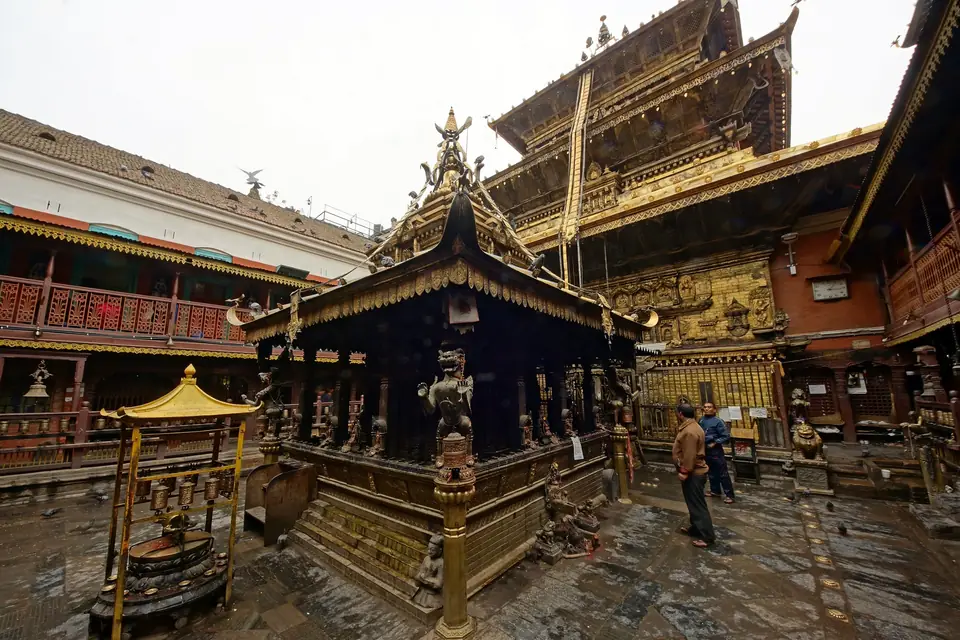
Hiranya Varna Mahavihar, the «great monastery the colour of gold», is the Newar Buddhist bahal that King Bhaskar Varman ordered built in the 12th century around a golden pagoda of Shakyamuni Buddha. The Newars call it Kwa Baha, and inscriptions, copper plates and medieval chronicles give it another name, Hemavarna Mahavihar, which also speaks of gold. Its main temple rises four storeys under three golden roofs, with the life of the Buddha told in metal from his birth.
What is extraordinary is not the shine but the routine: the chief priest is a child under twelve who serves for a month, walks the neighbourhood twice a day ringing a bell without saying a word and does not go to bed until he has left rice for the monastery's rats. According to legend, the temple was born where a golden mouse chased a cat.
Highlights
- Four-storey, three-roof golden façade, with scenes from the Buddha's life, the Five Buddhas and thirteen chaityas at the top
- Bapacha, the child priest under twelve who serves for a month and walks the neighbourhood ringing a bell in silence
- A 300-page Prajnaparamita manuscript in gold letters on black paper, read almost 300 days a year
- Swayambhu chaitya at the centre of the courtyard, bathed in milk once a year towards the stone of the serpent Vasuki
- Stone gateway with a lion and lioness by the stone carver Krishna Bir and a door that, when closed, forms the face of Bhairava
On Kwalakhu Road, a few steps north of Patan Durbar Square, a stone gateway flanked by lions opens onto one of the liveliest courtyards in the Kathmandu Valley. Inside stands Hiranya Varna Mahavihar, the Golden Temple of Patan: a Newar Buddhist bahal, known in the city as Kwa Baha, which most sources attribute to King Bhaskar Varman in the 12th century. The chronology is not unanimous: other references date the construction between 1045 and 1048 or give 1409 as the year of completion, and the three dates do not fit together.
The name has its own story too. «Hiranya Varna Mahavihar» means «great monastery the colour of gold», although there is a notion that hiranya would mean «mouse», in memory of the founding legend. And the nickname Golden Temple is not due to solid gold, but to the gilded metal that covers the façade. The history of Hiranya Varna Mahavihar is better understood as a routine than as a monument: children who serve the Buddha, rats that receive their rice and families who wait months for their turn to have a book written in gold read in their name.
What to see at the Golden Temple of Patan comes down to four points: the street gateway, the chaitya at the centre of the courtyard, the golden façade with its shrine and the arcades where the manuscript is restored. The audio guide, documented and checked against historical sources, walks the monastery in that order and keeps for each corner the detail that can only be appreciated there.
About 200 metres to the north, the Kumbheshwar Temple raises its five-roof pagoda beside a sacred pond, and south of Durbar Square another Newar Buddhist courtyard hides the terracotta tower of the Mahabuddha Temple.
A threshold with stone guardians and a god for a doorman
Gateway of the lions
Summary of this stop
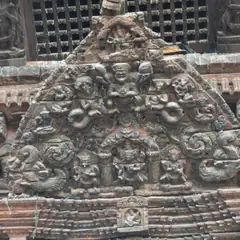
The entrance is already a small scene. A stone lion and lioness guard the gateway, beneath a stone torana and next to an inscription in several languages. According to tradition, they are the work of the 18th-century master stone carver Krishna Bir, who left his signature on the lions of the east door; the lioness is told from the lion by her human breasts, and the pair is held to be a guardian against evil spirits.
Behind waits the sturdy metal door, which also has a name of its own: Bhelukhwa Dwakhya. Open it says nothing; when closed, its leaves form the fierce face of Bhairava, the terrible form of Shiva, who looks towards the vestibule and protects those inside. It is the logic of the whole compound, where Hindu gods stand guard beside the Buddha, to the point that in the sanctum a small statue of Balbhadra keeps watch in front of the main image.
Once in the passage, the ceiling shows a painted Kalachakra mandala, and to one side an old drinking-water fountain survives, now disused. Medieval chronicles called the monastery Hemavarna Mahavihar, a name that also means «the colour of gold». What exactly that first threshold hides, and why almost nobody looks at it on entering, is told in front of the door itself.
The mouse that chased the cat
Swayambhu chaitya at the centre of the courtyard
Summary of this stop
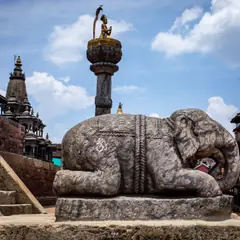
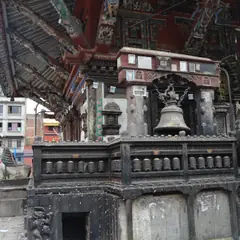
Crossing the second door, the one with struts showing incarnations of Vishnu and Shiva, two golden elephants appear standing on tortoises and, above them, a gilded copper torana that was not always there: it once crowned the main shrine, where a silver copy donated during the reign of Prithvi Bir Bikram Shah (1881–1911) replaced it. At the centre of the courtyard, the chaitya identified with Swayambhu is covered by a golden roof of parasols and serpents, surrounded by images of Lokeshvara and metal griffins. Once a year milk is poured over it; it runs down a spout and falls on a stone that symbolises Vasuki, king of the serpents.
The origin legend gives meaning to everything. An image of Shakyamuni that reached Patan from an abandoned vihara beside Pashupati would have been installed first by King Bhaskar Deva in another monastery, but the king dreamed that the image rejected that place and asked for another: the spot where he would see a mouse chase a cat. Tradition says that the next morning he saw a golden mouse run after a cat right here, and here he ordered the monastery built. A different version, of more disputed history, attributes the discovery to a priest lost in the fog who found some ruins and a buried statue.
That is why, within these walls, mice are not a plague but confidants of Kwapadyo, the Buddha of the shrine. Every day, before the temple closes, rice is left for the rats in at least ten places of the compound, and the child priest does not go to bed until it is done. What would happen, it is said, if one day that food were missing is the debt the narration reveals in the courtyard.
A chief priest not yet twelve years old
Golden façade and Shakyamuni shrine
Summary of this stop
The façade of the main temple rises four storeys under three golden roofs. Below follow scenes from the Buddha’s life from his birth and rows of the Five Buddhas and Tara; above the first roof, the Three Jewels; nine chaityas on the second and thirteen on the top one, with hanging banners. Inside, a large silver image of Shakyamuni, covered in cloths and jewels except for the face, rests beneath a silver torana. The gallery is closed off with railings: only the priest and his family enter.
And the chief priest, the Bapacha, is always a child under twelve. He and his assistant, an older boy or a young man, serve for a month and then hand over the post to another pair. During that month the child does not go to school or touch other people; his cook must be from a monastery family and he fetches his own water. Twice a day, morning and afternoon, he walks the surrounding neighbourhoods ringing a bell without uttering a word.
Tradition explains this oddity with a scene of war: nobody dared leave their house and the image was left without worship, until a family sent its young son to wash it. What happened when the child, with his jar at the door, burst into tears, and why the office has passed from child to child ever since without any adult teaching it, is the emotional heart of the tour.
Three hundred black pages and letters of gold
Sattal of the arcades
Summary of this stop
Under the golden canopies of the arcades around the courtyard are the sattal, the platforms where the monastery’s most fragile treasure is looked after: a 300-page Prajnaparamita manuscript in Ranjana script. The first is a silver plate with carved deities; the rest are black leaves, nil-patra, handmade Nepali paper dyed with copper sulphate, which also protects it from insects. Its age is debated: according to the sources, it would be around 800 years old or somewhat more, and tradition attributes it to a 13th-century monk.
Gold here is not decoration, it is work. In 2023, ten members of the monastery’s guthi took 25 days to go over the manuscript with gold ink and used only 11.7 grams, because this time the deterioration was smaller. And the book does not sleep in a display case: it is read today almost 300 days a year, and the monastery’s families wait up to eight months for the priests to read it in their name.
The care extends to stone as well. The 2015 earthquake damaged the structure of the courtyard buildings, and on 29 July 2021 the community held a Chhema Puja, a ritual to «ask forgiveness», before starting conservation and strengthening, budgeted at 181 million Nepali rupees with funds from the Government of India. How that daily reading began some four centuries ago, and who set it in motion, is what the audio guide keeps for the end.