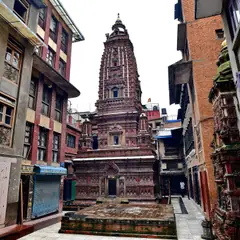
Shiva pagoda
Kumbheshwar Temple Audio Guide
A five-roof pagoda of Shiva watches from the north of Patan over a neighbourhood pond that, for half the Kathmandu Valley, is actually a piece of a sacred Himalayan lake.
- 30-min audio
- Newar architecture
The Kumbheshwar temple was built around 1392, in the time of King Jayasthiti Malla, some 200 metres north of Durbar Square, and is held to be the oldest in Patan. It was born with two storeys; in the 17th century King Srinivasa Malla added three more roofs and gave it the slender silhouette that makes it one of the few free-standing five-storey pagodas in the valley, alongside the Nyatapola of Bhaktapur.
The tower withstood the main shock of the April 2015 earthquake, but in May its top roof collapsed and the body was left slightly tilted. At its feet, a spring that devotees believe flows down from Lake Gosainkunda fills the pond where, every full moon of Janai Purnima, a silver-clad linga is installed and shamans come from the villages.
Highlights
- Five-roof pagoda: two storeys of around 1392 and three added in the 17th century, tilted since 2015
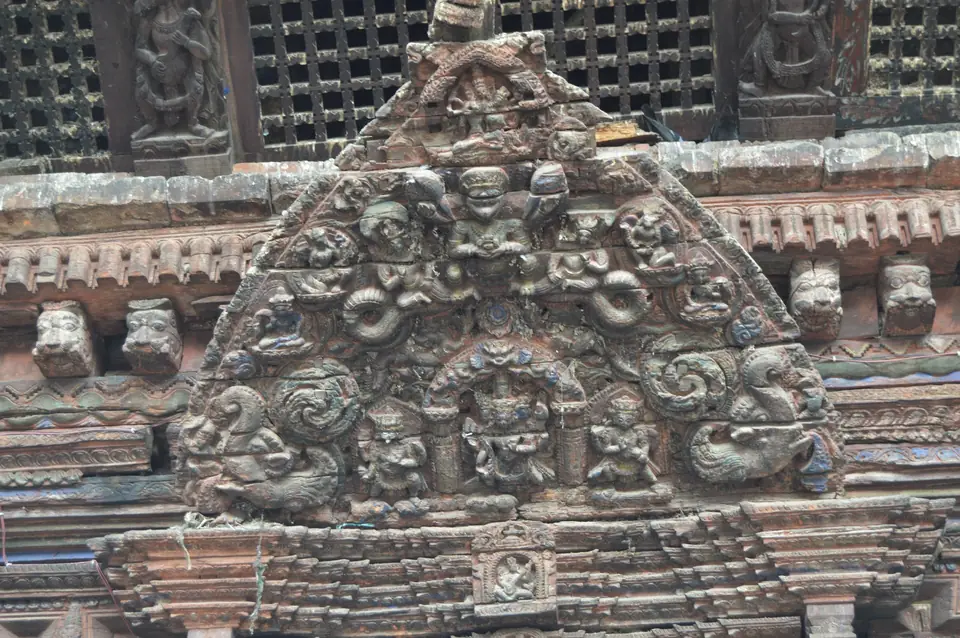
- Carved wooden struts and doors with deities under the eaves
- Kumbheshwor Pokhari pond, whose spring is believed to come from Lake Gosainkunda
- Linga with an embossed silver cover and jhakri shamans on the night of Janai Purnima
- Konti Hiti and the stone spouts of Kumbheshwor Hiti, in daily use
Above the rooftops of northern Patan rises a tall, slender tower unlike any other in the city. It is the Kumbheshwar temple, a pagoda dedicated to Shiva whose name joins the Sanskrit kumbha, «water jar», with ishwor, «lord»: the lord of the jar. The name is no accident, because everything in this compound revolves around water, from the pond that presides over it to the stone spouts where the women of the neighbourhood fill their jars every morning.
The history of the Kumbheshwar temple begins around 1392, in the time of King Jayasthiti Malla, and is usually presented as that of the oldest temple in Patan, although that attribution rests mostly on popular texts with no inscription to back it. Nor is there full agreement on its original form: some sources already describe the five-storey pagoda in 1392, and others hold that the medieval shrine had two and that the three upper roofs are the work of King Srinivasa Malla in the 17th century. What nobody disputes is its rarity: the Kathmandu Valley has barely a handful of five-storey pagodas, two free-standing according to most sources and three according to others.
The compound is much more than the tower. It gathers shrines of Bagalamukhi, Unmanta Bhairava, Gaurikunda, Harati, Manakamana, Kedarnath and Badrinath, is crowded on Mondays, Shiva’s day, and has its great nights at Janai Purnima, Shivaratri, Teej and Bala Chaturdashi. What to see at Kumbheshwar is thus split between architecture, ritual and neighbourhood life, and the audio guide covers it in four stops, with documented narration that keeps its most unexpected episodes for the place itself.
About 200 metres to the south, behind a stone gateway with lions, the Golden Temple keeps its Buddhist courtyard, and a little further on opens Patan Durbar Square, with the palace of the Malla kings.
A tower that grew, tilted and endured
Kumbheshwar Temple
Summary of this stop
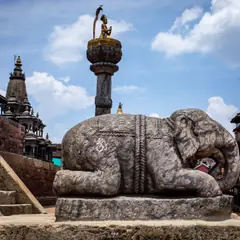
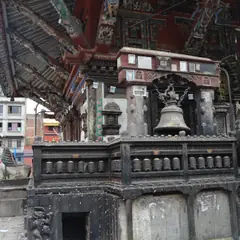
From the sattal, the pavilion-hostel that serves as the main entrance, the temple presents itself head-on, with a large stone Nandi bull staring at the shrine: the mark that Shiva reigns here. Kumbheshwar’s architecture is read in layers. Below, the two storeys of the first shrine; above, the three stepped roofs that stretched the silhouette skywards; and under the eaves, the slanting struts and the carved wooden doors with figures of deities, the feature for which the temple is famous throughout the valley.
The tower also has a recent scar. It withstood the main shock of the April 2015 earthquake, but in May of that year its top roof came down and the body of the pagoda was left slightly tilted. In February 2020, five years later, a small part of the reconstruction was still unfinished.
There are more stories hidden in that wood: according to tradition, 108 Bhairavas are counted on the struts, and inside the shrine waits a small five-faced linga. What happens to that linga on one particular day of the year, when Shiva and the Buddha end up sharing the same head, is one of the details revealed by listening to the narration in front of the Nandi.
A Himalayan lake in the middle of Patan
Kumbheshwor Pokhari pond
Summary of this stop
At the edge of the Kumbheshwor Pokhari pond, the temple’s name makes sense. For devotees, the spring that fills the compound’s ponds comes from Lake Gosainkunda, in Rasuwa district, 43 kilometres north of Kathmandu, and so bathing here at Janai Purnima is worth the same as doing so in the high-mountain lake.
How that water reaches a Patan neighbourhood is explained, according to popular belief, by three different tales: an arrow shot by Rama, the trident Shiva drove into a mountain with his throat burning from the poison he had swallowed, and a pilgrim who lost his vessel at Gosainkunda and recovered it on stopping to pray here. Of the three, the lost-jar one fits the temple’s name best.
The centre of the pond holds its own secret. For the Kumbheshwor Mela, at the full moon of Janai Purnima, usually in August, the Pokhari is filled with water and a priest walks to a central pavilion to install the image of Kumbheshwor Mahadev, a linga dressed in an embossed silver cover before which thousands of the faithful file past. So it happened, for example, at midnight on 2 August 2020. What happens that same day with the frogs of the valley is left for the audio guide.
Bagalamukhi and the village shamans
Bagalamukhi Temple
Summary of this stop
Inside the compound, the Bagalamukhi temple has its own calendar. The goddess, venerated as one of the valley’s most famous Shakti Peeths, keeps an inner shrine worked in silver and draws queues of the faithful above all on Thursdays, just as Mondays belong to Shiva. Kumbheshwar thus works as a cluster of shrines, each with its own public and its own day.
At Janai Purnima that cluster becomes a magnet for half the valley. The crowd comes from Patan and from villages to the south such as Chapagaun, Harisiddhi, Thaiba, Dhapakhel, Sunakothi, Bungamati, Khokana and Godawari; there are queues watched by police and young people who dive into the pond to swim. And the Tamang jhakri also come down, shamans from nearby villages, who hold their rites here and in 2025 danced beside the Bagalamukhi temple itself.
According to a documented tradition, the founding of the temple is attributed to the sage Agastya, and people come to Kumbheshwar to ask for long life and to be freed from illness. Why a newly initiated shaman does not consider his journey to the sacred lake complete until he reaches this city courtyard is one of the keys the narration reveals at this stop.
Everyday water
Konti Hiti
Summary of this stop
The tour ends where the temple blends into the neighbourhood’s daily life. At Konti Hiti, a deep stepped brick reservoir beside the temple, women gather to chat, wash clothes and fill their jars under a stone spout. Across Kwalakhu Road flow the spouts of Kumbheshwor Hiti, carved with Newar deities and fed, according to devotees, by the same water from Gosainkunda.
That spring has its own legend, disputed even by those who tell it: that of a leper cowherd from Kathmandu, a bamboo pole stuck in a meadow and a king who halts his procession. From that meeting would come, according to the tale, the name of the whole city, Lalitpur, although the sources leave it in the realm of legend.
A few steps away, in an alley north of the temple, the story is documented and recent. In 1983 Siddhi Bahadur Khadgi turned a nursery for the pode sweeper women, who swept the streets with their children on their backs, into the Kumbheswor Technical School, whose carpet and knitwear workshop has exported since 1989. And the compound itself carries a darker story, that of a year when its stone gods disappeared one after another, which the audio guide keeps for the end.