Malla palace and museum
Patan Museum Audio Guide
Behind a gilded copper door on Durbar Square, the old court of the Malla kings keeps bronzes that have never stopped being sacred: a throne once rented for two rupees, stolen gods that have come home and visitors who pray before the display cases.
- 90-min audio
- Sacred Newar bronzes
Keshav Narayan Chowk is the northernmost part of the Patan palace: it occupies the site of the city's first Malla palace, built on the foundations of a Buddhist monastery, and was called Chaukot Darbar, «the four-cornered fort», for its four tower pavilions. Inaugurated in 1734 as the residential court of the Malla kings, it was a public school from 1950 and, after a Nepali-Austrian project carried out between 1982 and 1997, opened as a museum of Hindu and Buddhist bronzes on 28 October 1997.
Its scale surprises by how intimate it is: with the same number of floors, the National Library in Vienna is three times taller. And what it holds does not behave like an ordinary collection: there are pieces people bow to pray before, a relief stolen in 1982 that came back from Berlin and a royal throne that still goes out once a year to the Krishna temple on the square.
Highlights
- Golden Door and Golden Window, with Avalokiteshvara creating Hindu gods above the palace entrance
- Gilded throne of 1666 of the kings of Patan, which according to its inscription could be rented for two rupees
- Uma-Maheshwar relief, stolen in 1982 and returned from Berlin in 2000
- Keshav Narayan Chowk courtyard with the Vishnu shrine, rebuilt after decades as a school
- Some 200 bronzes and gilded copper repoussé works in eight themed galleries
In almost any museum in the world, a god behind glass is a work of art. In the Patan Museum it is less clear. Housed in Keshav Narayan Chowk, the old residential court of the Malla kings on Durbar Square, it holds a collection of 1,100 objects of which it displays about 200, spread over eight themed galleries: mostly cast bronzes and gilded copper repoussé of Hindu and Buddhist deities, the crafts for which Patan is famous. Every piece carries labels in Nepali and English, but some still receive prayers as if they had never left their temple.
The history of the building is as eventful as that of its pieces. The palace was inaugurated in 1734, in the last reconstruction under Malla rule; the 1934 earthquake brought down its east wing; from 1950 it was one of the city’s first public schools, and in 1982 began the project with Austrian help that, coordinated by the architect Götz Hagmüller, turned from restoration into a museum. Some sources give 1982 as the founding year, although that date marks the start of the works: the inauguration came in 1997. Since then it has been run by a semi-autonomous board financed by tickets, café and rentals, the first time the «Development Committee Act 2013» was applied to a cultural institution in Nepal.
What to see at the Patan Museum runs from the façade on the square to the first-floor galleries. The audio guide covers in six stops the palace’s architecture, the history of its renovations and the episodes of stolen and returned gods, with documented narration that keeps the most revealing details for each room.
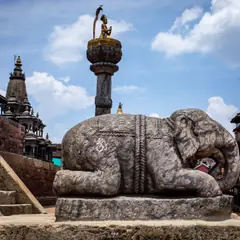
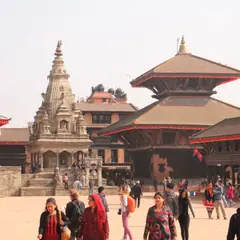
The palace closes Patan Durbar Square on the east, and from its golden door you can see, across the way, the stone tower of the Krishna Mandir.
The silhouette of the four-cornered fort
Museum façade
Summary of this stop
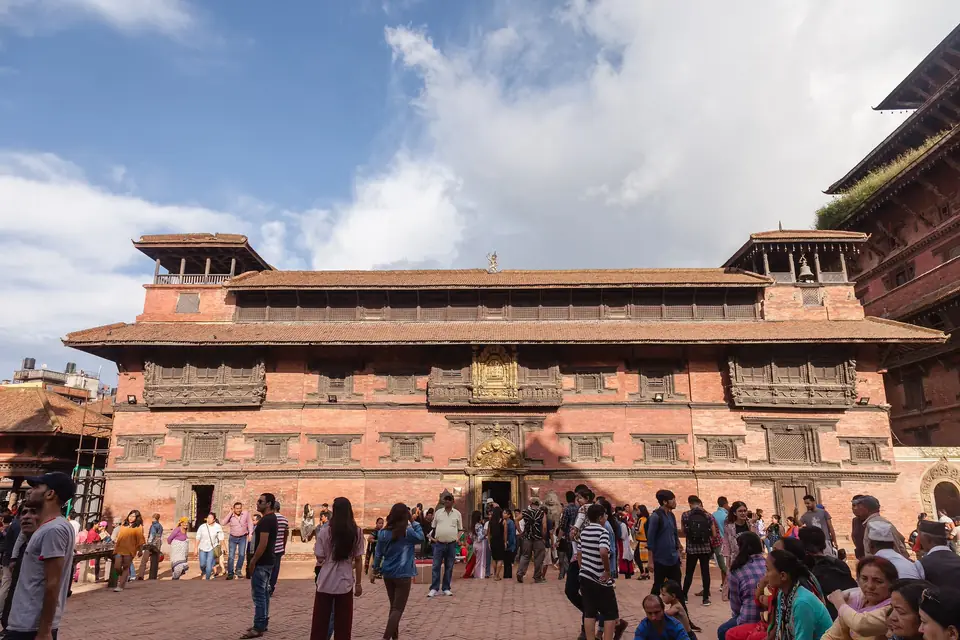
From Durbar Square, the west façade tells its story only halfway. The building was called Chaukot Darbar, «the four-cornered fort», for its four tower pavilions, but today only the two front ones remain. It occupies the site of the first Malla palace of Patan, itself built on the foundations of a Buddhist monastery, so beneath this court of Hindu kings lies an earlier layer of another faith.
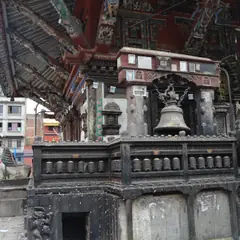
On the ridge gleams a gilded bronze figure of Hanuman, a gift from King Bhupatindra Malla of Bhaktapur. It and the bell of the tower pavilion returned to their place after more than 50 years, when the towers were rebuilt in 1986-1987 with the help of photographs from before the earthquake. The bell has its own episode: in times of drought it was rung without pause on the open terrace, in a ritual to bring rain, until Bhupatindra Malla himself, on the pretext of protecting the palace, had the terrace roofed over and the bell walled in so it could not sound.
That double gesture feeds a suspicion that local legend still debates: what if the Hanuman were really a poisoned gift, an icon of Saturn, the planet of ill fortune? Another version reverses the story and sees in the figure Shanichar, Saturn personified, placed to ward off evil. What material detail is put forward as proof is the first thing the narration reveals in front of the façade.
The Golden Window and its bodhisattva
Golden Door and Golden Window
Summary of this stop
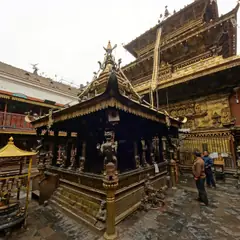
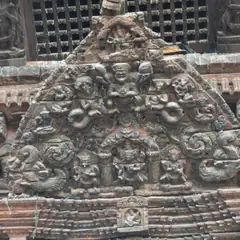
The museum entrance is a door clad in embossed gilded copper, guarded by two stone lions and crowned by a tympanum, the torana, peopled with gods. Above it opens the Golden Window, from which the king looked out over the square. In 1885, the Frenchman Gustave Le Bon photographed this entrance and published it as an engraving in Paris.
The puzzling part is at the centre of the panel. It is not a Hindu god who presides, but Avalokiteshvara, the Buddhist bodhisattva, in his form as Srishtikarta, «creator», making Hindu deities spring from his own body, with more Hindu gods at the sides, the base and the tympanum. A Buddhist symbol at the heart of the façade of Hindu kings: few images sum up better the religious coexistence of the valley.
The date of all that gold is more disputed than it seems. Some travel guides place it in 1734, the year of the Malla reconstruction; the museum’s own material dates the cladding and inscriptions to 1854, under Jung Bahadur Rana, and the scholar Gudrun Bühnemann argues there is no proof of a Malla date and that the window is probably from the Rana period. What consequences that difference has for reading the façade is explained right at the door.
Keshav Narayan Chowk, the courtyard that was a school
Keshav Narayan Chowk
Summary of this stop
Behind the door opens a square, silent courtyard. At the centre stands a small domed shrine dedicated to Vishnu as Mani Keshav Narayan, the god who gives this part of the palace its name. Arcades supported by pairs of carved wooden pillars surround three of its sides, and under the eaves runs a balcony open on all four, rebuilt from period models.
That balcony is the trace of a loss. When the palace became a school in 1950, the Department of Road Construction closed the whole courtyard balcony with a vertical wooden grille, plastered the walls with cement in a false brick bond and covered the roofs with industrial tile. What you see today is the result of undoing that adaptation, piece by piece.
The courtyard also lived the night of its second life. On 28 October 1997, King Birendra inaugurated the museum in the presence of the Austrian minister Benita Ferrero-Waldner, with a concert by Austrian and Nepali ensembles in this very space, lit by candles. What the palace was like before anyone decided to save it is told at the centre of the courtyard, beside the shrine.
Steel, temple struts and low ceilings
East wing staircase
Summary of this stop
The staircase of the east wing is wide, with a sloping Tibetan-inspired banister, and its walls display tall carved wooden struts rescued from temples felled by earthquakes. The whole wing is a reconstruction: it collapsed in the 1934 earthquake and was rebuilt at twice its original width; by 1990 it was so deteriorated that it was demolished and raised anew, with new interiors, a steel frame left visible inside and a Malla-period façade towards the courtyard. Towards the garden, by contrast, it shows a Rana-style façade of exposed brick with white cornices, reinterpreted with an arcade of steel beams.
Behind this work is an idea that grew along the way. In 1982 the proposal of the Austrian historian Eduard Sekler was accepted to restore, with Austrian help, the most damaged part of the «Palace of the Golden Window», starting with the north wing. Between 1982 and 1997, Nepal’s Department of Archaeology and the Austrian IIZ carried out the project, and Hagmüller expanded it into a museum.
What the body notices on the way up is the scale. With the same number of floors as this palace, the National Library in Vienna, designed in 1726 for the Habsburg court, is three times taller: the very low height between floors of Newar palaces marks the building’s intimacy. How this wing went from ruin to museum, and what it keeps of each of its lives, is told at the foot of the staircase.
The throne that could be rented for two rupees
Gilded throne of the kings of Patan
Summary of this stop
In the galleries awaits the gilded throne of the kings of Patan, from 1666 and about 188 centimetres tall, of gilded copper and wood. It presents the king as Vishnu on Garuda: beneath the seat, the bird spreads its wings among entwined serpents. Just below runs an inscription recording that it was offered to King Shrinivasa Malla and, most unexpectedly, that anyone could rent it by paying two rupees to the families of coppersmiths and carpenters.
The throne has not fully retired either: once a year it is displayed in the Krishna temple on the square. It is the best clue to how this museum works, where what is displayed remains sacred. Some visitors bow to pray before certain figures, and among the venerated pieces there is one no craftsman carved: an ammonite fossil millions of years old, a shaligram, revered because its spiral recalls Ganesh’s trunk, although by tradition the shaligram is an emblem of Vishnu.
All around, the galleries also show how these gods are made, with step-by-step sequences of lost-wax casting and copper repoussé, and deep window seats from which the square and the Krishna Mandir can be seen as the kings saw them. What exactly the throne’s inscription says, and why an art museum becomes a place of worship here, is heard in front of the display case.
Uma-Maheshwar, the god who came back from Berlin
Uma-Maheshwar relief
Summary of this stop
The tour ends before a grey limestone relief 62 centimetres tall and about 800 years old: Uma-Maheshwar, Shiva and Parvati on Mount Kailash with their divine court. In 1982 it was stolen from a shrine in Wotol, in Dhulikhel, and ended up in the Museum für Indische Kunst in Berlin. It formally returned to Nepal on 28 August 2000, although some later publication places the return in 1990 and sources differ on how it reached Berlin. For fear of another theft it stayed in the museum, while in Dhulikhel a replica receives daily worship.
It is not the only god to have crossed these doors on the way home. In December 2013, the American artist Joy Lynn Davis exhibited here paintings of shrines of the Kathmandu Valley with the stolen sculptures returned to their place in 23-carat gold; among them, the Lakshmi-Narayan of Patan, stolen in 1984. In 2015 Davis herself found the statue in the Dallas Museum of Art with a Google search.
What happened next, on 4 December 2021, closes the circle of the museum and of the audio guide: how that image left these rooms and where it was taken is the ending the narration keeps for the last stop.