Newar Buddhist temple
Mahabuddha Temple Audio Guide
Behind a narrow door in an Okubahal alley, a terracotta tower rises without warning, every brick bearing a Buddha: the copy of the Mahabodhi of Bodh Gaya that a single Patan family built over four generations.
- 25-min audio
- Terracotta and Newar Buddhism
The Mahabuddha Temple began as a private decision. According to the most cited date, Pandit Abhayaraj, head of the mint in the service of King Amar Malla, laid the first stone in 1564, the year 685 of the Nepal Sambat, in the courtyard of his own house. He had made pilgrimages to Lumbini, Bodh Gaya, Sarnath and Kushinagar and painted a picture of the Mahabodhi; after his death, sons and grandsons took that painting as their model and raised a shikhara of terracotta bricks moulded with Buddhist symbols, a 36-year undertaking that sources give as complete around 1600-1601.
The tower you see today is, in large part, the work of the neighbours. The 1934 earthquake brought down everything above the balcony, and the temple's gosthi rebuilt it with local resources and a Government loan of 3,100 rupees that Prime Minister Juddha Shamsher cancelled in the middle of the 1938 ceremony. The founder's descendants still take turns each month to look after it.
Highlights
- Terracotta shikhara tower: every brick, made for the temple, bears a small Buddha in relief
- Newar copy of the Mahabodhi of Bodh Gaya, raised by four generations of one family
- The balcony line: everything above it was rebuilt after the 1934 earthquake
- Maya Devi shrine, made with bricks and tiles left over from the reconstruction
- Rooftop at the back of the courtyard with the whole tower in view, at mid-height
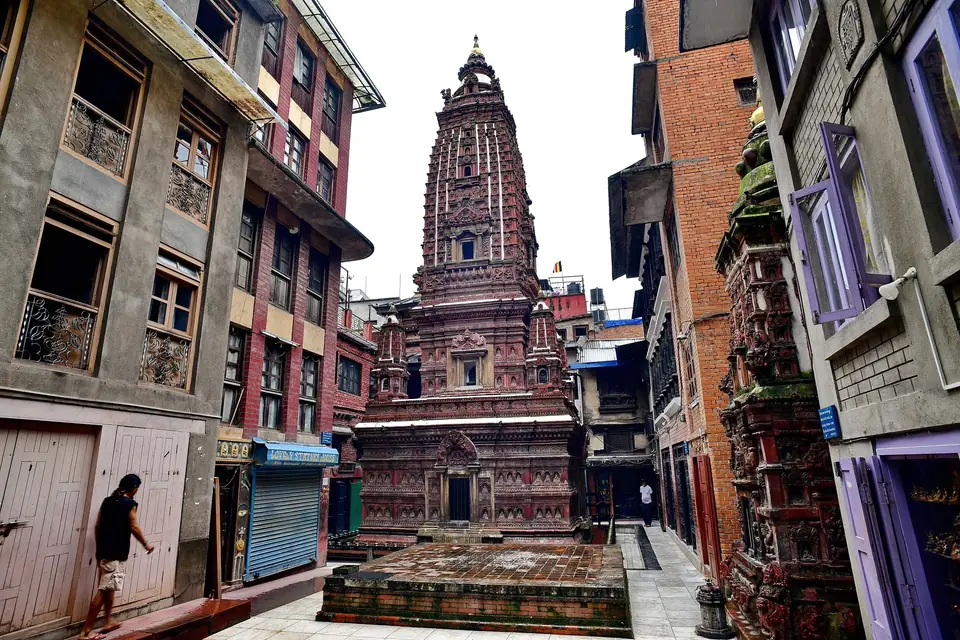
Rarely does a monument of this height hide so well. The Mahabuddha Temple occupies a tiny courtyard in the Okubahal neighbourhood of Patan, and from the alley you can guess nothing: only a narrow door near Sundhara Tole. On the other side, the tower fills the whole space at once, a red-brick shikhara that reproduces the Mahabodhi temple of Bodh Gaya, the place where the Buddha reached enlightenment.
The history of the Mahabuddha Temple is that of a pilgrimage turned into brick. Its founder, Pandit Abhayaraj, travelled to the four great sites of Buddhism and came back with a picture of the Mahabodhi painted by himself; the work began, according to the most repeated date, in 1564, although other sources speak of 1585 or even earlier centuries, and its completion varies between 1600 and 1610. What is not disputed is its architecture: terracotta bricks made expressly for the tower, each with a Buddha in relief, bonded with a mortar called vajra made of brick dust, lime, lentils and fenugreek.
What to see at the Mahabuddha Temple goes beyond the façade. The audio guide walks the courtyard in four stops, from the alley door to a rooftop from which the whole tower can be seen, with documented narration checked against historical sources that keeps its most surprising episodes for the courtyard itself.
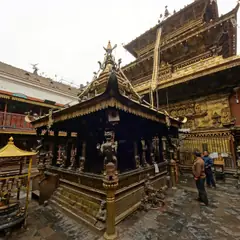
The same Newar Buddhism that raised this tower is still alive in the courtyard of the Golden Temple, north of Durbar Square, and about 450 metres to the west, in Ta Baha, the rain god of the Rato Machindranath Temple spends half the year.
The house of the mint master
Okubahal courtyard door
Summary of this stop
The temple was not built in a monastery or a royal square, but in the courtyard of a dwelling. It belonged to Pandit Abhayaraj, a powerful man: he had been appointed Dittha, head of the mint, in charge of striking coins with the copper of the Chitlang mines, and King Amar Malla had honoured him with royal titles. According to the most cited date, in 1564 he laid the first stone here.
The neighbourhood tradition adds a less earthly origin. It is said that one night Abhayaraj dreamed of the goddess Vidyadhari, who ordered him to build the temple, and that, awed by the vision, he began the work in his own house. There are other versions of the same dream: in one it comes to him in the middle of a pilgrimage and the goddess asks for a temple like the one at Kushinagar, not like the one at Bodh Gaya.
The paradox is that the tower of the buddhas is born of a goddess. And depending on who tells it, that goddess returns a generation later, when the work seemed doomed to stay half-finished; what happened then is revealed by listening to the narration in front of the door.
A trip to India brought home
Mahabuddha tower
Summary of this stop
At the foot of the south face, the tower shows its nature as a copy. Abhayaraj had made pilgrimages to Lumbini, Bodh Gaya, Sarnath and Kushinagar, and painted a picture of the Mahabodhi temple; after his death, his sons and grandsons raised the one in Patan taking that painting as their model. The construction occupied four generations of the same family for 36 years, with the craftsmen Hakuju, Muniju and Ratna Muni, although sources disagree on which descendant gave the final touch.
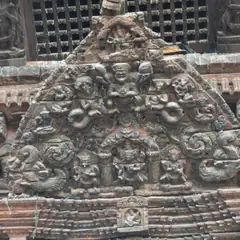
Up close, the shikhara narrows row by row and reveals its matter: terracotta bricks moulded with Buddhist symbols, each with a small Buddha in relief, between lions on the buttresses. How many buddhas there are exactly is another open question: the nickname varies between a thousand, 1,008 and nine thousand, and nobody has published a count.
That nickname also depends on who walks through the door. For the Newars it is the Mahabuddha, the great Buddha; for Tibetan pilgrims it is Sange Tungu, the thousand buddhas of Patan, one of their shrines to visit in the valley, where groups of monks pray before a large vajra on a stone pillar. What lies in the stone of the Buddha’s footprints, before this same face, the narration tells right there.
The balcony line where the tower fell
Maya Devi shrine
Summary of this stop
On the tower there is an invisible border. The 1934 earthquake brought down the whole part above the balcony, and the four small towers on its corners, modelled on the Bodh Gaya scheme, mark that line today: what remains above is the work of the reconstruction, which finished in 1938. Whether the result faithfully reproduces the original or turned out a different temple, without plans, is something the sources still debate.
The reconstruction was a neighbourhood effort. The temple’s gosthi decided to rebuild it with local resources and a Government loan of 3,100 rupees; the master craftsman Jogman Shakya led the neighbourhood’s artisans, with Buddhi Narsingh Shakya and Devaraj Shakya as supervisors. At the final ceremony, Prime Minister Juddha Shamsher cancelled the loan on the spot and handed out cash prizes among masters, priests and craftsmen.
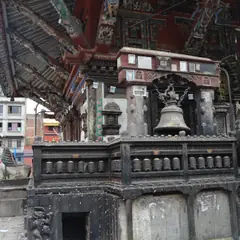
In a corner of the courtyard, wedged between two buildings, a witness to those years remains: the shrine dedicated to Maya Devi, the Buddha’s mother, made with leftover bricks and tiles and with materials recovered from the ruins. What was celebrated that day in 1938, and how long it lasted, is part of what the audio guide reveals in front of the shrine.
Six floors of buddhas and a monthly turn
Rooftop of the shop at the back of the courtyard
Summary of this stop
From the rooftop of the shop at the back of the courtyard, the tower is seen whole at mid-height, up to the golden pinnacle in the shape of a chaitya. Inside it is ordered like a staircase to the heights: Shakyamuni faces east in the main shrine, between Samantabhadra and Vajrapani; Amitabha occupies the first floor, a Swayambhu Mahachaitya the third, the Dharmadhatu and Vajradhatu mandalas the fourth and fifth, and the golden Sunyaniranjan chaitya the sixth.
The temple remains a family matter. The families of Abhayaraj’s five sons, the Nyacho Aaju lineage, look after it in turns, and the custodian family changes every month. When the 2015 earthquake brought down the inner structure and two pillars in front of the Amitabha image, it was local artists who paid out of their own pockets for much of the repair.
Every morning and every afternoon, the courtyard stops being a postcard: from a small room in the adjoining building come down the songs of the bhajan mandali, the Shakya custodian lights the lamps and devotees circle the tower spinning the prayer wheels. What happens in the prayer room that looks onto the temple’s second tier is the closing note the narration keeps for that moment.