UNESCO World Heritage
Choeung Ek Killing Fields Audio Guide
Half an hour by truck from the S-21 prison, a former orchard and Chinese cemetery holds the pits where the Khmer Rouge executed their prisoners at night. Today it is a memorial and World Heritage.
- 90 min of audio
- Genocide memorial
The Choeung Ek Killing Fields were, between 1977 and 1979, the place of execution and burial of the S-21 prison. Kang Kek Iew, alias Duch, its director, chose it far from Tuol Sleng for fear that the corpses would cause an epidemic. In 1980 the remains of 8,985 people were exhumed here, according to the most-cited figure, and in 1988 the memorial stupa that now presides over the site was built. Since 11 July 2025 it has been part, together with Tuol Sleng and the former M-13 prison, of the “Cambodian Memorial Sites” property, inscribed on UNESCO’s World Heritage List.
Beneath the calm of the paddy fields and the shade of the trees, the ground preserves its layers: Chinese gravestones of the sixties and seventies, hollows that mark the opened pits and, beside the paths, fragments of bone, teeth and shreds of clothing that the rain still brings to the surface. Dozens of pits were never opened, and the chankiri tree, against which children were killed, appears today covered in coloured bracelets left by visitors.
Highlights
- 1988 memorial stupa — thousands of skulls behind glass panels, ordered by sex
- Mass graves exhumed in 1980, among them the one with 166 headless bodies
- Chankiri tree, covered by hundreds of bracelets left by visitors
- Loudspeaker tree, tied to the music that covered the night executions
- Gravestones of the old Chinese cemetery still standing among the pits
What to see at Choeung Ek and why it matters: on the outskirts of Phnom Penh, a former orchard of maize, rice and watermelons, which was also the cemetery of the local Chinese community, became between 1977 and 1979 the last stop for the prisoners of S-21. The history of Choeung Ek is read on the ground itself, in the mass graves opened in 1980 and in those still unexhumed beneath the paddy field, and its architecture comes down to a white Buddhist stupa of 1988 that keeps the victims’ skulls behind glass. Figures vary from one source to another: the exhumed remains are given as 8,985 or 8,895 people, and the total dead at the site is estimated at between some 15,000 and 20,000. Every 20 May the site hosts the national ceremony for the victims, and since 2025 it has been a UNESCO World Heritage Site, the first in Cambodia devoted to its recent history. The audio guide, documented and cross-checked against historical sources, accompanies the tour stop by stop, with the sobriety the place demands.
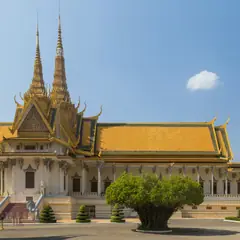
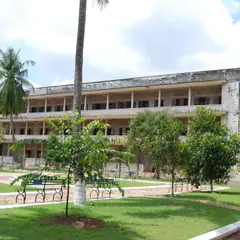
The prisoners came from the S-21 prison, today the Tuol Sleng Genocide Museum, and during part of those same years Norodom Sihanouk lived under house arrest inside the Royal Palace.
The trucks to the “new home”
Choeung Ek centre
Summary of this stop
The entrance esplanade marks the end of a journey of about 30 minutes. Around 18:30, the S-21 guards took the prisoners on the list out of their cells, 60 to 100 per convoy, and loaded them, handcuffed and blindfolded, onto covered trucks. They were told they were going to “a new home”, and the guard Him Huy checked their names against the list.
That journey explains the existence of the place. Kang Kek Iew, alias Duch, director of S-21, chose Choeung Ek as a burial site far from Tuol Sleng for fear that the corpses would cause an epidemic, and between 1977 and 1979 the site operated as an execution field. Prison and field were also joined in their recognition: on 11 July 2025, in Paris, both entered the World Heritage List together with the former M-13 prison, as the serial property “Cambodian Memorial Sites”, Cambodia’s fifth World Heritage Site. The narration at this point reconstructs the administrative machinery that connected the two places.
A Chinese cemetery beneath the pits
Mass graves and Chinese gravestones
Summary of this stop
Before the Khmer Rouge, this land was an orchard of maize, rice and watermelons and a cemetery of Phnom Penh’s Chinese community, in use during the sixties and early seventies. Some of those gravestones still stand among the pits, like a first stratum of memory on which another, much darker one was later deposited.
In 1980 the remains of 8,985 people were exhumed from the pits of the old orchard, many of them bound and blindfolded. The hollows that cross the site today mark the opened pits: in No. 7, 166 bodies were found buried without heads, and in No. 5, more than 100 women and children buried naked. Each pit contained on average between 10 and 30 people; one reached 450. Sources do not entirely agree on the count or on the date of the exhumation, which some place in 1979, and of the 129 mass graves located, 43 were left unopened according to some and 86 according to others.
In the unexcavated area rice now grows. Along the paths and beside the pits, the rain still brings fragments of bone, teeth and shreds of clothing to the surface, a detail the audio guide places in context on the ground.
Coloured bracelets on the chankiri tree
Chankiri tree (Killing Tree)
Summary of this stop
The chankiri tree appears covered with hundreds of coloured bracelets left by visitors. The gesture has a grave reason: against its trunk, the Khmer Rouge killed the babies and small children of the accused. The bracelets are today a silent form of tribute at the hardest point of the tour.
To this same tree Kang Kek Iew, Duch, returned on 26 February 2008, taken by the tribunal to reconstruct the crimes together with the investigating judges, the prosecutors, his two lawyers and four witnesses who had worked at Choeung Ek and at Tuol Sleng. Frail and helped by a guard, he walked the field for more than three hours. According to his lawyer, Kar Savuth, he knelt, wept and asked the victims for forgiveness, and had only followed orders; Judge You Bunleng and the prosecutor Robert Petit, by contrast, said they had not seen him cry, and Petit called the day “strange”.
It is also unclear how many times he set foot on the site. Duch told the tribunal that he visited Choeung Ek only once, forced by his superiors; the guard Him Huy testified in 2009 that he saw him there at least twice. The audio guide goes through that day and the question it leaves open about repentance.
The tree that covered the screams
Loudspeaker tree
Summary of this stop
Under the loudspeaker tree the mechanics of the nights at Choeung Ek are reconstructed. When each convoy arrived, the camp unit switched on a generator that powered ten fluorescent tubes, and loudspeakers with Khmer Rouge revolutionary music hung from the trees to cover the screams. The prisoners waited hidden under a large house and were taken one by one to the edge of the pits, where they were killed with iron ox-cart axles and knives to save bullets. The executions sometimes dragged on until two in the morning, and on some days more than 300 people died here.
The remains themselves confirm those testimonies. An analysis of 508 skulls from Choeung Ek, published in 2019 by the forensic anthropologist Julie Fleischman, estimated that 82.9% were men and 68.3% young adults aged 20 to 35; 61% showed trauma at the time of death, in 87% of cases from a blunt blow and mostly at the base of the skull.
Around the field, the accounts of neighbours are more diffuse and not always verifiable. It is said that a local farmer believed it was an army training camp, that after the fall of the regime a local family kept the loudspeakers and, according to one neighbour, that the crew from Battambang that looted the pits on Koh Sap island in search of gold also dug up some of those at Choeung Ek. Those episodes, with their nuances, are heard in full at this point.
Skulls behind the glass of 1988
Memorial stupa
Summary of this stop
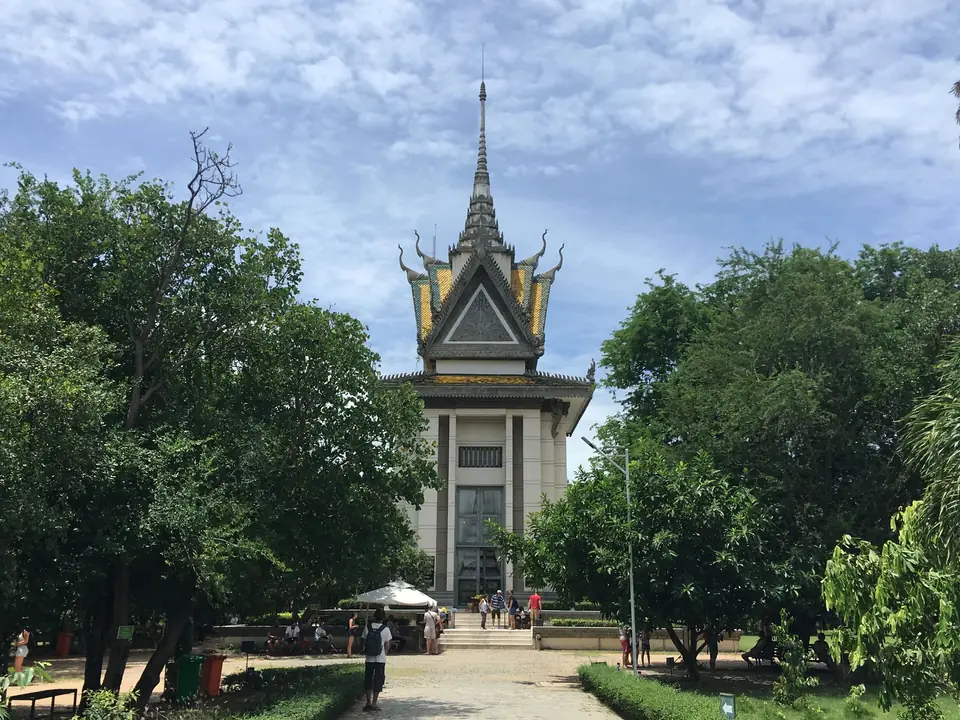
The white Buddhist stupa of 1988 presides over the centre of the site. Inside, behind transparent glass panels, storeys of shelves follow one another with thousands of skulls ordered by sex, as well as jawbones and long bones; before it burns the incense of the offerings. It is usually said that there are more than 8,000 skulls, although the count varies by source. Before the stupa, the remains were kept in a wooden memorial, and in 2010 the first renovation of the structure was announced, without moving any bone.
The monument was built under the Vietnam-backed People’s Republic of Kampuchea, as a tribute to the victims and at the same time as an endorsement of the new regime. Its development was directed by Mai Lam, who also took part in the creation of the Tuol Sleng museum and of the Ho Chi Minh City War Remnants Museum. That political dimension has not disappeared: every 20 May the stupa hosts the national ceremony for the victims, called the “Day of Anger” until 2018, when it became a public holiday as the National Day of Remembrance. Monks pray and students of the Royal University of Fine Arts, dressed in black and with wooden rifles and bamboo clubs, re-enact the executions, scenes that bring survivors to tears and whose meaning not everyone shares.
Alongside the official rite there is another, Buddhist and familial. During Pchum Ben, the festival of the dead, the site fills with monks and food: on 7 October 1999, at least 2,000 mourners surrounded the stupa and four hundred monks chanted for the victims, and in September 2000 dozens of tables with rice, noodles, fruit and sweets occupied three of its sides. Some Cambodians feared the bad karma of spirits dead without burial or last rites; in 1993 some monks prayed for them here, and over the years the care of these dead entered the annual cycle of Pchum Ben and the Khmer New Year. The audio guide closes the tour with those living rites.