Royal residence
Royal Palace Audio Guide
The residence of Cambodia’s kings stands on the bank of the Four Arms, where the Tonlé Sap meets the Mekong. Among Khmer rooftops and a 59-metre spire survives an iron house that came out of a Paris workshop.
- 90 min of audio
- Khmer architecture
King Norodom moved the court from Oudong in 1866 and between 1866 and 1870 built his palace here, the work of the architect Neak Oknha Tep Nimith Mak, on the western bank of Chaktomuk, the confluence that gives the compound its Khmer name. Between 1912 and 1919 his half-brother and successor, Sisowath, tore it down and rebuilt it: the complex visited today, with all its buildings facing east, is above all his work.
Of the first palace only a stretch of the eastern wall and the Napoleon Pavilion remain standing, a prefabricated iron house made in the Paris workshops of Ducros and shown there already assembled around 1875. A few steps away, the Throne Hall holds the Preah Tineang Bossabok, the nine-tiered throne on which every Khmer king must sit on the day of his coronation.
Highlights
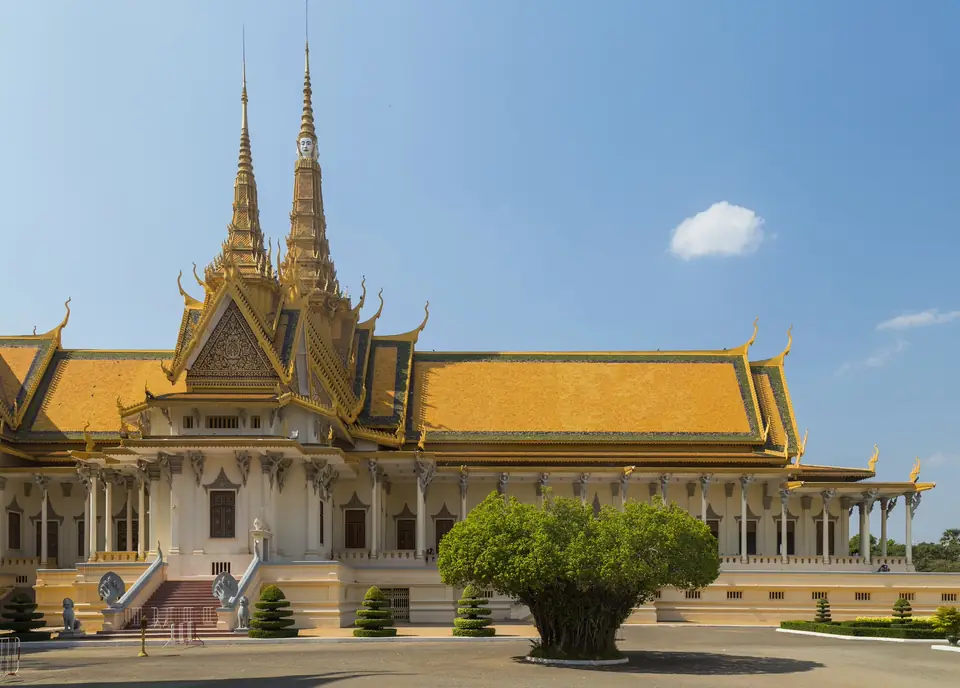
- Throne Hall — 59-metre central spire with the four-faced head of Brahma
- Preah Tineang Bossabok, the nine-tiered coronation throne held up by garudas
- Chan Chhaya Pavilion, the royal balcony for parades, dances and speeches
- Napoleon Pavilion, the iron house made in Paris for King Norodom
- Frescoes of the Reamker, the Khmer Ramayana, on the Throne Hall ceiling
The history of the Royal Palace of Phnom Penh begins before the palace itself. In 1813 King Ang Chan raised the citadel of Banteay Kev, the “Crystal Citadel”, on this site, and the retreating Siamese army burned it in 1834 when it razed the city. In 1866 Norodom chose the same place, beside Chaktomuk, the Four Arms where the Tonlé Sap and the Mekong meet, to install his court; Sisowath rebuilt it between 1912 and 1919, and since then the compound has seen coronations, a parcel bomb, the house arrest of one king and the mourning for another. Sources do not agree on some founding dates (the move from Oudong is given as 1865 or 1866, and the end of the works as 1870 or 1871) or on the area of the compound, given as 174,870 or 183,135 square metres. Every year, in October or November, at full moon, the Water Festival (Bon Om Touk) fills the river in front of the palace for three days with boats from all over the country, and the king presides over the regattas from a pavilion of honour; according to tradition, they recall the naval victories of Jayavarman VII. The palace is still the king’s residence and half of the complex is closed to the public: what can be visited is a living stage of the Khmer monarchy, and the audio guide covers it in five stops, from Sothearos Boulevard to the iron house.
Less than 300 metres away, the National Museum of Cambodia holds one of the largest collections of Khmer art in the world; the Independence Monument, commissioned by Norodom Sihanouk, is less than a kilometre away, and Wat Phnom, the hill that gave the city its name, lies about 1.6 km to the north.
A royal balcony facing the gunboats
Royal Palace
Summary of this stop
The visit starts outside, on Sothearos Boulevard, in front of the Chan Chhaya Pavilion, the “Moonlight Pavilion”. Built on the wall in 1913-1914, under Sisowath, it replaced a wooden one from Norodom’s time and is the part of the palace seen from the street. Its balcony was used to watch parades; the king speaks to the crowd from it, and it has hosted classical dance by the Royal Ballet and state banquets such as those of the 2004 coronation. In the late 1950s, according to tradition, Chheng Phon, a 27-year-old clown in whom Queen Kossamak saw a future great master of dance, rehearsed here among eight-year-old girls; he survived the Khmer Rouge and in 1981 was named Minister of Information and Culture.
From this point the choice of site also makes sense, the western bank of the river confluence. That same river was the setting for the most humiliating episode of Norodom’s reign. According to accounts of the meeting, on 17 June 1884 the Governor of Cochinchina, Charles Thomson, arrived at the palace while French gunboats anchored in view, woke the king by entering his private chamber and read him a convention that handed control of the kingdom’s internal affairs to France. The king’s interpreter, Coi de Monteiro, protested that this was not a convention but an abdication, and Thomson’s aides removed him from the room.
Norodom knew the French had his half-brother Sisowath ready as a replacement, and he signed; less than a year later a rebellion against French rule broke out. The question the king is said to have asked about a gunboat called the Alouette, and the answer he received, are left for the narration in front of this same balcony.
A 59-metre spire above three palaces
Throne Hall central spire
Summary of this stop
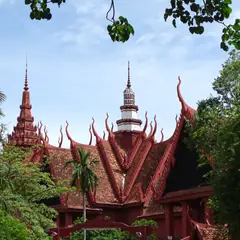
In the eastern courtyard, the eye climbs the central spire of the Throne Hall: 59 metres topped by the white four-faced head of Brahma, visible from the whole courtyard and from the riverfront esplanade. The hall has a cross-shaped plan, measures 30 by 60 metres and has three spires in all; like every building in the compound, it faces east.
Beneath this ground three chapters follow one another. First, the citadel of Banteay Kev, which Ang Chan raised in 1813 and the Siamese burned in 1834. Then Norodom’s palace, with a first wooden Throne Hall built in 1869-1870 (other sources date it to 1866) and torn down in 1915. Last, Sisowath’s palace: the current masonry hall was begun in 1917 and inaugurated on 16 June 1919.
Sisowath’s reconstruction, between 1912 and 1919, erased almost all of the earlier palace; only a stretch of the eastern wall and the iron house held out. What it means that the great builder of the compound was the king France kept in reserve is one of the keys the audio guide develops in the courtyard.
A nine-tiered throne for taking the oath
Preah Tineang Bossabok throne
Summary of this stop
From the eastern doors of the Throne Hall the whole interior can be taken in: in front, the Reach Balaing; behind and higher, the Preah Tineang Bossabok, a nine-tiered throne held up by garudas and covered by a white nine-tiered parasol, among golden parasols and the golden statues of Sisowath and Monivong. Behind it rises another bossabok reserved for the queen, and the ceiling is covered with frescoes of the Reamker, the Khmer version of the Ramayana. Every Khmer king must sit on this throne on the day of his coronation, dressed in the regalia.
Here Norodom Sihamoni took the oath on 29 October 2004. He had lived mostly in Prague and Paris, devoted to dance, and he ascended the throne without a crown, with a small sprig of leaves behind his ear, among xylophones and military drums. His father, Norodom Sihanouk, died in Beijing on 15 October 2012: on his return, some 1.2 million people lined the route from the airport to the palace, where he lay in state until 1 February 2013, and after the cremation of 4 February part of his ashes was kept for nearly a year in this hall.
The hall has also hosted rites for the gods. According to a documented tradition, in Sihanouk’s last years, with Cambodia battered by drought and American bombing, the court dancers performed the Buong Suong here, sacred dances that ask the heavenly powers for rice and peace. At their centre are Moni Mekhala, the goddess of waters who guards a gleaming magic ball, and the ogre Ream Eyso, who courts her in order to steal it; Khmer tradition uses them to explain thunder and lightning. The dance was performed again at palace ceremonies in 2008 and 2019, and the outcome of the duel is told in the audio guide.
Half the palace closed to the public
Royal residence wall and Phochani Pavilion
Summary of this stop
To the west, behind a wall, lie the Khemarin Palace and the Kantha Bopha villa: the king’s residential area occupies half the compound and is closed to the public, and from the visitable side only the top of its prang peeks out. In the visitable part remain the Phochani Pavilion, a reinforced-concrete banquet hall of 1912 that was a classical dance theatre and hosts the king’s birthday celebrations, and, beside the Throne Hall, the Hor Samran Phirun, of 1917, from which the king mounted the elephant for processions and which today displays gifts from foreign heads of state. It is said that one only has to look at the flag: when Norodom Sihamoni is in the palace, the royal blue flag flies over the buildings of the compound.
According to a documented tradition, until 1941, behind the Throne Hall, there was hidden a small walled village where hundreds of women lived: all the royal dancers and their female relatives. Apart from the eunuchs, the king was the only man who could enter, and the compound had its own maternity house. The dancers left only once or twice a year, as on the king’s birthday, when they walked to the river between temporary walls raised to hide them and danced all night on platforms in the water. In 1941, on the death of King Monivong, the French colonial authorities abolished the harem, and Queen Sisowath Kossamak took the homeless dancers into her own compound, south of the palace.
The twentieth century left more direct wounds here. On 31 August 1959 a lacquered gift containing a parcel bomb reached the palace: on opening it, the chief of protocol, Prince Norodom Vakrivan, was killed on the spot, while King Suramarit and Queen Kossamak were in a nearby room. Years later, Norodom Sihanouk, nominal head of state of the Khmer Rouge’s Democratic Kampuchea, resigned on 2 April 1976 and was kept under house arrest inside the palace until September 1978. How that village of women, who could not go to the market, was supplied is one of the details the narration reserves for this wall.
An iron house made in Paris
Napoleon Pavilion
Summary of this stop
South of the Throne Hall appears the oldest building of the palace, and the one that fits in least: the Napoleon Pavilion, a cast-iron villa of European air, with galleries, wrought-iron columns and stained glass bearing a coat of arms and monogram, among Khmer roofs. It is a prefabricated house ordered for the King of Cambodia from the Paris workshops of the builder Ducros, where it was shown already assembled around 1875. Norodom called it braḥ dināṃṅ tusti, after the Buddhist Tusita heaven, and in the palace it is still called Prasat Dek, “iron palace”.
Around 1879 the king received his French visitors there: a dozen steps led to a long salon furnished in the European style on a blue background, with a round table on which the royal spittoon stood out, of solid gold with precious stones.
Its origin remains disputed. The most widespread version presents it as the chalet of Empress Eugénie for the opening of the Suez Canal in 1869, later given by Napoleon III to Norodom; that story appears in writing in 1922 and 1925, whereas the magazine L’Univers Illustré showed the pavilion in 1875, assembled in Paris as a work for the King of Cambodia, and no document proves the imperial gift or its passage through Egypt. A purchase at the 1878 Universal Exhibition has also been proposed, which testimonies of the iron house at the palace since 1870 contradict. The audio guide closes the tour here, in front of the only building that survives from the first palace, together with that stretch of wall.