Genocide memorial
Tuol Sleng Genocide Museum Audio Guide (S-21)
A school compound of 1962 that the Khmer Rouge turned into the secret prison S-21. Its classrooms, its playground and the photographic archive of the prisoners are preserved today as a memorial, judicial evidence and World Heritage.
- 90 min of audio
- UNESCO World Heritage
The Tuol Sleng Genocide Museum occupies the buildings of two adjoining schools opened in 1962, the Tuol Sleng primary school and the Tuol Svay Prey secondary school. Between 1975 and 1979 the Khmer Rouge regime turned them into S-21, a detention and interrogation centre through which between 15,000 and 20,000 prisoners from all over the country passed, including members of the movement itself accused of treason. Since 11 July 2025 it has been part of UNESCO World Heritage together with the former M-13 prison and the Choeung Ek centre.
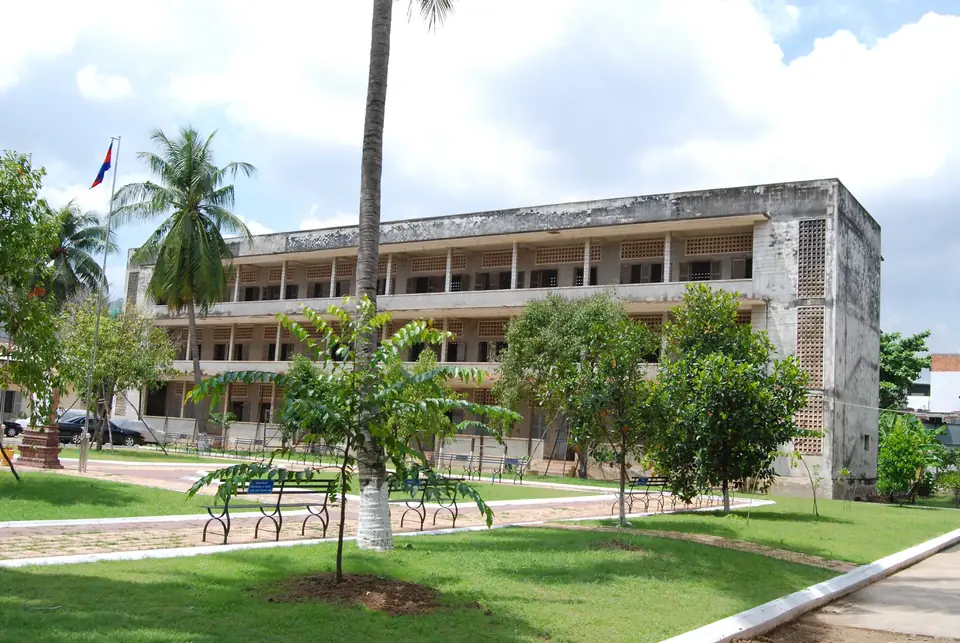
The school architecture is still in view: outer galleries, classrooms in a row and a playground. But the galleries of the upper floors are closed off with barbed wire and the classrooms divided into brick and wooden cells. The other great witness is the archive: when the prison’s director fled in January 1979, there was no time to destroy the prisoners’ photographs, biographies and confessions, which today make it possible to put names and faces to the victims.
Highlights
- Building B — classrooms lined with the numbered arrival photographs of the prisoners
- 0.8 by 2 metre cells built inside the classrooms of Building C
- The 14 white graves in the yard and the gymnastics frame turned into a gallows
- Paintings by Vann Nath, an S-21 prisoner from 1978, of what he witnessed
- S-21 archive on UNESCO’s Memory of the World Register since 2009
What to see at the Tuol Sleng Genocide Museum: a former school compound in Phnom Penh that, between 1975 and 1979, operated under the code S-21 as a secret prison of the Khmer Rouge. The history of Tuol Sleng has three layers that can be read in its own names: the schools opened in 1962, the detention centre in which some 1,720 people worked for the centre, and the memorial opened after the entry of Vietnamese troops in January 1979. The Vietnamese officer Mai Lam was commissioned to turn it into a museum, and that origin is still debated: some have read the initial display as a tool to legitimise Vietnam’s intervention, and Pol Pot dismissed it as a “Vietnamese exhibition”. There is also no agreement on the exact opening date, which sources place in late 1979 or already in 1980; in that same 1979, on 19 August, the People’s Revolutionary Tribunal sentenced Pol Pot and Ieng Sary to death in absentia. In 2003 the filmmaker Rithy Panh brought two survivors, the painter Vann Nath and the mechanic Chum Mey, back to these corridors to confront their former jailers on camera. The 90-minute audio guide accompanies the walk through the yard and the buildings of the compound with narration that is documented and cross-checked against historical sources, at whatever pace each visitor needs in a place like this.
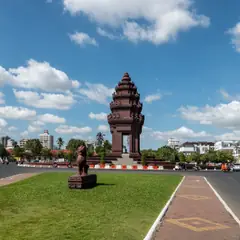
Between 1977 and 1979, S-21 executed and buried its prisoners at the Choeung Ek Killing Fields, the other Phnom Penh memorial inscribed in the same UNESCO property. The classrooms had opened in 1962, the year the Independence Monument was inaugurated, 1.4 km from here.
A 1962 school behind the gate
Tuol Sleng Museum
Summary of this stop
From the entrance, the compound presents the recognisable architecture of a school: blocks of classrooms lined up around a yard. In 1962 two adjoining schools opened here, the Tuol Sleng primary school and the Tuol Svay Prey secondary school, and nothing in their layout announces at first sight what came afterwards.
The names of the place sum up its history. During the years 1975 to 1979 the centre had no official name other than the code S-21; that of Tuol Sleng, “hill of the sleng tree”, a tree with poisonous fruit, took hold when it opened as a museum around 1980. The third name came on 11 July 2025 in Paris, when UNESCO inscribed Tuol Sleng on the World Heritage List together with the former M-13 prison and the Choeung Ek centre, under the title “Cambodian Memorial Sites”. The narration at this point explains why that passage from school to prison is the key to the whole tour.
Fourteen graves in the playground
The 14 white graves and the gymnastics frame
Summary of this stop
In front of Building A, 14 rectangular white concrete gravestones are lined up. They correspond to the last 14 victims, one of them a woman, found in the compound on 7 January 1979, when the troops that ended the regime arrived, and buried right there. In the rooms of that building, former classrooms, rusted iron bedframes remain and, above each one, the black-and-white photograph of how the room was found that day.
Next to the graves stands a gymnastics frame from the old school yard. The Khmer Rouge used it as a gallows during interrogations: they placed large traditional water jars at its foot to hang prisoners upside down and submerge their heads. The playground thus became part of the prison’s apparatus.
That same yard also holds the memory of the liberation told by a child. According to the testimony of Norng Chanphal, aged 8, in January 1979 he hid with his younger siblings under a pile of clothes left by the prisoners so as not to board the trucks and so that his mother could find him; the next morning, two soldiers, one Cambodian and one Vietnamese, discovered them and gave them food. The number of survivors found alive that January varies by source, and the audio guide gives the rest of his story at this point.
Thousands of arrival photos that accuse
Portrait panels of Building B
Summary of this stop
The classrooms of Building B, without partitions, are lined with portraits: the numbered photographs taken of each prisoner on arrival. They are part of the S-21 archive, with photographs, biographies and confessions of more than 6,000 prisoners, which entered the Memory of the World Asia-Pacific Register in 2008 and UNESCO’s International Register in 2009. Even today there are families who walk along these panels searching for the disappeared.
That archive exists because no one managed to destroy it. In January 1979 the director of S-21, Kaing Guek Eav, alias Duch, fled after ordering the prisoners liquidated, but without time to erase the documents, which remained as evidence of the crimes. The figures are still not settled: official sources speak of between 15,000 and 20,000 prisoners from all over the country, others of some 15,000, of 17,000 or of the 18,145 listed by the prosecution in Case 001 of the ECCC tribunal, and the people identified by name are fewer.
Among those files is that of the New Zealander Kerry Hamill, captured in August 1978 with the Briton John Dewhirst when their yacht, the Foxy Lady, strayed into Cambodian waters near the island of Koh Tang. Forced to confess that he was a CIA agent, he filled his statement with coded messages for his family, with names and details that only his own people could recognise. His last confession is dated 13 October 1978, and in 2009 his brother Rob Hamill testified at the trial of Duch. What exactly that confession concealed is revealed in the narration in this room.
Eighty-centimetre cells in a classroom
Brick and wooden cells of Building C
Summary of this stop
In Buildings B, C and D, the classrooms were divided into individual cells of 0.8 by 2 metres: of brick on the ground floor and of wooden planks on the first floor. On the second floor, the classrooms served as communal rooms for 40 or 50 prisoners. On the ground floor of Building C those rows of cubicles still stand, and the narrowness is felt with one’s own body inside what was a classroom. The outer galleries of the upper floors are closed off with a net of barbed wire, put up to prevent escapes and suicides.
S-21 was not the end of the road. Until late 1976 the dead were buried next to the prison; when space ran out, the prisoners and their families were executed at Choeung Ek, 15 kilometres from Phnom Penh. The compound also displays a sign with the ten rules imposed on the prisoners, in faulty English translated from Khmer. Before the tribunal, in April 2009, Duch maintained that this panel was an invention of the Vietnamese officials who set up the museum, and the audio guide presents the terms of that debate at this point.
The painters who survived to tell it
Vann Nath paintings and skull display case
Summary of this stop
In the rooms of Building D hang the paintings of Vann Nath (1946-2011), a prisoner in S-21 from 1978, who survived by being forced to paint portraits of Pol Pot. His paintings reconstruct scenes of detention and torture that he witnessed. Another prisoner saved by his trade as a painter, Bou Meng, a witness at the trial of Duch, devoted his last years to telling his story to visitors to the museum; he died on 14 August 2026, aged 85.
A wood-and-glass display case holds skulls of victims as forensic evidence. It takes the place of the 12 m² map of Cambodia made with some 300 skulls joined with wire that was shown on a wall from 1979 and was dismantled in March 2002, after a Buddhist ceremony. That map divided opinion: King Sihanouk argued for cremating the remains according to Buddhist tradition, Hun Sen for keeping them as a lesson and Youk Chhang, of DC-Cam, considered it sensationalist propaganda; the museum cited the deterioration of the skulls to remove it.
The memory of this place is also practised. Twice a year, around the Khmer New Year and Pchum Ben, the staff invite monks from the nearby Wat Tuol Tumpoung pagoda to pray for the dead of the prison, with offerings of food, candles and incense. For those who work here, the ceremony serves to free spirits they consider still “chained”, and at Pchum Ben, the largest of the year, one more monk is added each year to mark the time elapsed since 1979. The meaning of that ritual closes the narration of the tour.