Khmer art
National Museum of Cambodia Audio Guide
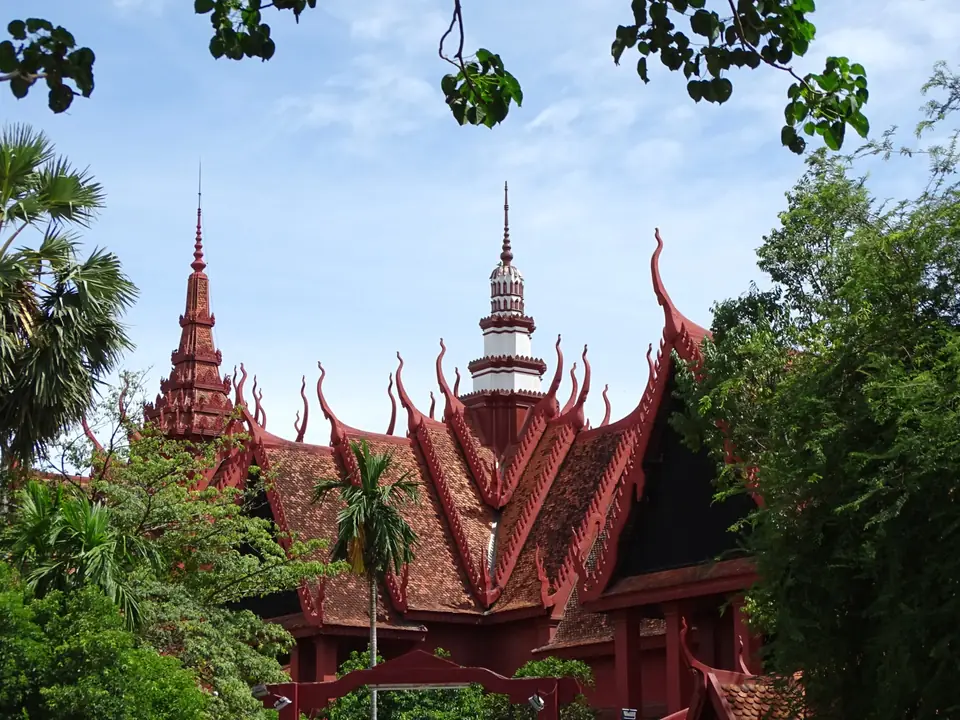
A red pavilion that looks like a timeless Khmer temple and is an invention of 1917. Inside, one of the largest collections of Khmer art in the world, the original Leper King and looted gods coming home.
- 75 min of audio
- Khmer art museum
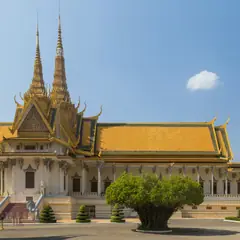
The National Museum of Cambodia opened on 13 April 1920, in the middle of the Khmer New Year, before King Sisowath and under the name Musée Albert Sarraut, in honour of the Governor-General of Indochina. It was designed by George Groslier, the first French child born in Cambodia, enlarging the temples shown in the ancient bas-reliefs, and that terracotta pavilion, raised between 1917 and 1924, ended up as the template for what is now taken to be traditional Khmer architecture.
Its history is not only one of stone. Between 1975 and 1979 it was closed and abandoned, its first two Cambodian directors were murdered under the Khmer Rouge and around 2001 between one and two million bats lived in its attic. Today it is also a home for the returned: in February 2026 74 looted pieces that had passed through the hands of the British dealer Douglas Latchford went on display here.
Highlights
- Terracotta façade — 54 by 66 metres on a two-and-a-half-metre plinth
- Doors and shutters carved by students of the School of Cambodian Arts
- The original Leper King, a 12th-century figure of Yama, in the courtyard of the four ponds
- The empty space of the Reclining Vishnu, the largest known bronze of Khmer art
- Jayavarman VII and the Koh Ker statues returning after looting
The history of the National Museum of Cambodia begins with a foundation stone laid on 15 August 1917, although Albert Sarraut’s decision to create the museum is dated by sources to 1914 or to May 1917, when George Groslier arrived in Phnom Penh. The red pavilion that stands beside the Royal Palace was born paired with the School of Cambodian Arts, today the Royal University of Fine Arts, and passed into Cambodian hands on 9 August 1951; in 1966, Chea Thay Seng, trained at the École du Louvre, became its first Cambodian director. Groslier himself died on 18 June 1945, after being interrogated and tortured by the Kempeitai during the Japanese occupation, and his role is still debated: a benevolent guardian of Khmer art for some, a paternalistic gatekeeper of a colonial cultural policy for others, while recent research stresses that Cambodian artists and officials co-created the museum and the school. What to see at the National Museum of Cambodia goes well beyond its display cases: there are pieces that have taken more than a century to be whole again, such as the Harihara of Phnom Da, whose head spent 126 years in Paris. That thread between architecture, looting and return is best followed by walking the galleries with the audio guide, stop by stop.
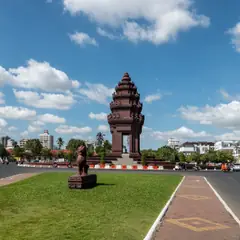
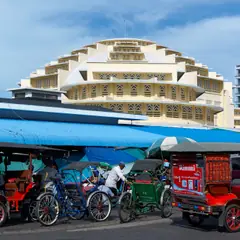
The museum is less than 300 metres from the Royal Palace, which Sisowath rebuilt between 1912 and 1919. The modern rereading of Khmer architecture continued in Vann Molyvann’s Independence Monument, which echoes the ancient Khmer temples, and the French protectorate left another period building a kilometre away, the Art Deco Central Market of 1937.
A Khmer temple invented in 1917
National Museum
Summary of this stop
The visit starts in the garden, in front of the eastern terracotta façade: superimposed roofs, pediments with nagas and a building 54 metres wide by 66 deep, raised on a two-and-a-half-metre plinth. The two end wings were added in 1924 and made it even more imposing.
The architecture of the National Museum of Cambodia is deceptive at first sight. What looks like the archetype of a Khmer temple is a reinterpretation by Groslier, who took the temple prototypes shown in the ancient bas-reliefs, enlarged them and adapted them to the colonial criteria of a museum. The result later became the model of what is taken to be traditional Khmer architecture.
The inauguration, on 13 April 1920, coincided with the Khmer New Year and brought together King Sisowath, the Resident Superior François-Marius Baudoin and Groslier himself. At this point the narration reveals why such a recent building passes for eternal.
Carved doors and a thief named Malraux
Carved entrance doors
Summary of this stop
On the plinth wait the great doors and shutters of carved wood, the work of the young Khmer craftsmen of the School of Cambodian Arts, founded in 1917 and located behind the museum. Those same students painted the interior panels with mythological themes, which remain in place. In front of the door, a statue of Garuda, king of the birds, points with his right hand to the clockwise direction of the tour.
Here appears the tension that runs through the whole museum: who protects this art and who covets it. In 1923, a 22-year-old André Malraux aroused Groslier’s suspicions by speaking again and again of the commercial value of the pieces of the Sarraut Museum. In December he tore four devatas from Banteay Srei; Groslier identified the crates in Kampong Chhnang and the police arrested him on arrival in Phnom Penh.
In July 1924 Malraux was sentenced to three years, a penalty later reduced on appeal. At the door the audio guide reconstructs how the trail of those crates was followed.
The empty space of the Vishnu a farmer dreamed
Space of the bronze Reclining Vishnu
Summary of this stop
The eastern gallery gathers Khmer bronzes of the 6th to 13th centuries in display cases that are part of the original furniture of the 1920s. In its north-eastern corner the great Reclining Vishnu of the Western Mebon is exhibited, the largest known bronze of Khmer art: complete it measured about six metres and today less than a third survives. Found in 1936 and in the museum since 1950, it has been on tour since 2025 in Paris, Minneapolis and Washington, and is on display in San Francisco until 25 January 2027, so its space is today an absence.
That absence holds a transmitted account of its discovery. In December 1936, a farmer from the Angkor area is said to have dreamed that a buried Buddha asked him to free it from the ground, and he guided the curator Maurice Glaize, of the École française d’Extrême-Orient, to the temple of the Western Mebon, in the middle of Angkor’s largest reservoir. At the end of a causeway appeared a bronze Vishnu, and no Buddha.
The confusion went back a long way: at the end of the 13th century, the Chinese diplomat Zhou Daguan had already described in that temple a large Buddha from which water flowed. How two views six centuries apart fell into the same error is left for the narration in that corner.
The Leper King under the bats’ roof
Leper King pavilion
Summary of this stop
In the centre of the square courtyard, with four ponds, a garden and palm trees, a pavilion shelters the original sandstone of the so-called Leper King: a 12th-century figure, naked and seated with the right knee raised, taken from the terrace of the same name in Angkor Thom, where a copy is seen today. Its identity is debated. Popular belief associates it with a leper king, Jayavarman VII or Yasovarman I, without historical support; an inscription of the 14th-15th centuries links it with Yama, god of death and judgement, and other hypotheses point to Kubera or to the lichen that covered the stone.
Under these roofs the museum’s wound was lived. Between 1975 and 1979 it was closed and abandoned with the evacuation of Phnom Penh: the roof rotting, an enormous colony of bats, the garden overrun with weeds and the collection in disarray, with pieces damaged or stolen. It was cleaned in haste and reopened on a 13 April, in 1979 according to most sources and in 1980 according to others. Around 2001 between one and two million bats of four species lived in the attic, perhaps the largest colony in the world in a man-made structure, and the guano mixed with rainwater dripped on the works until in 2002 the director Khun Samen sealed the roof.
Harder still was the human loss. Of the some ninety curators and commissioners trained by the French, most had been murdered; Meas Khim was the first surviving employee to return, in 1979, and on reopening only six of the former workers had come back. Many of the new ones were relatives of dead colleagues. Beside Yama, the audio guide tells how that staff was rebuilt.
Jayavarman VII and the gods who return
Statue of Jayavarman VII
Summary of this stop
The western gallery, devoted to the Angkor Wat and Bayon styles (12th-13th centuries), gathers around the seated statue of Jayavarman VII a story of repair. Henri Marchal found its fragments at Angkor in 1924 and Groslier assembled them in late 1934; in 1998 the museum’s restoration team noticed that the assembly was badly done and in 1999 it was taken apart. Among the pieces that turned up were a left forearm, in 1924, and fragments of the right hand, in 1990. The archaeologist Michel Tranet maintained that they belonged to the king without being able to check it, until in 2019 a 3D scan confirmed that the breaks matched almost one hundred per cent. In January 2023 the museum’s stone workshop rejoined arm and hand.
Nearby wait the 10th-century sandstone figures from Koh Ker, with breaks at ankle height that betray the looting. The Duryodhana of Prasat Chen, torn from its pedestal around 1972 and put up for sale by Sotheby’s, returned in 2014 together with the Bhima and the Balarama, and the three passed to the restoration team to reunite them with the pedestals where their severed feet still remained. In 2023 a Ganesha of almost four tonnes looted from the temple of Bak arrived from the United States, received with lotus flowers and a glass of water.
The museum also works as a place of worship: in 2000 the permanent exhibition of post-Angkorian Buddhas opened, with UNESCO support, and attendants in silk sarongs hand out garlands of white jasmine that visitors raise to their foreheads as they bow before the statues. The close of the tour explains why here the stone still receives prayers.