National symbol
Independence Monument Audio Guide
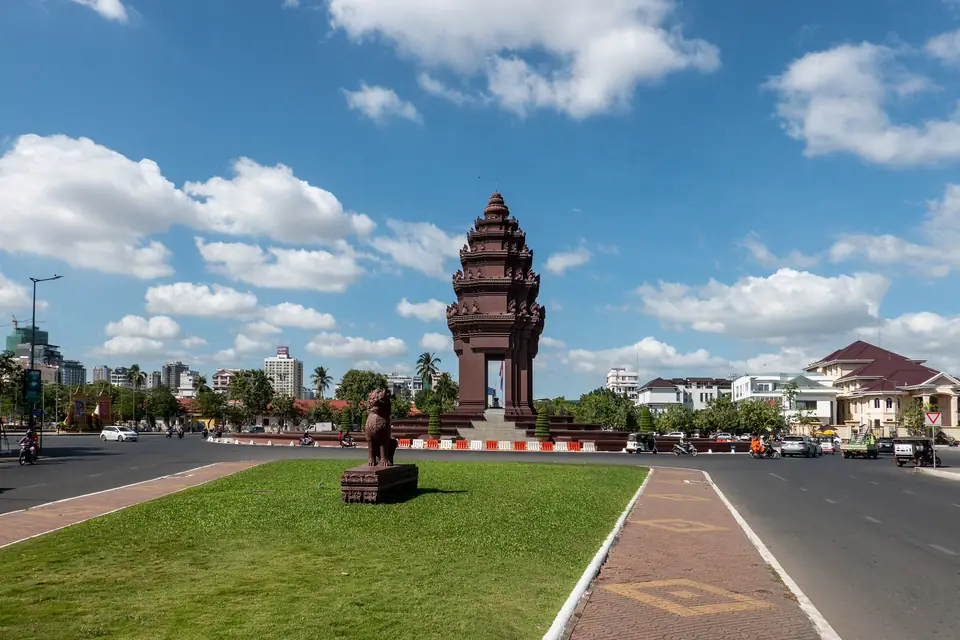
A lotus-bud tower bristling with nagas that celebrates the end of French rule in the centre of Phnom Penh. It looks like ancient stone and is a modern work by Vann Molyvann, built over old canals.
- 20 min of audio
- Architecture by Vann Molyvann
The Independence Monument commemorates the independence from France of 1953. It was designed by the Cambodian architect Vann Molyvann on the personal commission of Prince Norodom Sihanouk, who wanted a work able to unite the religious and the secular. Construction began in 1958 and the official inauguration came on 9 November 1962, on the ninth anniversary of independence. The five-level tower, in the form of a stupa shaped like a lotus bud, is inspired by the Khmer temple of Banteay Srei and rises on the roundabout where Norodom and Sihanouk boulevards cross.
Its reddish tone recalls the sandstone of Banteay Srei but, according to the construction documentation, it contains not a single block of stone: it is reinforced concrete clad in crushed red marble. An ancient bridge turned up buried under its foundations, and the flame celebrating the end of French rule was, it is said, commissioned from the best French goldsmith.
Highlights
- Five-level lotus tower with a hundred naga heads
- A modern Mount Meru surrounded by fountains evoking its oceans
- The buried bridge and the construction delay that no one has explained
- The flame of victory, lit by the king every 9 November
- Norodom Sihanouk memorial — 4.5-metre bronze statue
The history of the Independence Monument begins with a date, 1953, and a wait. Cambodia ceased to be a French protectorate that year, but its great symbol was not inaugurated until 9 November 1962, after works begun in 1958; many sources repeat that it was built or even inaugurated in 1958, and some even give 1955. The architecture of the Independence Monument bears the signature of Vann Molyvann, who had returned from Paris in 1956 as one of the very few qualified Cambodian architects and was named head of Public Works and State Architect. In Phnom Penh, however, other names were always mentioned: the decorator Seng Suntheng, who according to rumour was involved before him, and a team in the style of the Khmer tradition that included the sculptor and mason Tan Veut, author of the network of piles on which the platform rests, and the sculptor Chieng Suon. Since 1980 the tower has appeared on riel banknotes, from the 5-riel note of the first series after the Khmer Rouge abolished money to a 2021 commemorative note that prints it next to the Eiffel Tower. All of that, together with what it means to the country today, is best understood by walking it with the audio guide, from the tower to the memorial of the king who commissioned it.
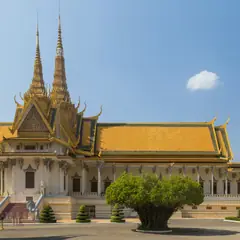
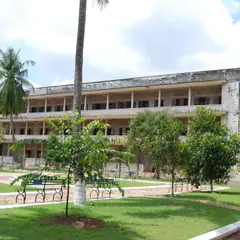
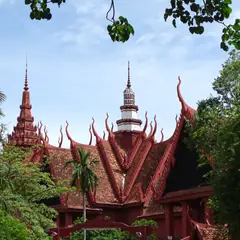
Sihanouk’s commission leads to the Royal Palace, less than a kilometre away, and the look to ancient temples to the National Museum of Cambodia, whose terracotta pavilion had already reinvented Khmer architecture. 1.4 km away, the classrooms that opened in that same 1962 are today the Tuol Sleng Genocide Museum.
A lotus of nagas commissioned in pyjamas
Lotus-bud tower
Summary of this stop
The visit starts at the western end of the park, from where the tower is seen whole. It is a stepped stupa in the shape of a lotus bud, reddish in tone, narrowing towards the tip in five levels. Most sources give it a height of 37 metres, although the Khmer-language Wikipedia and some guides speak of 20. Its model is linked to the temple of Banteay Srei, although others relate it to Angkor Wat or to the Bakong.
The five levels are decorated with a hundred naga heads, the mythical many-headed serpent of Khmer art. Reading the tower from bottom to top is the way to understand Norodom Sihanouk’s commission: a monument that united the religious and the secular to celebrate independence from France.
According to a documented tradition, the first meeting between Vann Molyvann and Sihanouk was precisely to talk about this monument: Prime Minister Penn Nouth took the young architect to the Royal Palace first thing in the morning and the head of state received him there still in pyjamas. What Sihanouk said on the day of the inauguration, and what he left unsaid, is left for the narration on site.
A sacred mountain over a buried bridge
Fountains at the base
Summary of this stop
Around the base, the rectangular structures that were once flower beds became fountains. The Phnom Penh municipality began installing water jets and coloured lights in June 2007, in a remodelling that by the end of that year cost some 500 million riels. The water is no ordinary ornament: for Vann Molyvann the tower, like Angkor Wat, represents the sacred Mount Meru of Hindu and Buddhist cosmology, surrounded by oceans on all sides.
The architect himself explained in 2007 that he had already foreseen those “oceans” when starting the work. It made sense: before the French redesigned the city in the early 20th century, there was a network of canals here.
That terrain is the clue to a riddle that remains unsolved. There are plans of the monument dated 1957 in the National Archives, a contractor who, according to Molyvann, lost two years with piles he could not drive deep enough, and a minister who blamed the ground, an old arm of the Bassac where the Kaun Kat bridge turned up buried. Why the inauguration was delayed until 1962 no one has fully explained.
The flame that burns for only three days
Victory flame pedestal
Summary of this stop
In front of the staircase, up close, the reddish surface tells another story. According to the construction documentation, what looks like sandstone is a reinforced-concrete skeleton clad in panels and nagas finished in crushed red marble, with steps of grey Chinese marble. And the flame of the monument to independence from France was, it is said, commissioned from the best French goldsmith.
At the heart of the monument is a pedestal that stays empty for most of the year. Every 9 November King Norodom Sihamoni lights the flame of victory there, which burns for three days until he himself puts it out on 11 November; in 2017 the ceremony lasted an hour and a half and drew some 15,000 people, and on those days the stairs fill with floral offerings. After the Khmer Rouge regime (1975-1979), the monument also became a memorial to the lives lost in the war.
At night, red, white and blue spotlights bathe the upper levels: the colours of the Cambodian flag, which are also those of the French one. Vann Molyvann was not interested in that lighting for a monument to independence, and said so in 2007 in a phrase the audio guide recovers at this point.
The father of independence cast in bronze
Statue of Norodom Sihanouk under his stupa
Summary of this stop
The tour ends in the park east of the monument, in front of the Norodom Sihanouk memorial: a 4.5-metre bronze statue of the King Father, in a suit, under a 27-metre stupa. It was inaugurated on 11 October 2013, cost 1.2 million dollars and the opposition did not attend the ceremony.
The man who commissioned the tower thus closes the axis that it opens. To imagine how all this looked when newly finished there is an aerial image taken around 1963 by Micheline Dullin, official photographer of the palace, from helicopters that Sihanouk himself chartered for her; the print is kept in the National Gallery Singapore. What that photo reveals about the original landscape is told at the end of the narration.