Origin of the city
Wat Phnom Audio Guide
The only hill in Phnom Penh is a hand-made mound, and from it the capital took its name. At the top stand the stupa of a 15th-century king and the shrine of Grandmother Penh; at the foot, a colonial monument celebrates Angkor’s return to Cambodia.
- 40 min of audio
- Pagoda on an artificial hill
According to tradition, in 1372 a rich old woman named Penh pulled a log with sacred statues out of the river and had a mound raised to house them: hence Wat Phnom and hence Phnom Penh, “Penh’s hill”. On that artificial rise, the only one in an almost flat city, follow one another the stupa of King Ponhea Yat, built in 1433-1434, the stupas added by Dharmaraja II in 1485 and a vihara rebuilt in 1926, with a large bronze Buddha and murals of the Reamker, the Khmer version of the Ramayana.
The sacred hill also has its less solemn chronicle. At its foot, for thirty years, waited Sambo, the elephant who survived the Khmer Rouge and gave visitors rides for 25 cents. In its trees, the macaques became a public-order matter, with a 20-kilo male shot dead in 2008. And among the cages of little birds bought to be released and make a wish, many birds end up recaptured and sold for another release.
Highlights
- Hand-made hill — the only rise in the city and the origin of its name
- Ponhea Yat stupa — a king’s ashes and some 10,000 precious stones
- Grandmother Penh shrine — jasmine, lotuses and wishes paid for in bananas
- 1926 vihara — bronze Buddha and murals of the Jataka and the Reamker
- Sisowath monument — the 1907 treaty that returned Angkor to Cambodia
The history of Wat Phnom is the history of the capital’s name. “Phnom” means hill in Khmer and Penh is the old woman to whom tradition attributes the founding of the temple in 1372, although some sources give 1373 and the story was not written down until nearly a century later. The hill is about 27 metres high, a figure that other sources apply to the stupa at the summit, and it is man-made. On it were added in turn the ashes of King Ponhea Yat, the royal endowment of Dharmaraja II in 1485, the vihara of 1926 and, at the foot, the 1909 monument to the Franco-Siamese treaty that returned Angkor to Cambodia. It is also said that during the Siamese bombing of 1941 the neighbours took refuge here and no bomb exploded in the compound; since then the shrine of the guardian spirit Neak Ta Preah Chau, east of the hill, has received a steady flow of offerings, above all from Cambodians of Chinese origin. Each stretch of the hill holds a different century, and the audio guide puts them in order, stop by stop.
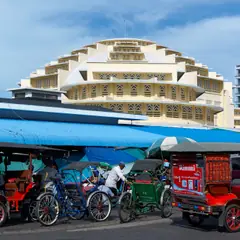
A kilometre away, the Central Market spreads its 1937 Art Deco dome, and about 1.6 km away, by the river, the Royal Palace is still the residence of the kings of Cambodia.
A concrete king receives Angkor
Sisowath monument and flower clock
Summary of this stop
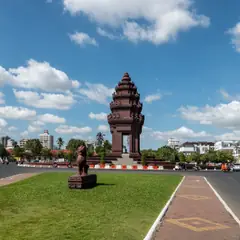
The tour starts at the southern foot of the hill, in front of a bronze monument of 1909 by Théodore Rivière. It celebrates the Franco-Siamese treaty of 15 March 1907, by which Siam returned to Cambodia Battambang, Siem Reap, with Angkor, and Sisophon. King Sisowath appears on his throne receiving from three women the symbols of the three provinces, beside the letters “RF”, a Khmer soldier in French uniform and flag, and the inscription of the treaty: the recovery of Angkor told under colonial tutelage.
The figure of the king seen today is not the original. It is a concrete copy commissioned by the city council in January 1998, because the bronze was moved to the National Museum after the coup d’état of 18 March 1970.
Opposite, on the lawn, stretches a flower clock about 20 metres in diameter, a gift from China installed in April 2000 to replace the old French clock of the early 1960s. The narration on site explains what each piece of this first group tells and what it says about its era that the Angkor scene carries a French flag.
The elephant who no longer waits below
Eastern naga staircase
Summary of this stop
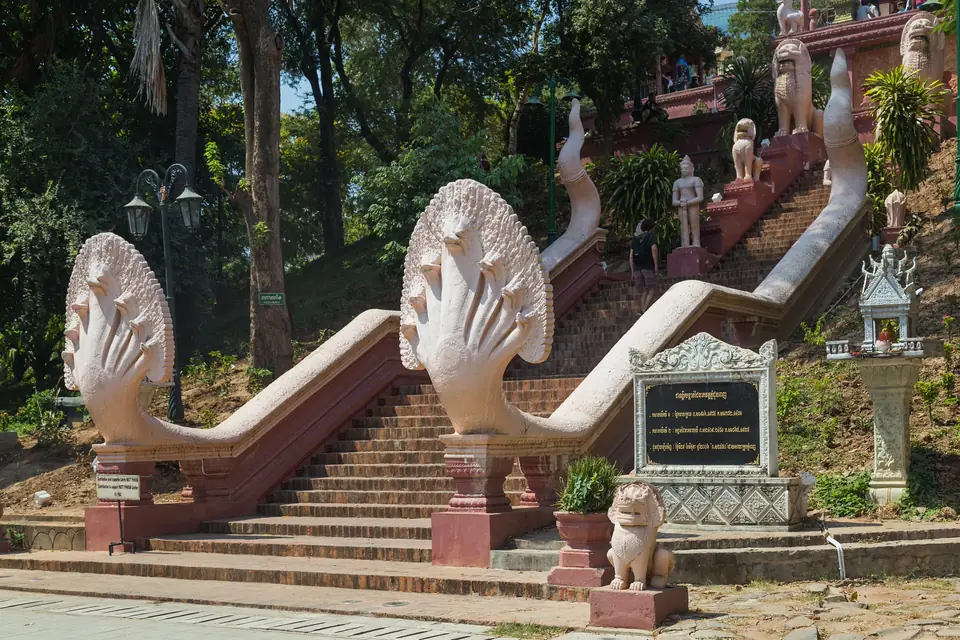
The eastern staircase, flanked by two nagas and guardian lions, leads to the main entrance of the temple. At its foot an absence is noticed: there is no elephant any more. For three decades Sambo waited there, the elephant who in 1977 survived the machete attack by the Khmer Rouge on the five elephants of Sin Son’s family.
The reunion is one of the most remembered episodes of the hill. In 1979, back from a labour camp, Sin Son found his village empty; the only surviving neighbour told him that Sambo was still alive on a farm in the Cardamom Mountains. He pedalled three days by bicycle to get there and, before owners who did not believe him, called her by name: the elephant came out of the forest behind the house. He got her back in exchange for a buffalo, in 1980 took her to Phnom Penh, where the cars terrified her, and in 1982 built a staircase at the foot of Wat Phnom to sell rides at 25 cents.
The rides lasted until 2012, when a leg infection and complaints about traffic jams retired her. In 2014 she travelled to a sanctuary in Mondulkiri, where she died in October 2023 aged 63; she was the last working elephant in the capital. The audio guide recovers at this point what Sambo meant to those who passed under her trunk.
A log in the river, a temple above
Wat Phnom
Summary of this stop
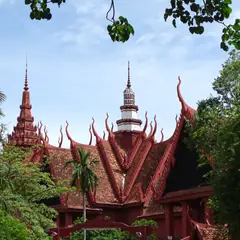
At the top stands the vihara, the main sanctuary, with roofs in traditional Khmer motifs. It was rebuilt several times in the 19th century and again in 1926, and the current building is the one from that date. Inside, a large seated bronze Buddha presides over the altar among statues, flowers and candles, and the walls are covered with murals of the previous lives of the Buddha, the Jataka, and scenes from the Reamker; the paintings in the lower registers are more recent.
This is the place of origin. According to tradition, during a flood in 1372 the old woman Penh pulled out of the river a koki tree log with statues inside, had a mound and a small wooden temple raised to house them, and the monks called the hermitage Wat Phnom. Exactly which images there were varies by version: four Buddhas and a Vishnu, a jade Vishnu, a gold Buddha, a bronze Indra and a brass Budai, or four bronze Buddhas and a stone goddess.
That mound is the very hill one steps on: a hand-made rise in an almost flat city. The narration right there links the log in the river with the shrine that replaced it centuries later.
The ashes of the king who brought the court
Ponhea Yat stupa
Summary of this stop
West of the vihara rises the great white stupa of Ponhea Yat. After the flooding of the old capital, Tuol Basan, in 1396, the king ordered a palace built beside Wat Phnom. The earth was taken from the place where the Central Market stands today and the hole formed Lake Boeung Decho. The court moved to the river confluence in 1397, although other sources place the move in 1431 or in 1434.
The stupa was built by his eldest son, Noreay Reamea, between 1433 and 1434 to hold his father’s ashes, and on completing it he placed in it some 10,000 precious stones. Half a century later, in 1485, Dharmaraja II added two more stupas for the remains of his lineage and endowed the temple in a very precise manner: 21 villages, 21 rice fields, 21 male servants, 21 female servants, 21 ox carts, 21 horses and 21 elephants.
Before this mass one understands how a modest hill came to be tied to the birth of the capital. The audio guide completes on site the story of this endowment, told in twenty-ones.
Grandmother Penh charges in jasmine
Daun Penh shrine
Summary of this stop
In the south-west corner of the summit, beside the temple and the stupa, a small pavilion holds the polychrome statue of Daun Penh, Grandmother Penh. It was made in the 1990s, at the end of the civil war, and before it the faithful leave jasmine, lotuses, prayers and food for the woman to whom the founding is attributed.
It is also the point where legend crosses the map. From her comes the name of the city, Phnom Penh, “Penh’s hill”, although her story was not written down until nearly a century after the date assigned to it.
The devotion is still alive and has its rules. According to popular belief, Grandmother Penh is asked for passed exams and good business, but the deal is a promise: whoever sees a wish granted must come back with the offering promised when asking, a jasmine garland or bananas, which the spirits especially like. The narration closes the tour here with what this custom reveals about the founder.