Art Deco monument and shrine
Christ the Redeemer Audio Guide (Cristo Redentor)
Thirty metres of concrete on the summit of Corcovado, paid for by donations and clad in thousands of stone triangles with names and prayers written on the back. A perfect silhouette that, up close, turns out to be a collective patchwork.
- 90 min of audio
- Art Deco and viewpoint
The idea of a Christian monument on Corcovado arose in the mid-nineteenth century, but the statue that now embraces Rio did not arrive until 12 October 1931. It was not a gift from France: the Archdiocese relaunched the project in 1921 and it was paid for mostly by Brazilian Catholics. The engineer Heitor da Silva Costa conceived it, Paul Landowski modelled it in his workshop near Paris and Albert Caquot designed a reinforced-concrete structure instead of steel, better suited to a cross-shaped figure.
Its whole skin is a mosaic of soapstone triangles about 3 cm across. Volunteers, mostly women, glued them onto cloth sheets, and on the backs they wrote petitions, blessings and names. That skin takes an average of six lightning strikes a year, and each restoration patches it with stone from the same quarry, increasingly darker.
Highlights
- Open arms — 28 metres from arm to arm, with 3.2 m hands repaired after lightning strikes
- Christ’s face — a 3.75 m head weighing 30 tonnes, assembled from 50 pieces
- Pedra-sabão mosaic — soapstone triangles about 3 cm across with names written on the back
- Chapel of Nossa Senhora Aparecida — in the pedestal, a Catholic shrine since 2006
- Trem do Corcovado — a rack railway from 1884, older than the statue
The history of Christ the Redeemer begins with a refusal. In 1888, after the Lei Áurea, Princess Isabel turned down a statue representing her as ‘the Redeemer’ and asked that the tribute go to the Sacred Heart of Jesus. The Republic of 1889 and the separation of Church and State shelved the project, and it was not until 1921 that the Archdiocese of Rio rescued it with a petition signed by 20,000 Brazilian women. The magazine O Cruzeiro, of Assis Chateaubriand, also opened a public subscription that raised 2,500 contos de réis.
The result is a 30-metre figure on an 8-metre pedestal, 28 metres from arm to arm, which on 12 October 2006, its 75th anniversary, became a Catholic shrine. But its history and architecture are not read in the postcard silhouette, only in the details: a telephone antenna, a Romanian sculptor, stone tesserae with written names and an ill-timed cloud. All of it makes sense when walking the summit of Corcovado from the station to the viewpoint, with documented narration that reveals each piece in its place.
The visit combines well with Sugarloaf Mountain, the other great lookout over Guanabara Bay, and with Copacabana Beach, below, facing the Atlantic.
A train older than the Christ
Trem do Corcovado upper station
Summary of this stop
The tour starts on the arrival platform of the Trem do Corcovado, a 3,824-metre rack railway that Emperor Pedro II inaugurated on 9 October 1884 and that was electrified in 1910. It predates the statue: for four years it carried the statue’s pieces up to the summit along the same route visitors use today.
Before the Christ, other things stood up here. From the late nineteenth century the summit was occupied by the Chapéu de Sol lookout, a 13.5-metre-wide pavilion of iron, glass and slate weighing 46 tonnes, which the Light company had to move when work began. And the idea of crowning the mountain with a Christian monument dated from the middle of that century, from the priest Pedro Maria Boss.
Between the emperor, the iron pavilion and the princess who did not want to be a statue, this first stop sets the scene for understanding why the figure waiting a few metres higher took so long to arrive. What had to happen for the project to revive is what the audio guide tells on the platform.
The arms that came from an antenna
Christ the Redeemer
Summary of this stop
Facing the statue, the scale takes over: a 30-metre figure, 28 metres from arm to arm, hands of 3.2 metres weighing 8 tonnes each, and a 3.75-metre head of 30 tonnes assembled from 50 pieces. That human cross was not in the first design. Heitor da Silva Costa won the competition with a Christ holding a cross and a globe, and the cariocas, so the story goes, soon nicknamed it ‘Cristo da Bola’, because they saw a football where the world should be.
In 1924 the telephone company installed an antenna on the summit with 16-metre horizontal arms, and Silva Costa saw it from his home in Botafogo as a gigantic cross; he redrew the design and the planned height dropped from 42 to 38 metres. The origin of the open arms is still disputed: some sources credit the painter Carlos Oswald, others that antenna, and the engineer himself wrote in 1931 that he was influenced above all by the statue of San Carlo Borromeo in Arona.
The face looking toward Guanabara Bay is mostly attributed to the Romanian sculptor Gheorghe Leonida, born in Galați and hired by Landowski in Paris, although some sources give the head to Landowski himself. Who Leonida was and how his life ended in Bucharest is one of the stories the narration saves for this point.
Stone triangles with prayers on the back
Soapstone mosaic of the robe
Summary of this stop
At the foot of the pedestal, the statue’s surface stops being smooth and becomes a grid of small triangles of greenish soapstone, the pedra-sabão brought from Carandaí, in Minas Gerais. Volunteers glued them onto cloth sheets before the workers applied them, and on the backs they wrote petitions, blessings, prayers and names that are still there, hidden beneath the giant’s skin.
That skin is full of scars. The statue takes an average of six lightning strikes a year: one damaged fingers, head and eyebrows on 10 February 2008, and another knocked off a finger of the right hand on 17 January 2014. The 2010 restoration employed a hundred people and more than 60,000 pieces from the original quarry, but the pale soapstone no longer exists in sufficient quantity and the replacement tesserae are increasingly darker. The 2014 one, paid for by the Archdiocese and Pirelli, extended the lightning rods.
In the middle of the 2010 works, with the statue covered in scaffolding, the monument also lived through a night Rio has not forgotten, when its face and arms woke up turned into a banner. What those graffiti said and who climbed up there is the story told in front of the mosaic.
The cloud that dimmed the premiere
Chapel of Nossa Senhora Aparecida
Summary of this stop
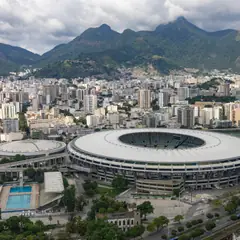
The balustrade of the viewpoint, beside the chapel of Nossa Senhora Aparecida, opens the full panorama: Pão de Açúcar, the Lagoa Rodrigo de Freitas, Copacabana, Ipanema and the Maracanã, with the Tijuca forest behind the statue. At the base, the small chapel hosts masses, weddings and baptisms; the Archdiocese manages the statue, and access depends on Tijuca National Park.
The monument was inaugurated on 12 October 1931, the feast of Nossa Senhora Aparecida, with four special trains for the guests and Getúlio Vargas present. The lighting was planned to be triggered by radio from Italy by Guglielmo Marconi, although sources disagree on whether the signal actually switched on the lights or whether they were operated from Rio. What is on record is that that night a dense cloud hid the statue from the public.
Today the figure communicates with the city in a different way. Since 2008 it has been lit in colours for various causes, and sometimes it is deliberately switched off. How that custom began, with a material that lasted no more than twenty minutes, is the close of the tour.