Urban tile art
Selarón Steps Audio Guide (Escadaria Selarón)
A penniless Chilean painter single-handedly covered a public staircase between Lapa and Santa Teresa in tiles, using pieces rescued from rubble and sent from half the world. He promised he would finish it only on the day he died, and the staircase is still unfinished.
- 30 min of audio
- Mosaic and tilework
In 1990, Jorge Selarón, who lived beside the staircase, began renovating on his own the worn steps that ran past his house. The work ended up covering all 215 steps of the Escadaria do Convento de Santa Teresa, which climb some 125 metres from Rua Joaquim Silva, in Lapa, to the Ladeira de Santa Teresa. It was done with no patron and no public or corporate money: the artist paid for it by selling his paintings.
The first tiles came from building sites and rubble heaps on Rio’s streets, in green, yellow and blue, the colours of the Brazilian flag, and the neighbours mocked him for that combination. That run-down passage in Lapa is now one of the city’s most visited tourist spots, protected by the City Council and declared municipal heritage.
Highlights
- 215 steps — some 125 metres of tiles between Lapa and Santa Teresa
- Tiles from around the world — more than 2,000 pieces donated from more than 60 countries
- The pregnant woman — some 300 pieces hand-painted by Selarón
- Pregnant self-portrait — the circular mosaic at the foot of the staircase
- Dona Elena’s tile — the artist’s apology to his landlady over the rent
The history of the Selarón Steps begins with a neighbour and a stretch of broken steps. Jorge Selarón, a Chilean painter settled beside the staircase that links Lapa with Santa Teresa, began fixing it on his own; most sources put the start in 1990, although others say 1994 and link it to a football World Cup. With no patron, no incentive laws and no public money, he financed it by selling his paintings with a slogan that said it all: ‘Compre uma pintura minha, que eu preciso concluir a obra’.
For years, Selarón himself was part of the landscape: thick moustache, red shirt, jeans and flip-flops, cleaning the steps every day and posing with tourists with a hand raised and his tongue out. He kept saying that this ‘crazy and unique dream’ would end only on the day of his death. What to see at the Selarón Steps, where each tile came from and why the work remains open are best understood by climbing it step by step, with documented narration that reveals each stretch in its place.
From Lapa, the walk through the centre continues well toward the port area, where the Pedra do Sal, home of Rio’s samba, and the Museum of Tomorrow, on Pier Mauá, wait.
A neighbour’s whim in Lapa
Escadaria Selarón
Summary of this stop
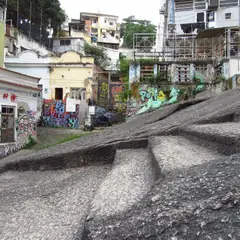
The tour starts at the foot of the staircase, on Rua Joaquim Silva, a few minutes from the Arcos da Lapa. From below, the whole ramp of colour can be seen climbing toward Santa Teresa: the 215 steps of what is officially the Escadaria do Convento de Santa Teresa, on Rua Manoel Carneiro, some 125 metres of climb up to the Ladeira de Santa Teresa. The figures, mind you, vary by source, and some even speak of 250 steps.
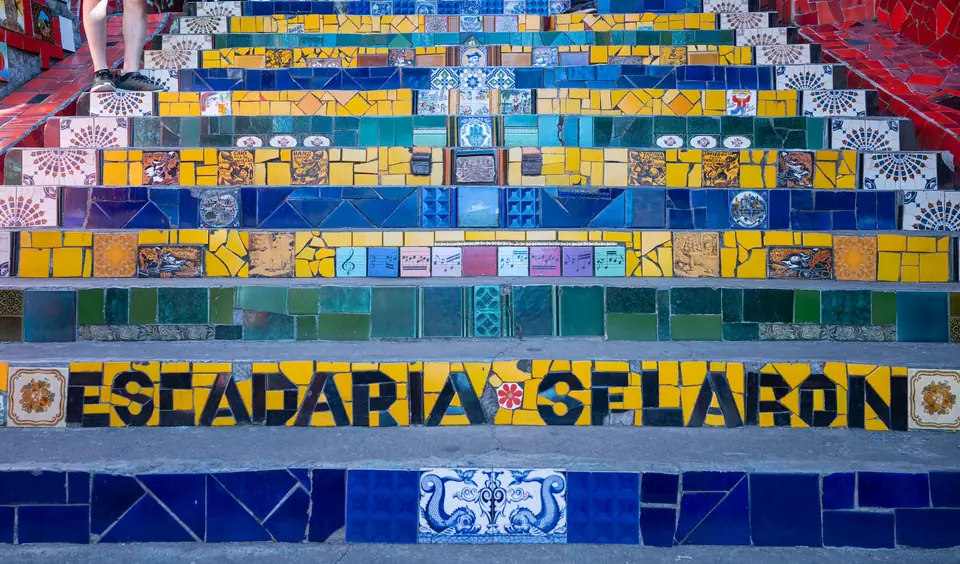
The first stretches were covered with fragments of green, yellow and blue tiles, the colours of the Brazilian flag, and the neighbours laughed at Selarón for that combination. Side walls of red tile now frame the whole like a great picture frame, the same red the artist wore on his shirt.
Right here, at the foot of the steps, a baffling circular mosaic appears: the body of a pregnant woman with Selarón’s head. He justified it by saying he had painted her so many times that he had ended up pregnant himself. Who that woman was is the question that accompanies the whole climb.
Rubble from Rio, gifts from the world
Tiles from countries around the world
Summary of this stop
On the second stretch the staircase changes scale: pieces with names, coats of arms, flags and motifs from dozens of countries begin to appear. The first tiles came from building sites and rubble heaps on Rio’s streets; over the years, most were donated by visitors, adding up to more than 2,000 pieces from more than 60 countries, according to the most quoted count. Many tourists climb looking for the one from their own country.
Fame came through music. The staircase appeared in the music videos for U2’s ‘Walk On’, in 2001, and Snoop Dogg’s ‘Beautiful’, and in 2009 in Rio’s bid video for the 2016 Olympic Games. According to a story told in Lapa, Selarón did not like that the world had started talking about ‘Snoop Dogg’s staircase’.
What he did about it can still be read on this stretch, written in ceramic. How an artist won his work back from a rap star is one of the episodes the audio guide keeps for this point.
An unexplained figure and a promise kept
Selarón’s house and studio
Summary of this stop
In front of the house and studio where Selarón lived, the staircase shows its most intimate side. Scattered along the steps are some 300 pieces hand-painted by him with the silhouette of a pregnant African woman. He began painting her on 12 March 1977, said he had repeated her more than 25,000 times and never explained her beyond ‘a personal problem from my past’.
Nearby appears a tile with Portuguese text in which the artist thanks his landlady, Dona Elena, for her understanding and begs her pardon for not having been able to pay her rent since he began decorating the staircase. It is the accounting of a work built without money, written on the work itself.
On 10 January 2013, Selarón, aged 65, was found dead with his body burned on these same steps, in front of his house, beside a can of solvent. The Civil Police pointed to suicide as the main line of inquiry, although a possible homicide was also investigated, and the case remains disputed. How the staircase became its own funeral monument that day is told in front of that door.
Protected heritage, work still open
Upper stretch and ‘invader’ tiles
Summary of this stop
At the top, beside the Ladeira de Santa Teresa, one sees the road travelled by a work that was once mocked. In May 2005 Rio’s City Council gave it provisional protection and named Selarón an honorary citizen of the city; in August 2015, a municipal law promoted by councillor Jefferson Moura declared it heritage of Rio and banned demolishing it or altering its artistic features. That run-down passage in Lapa is now one of the city’s most visited tourist spots.
Its fragility is also in plain sight. Ten years after the artist’s death, the staircase shows gaps, broken pieces and ‘invader’ tiles stuck on by visitors that are not part of Selarón’s work. In 2022, a Muslim organisation in Rio asked to relocate some tiles with the Arabic inscription ‘God is victorious’, and one broke and was left in municipal custody, with no date for restoration. The guides’ association Liguia inventoried the pieces with the project Selarón Pedaço(s) do Mundo, completed in 2020, and estimates between 1.5 and 4 million reais to restore it.
That inventory counted 4,994 ceramic elements, far more than the ‘more than two thousand’ that used to be quoted. The story goes that the idea was born on a Carnival Sunday, with a bus of Burmese tourists looking for a single tile; how that search ended is the close of the tour.