Calatrava architecture
Museum of Tomorrow Audio Guide (Museu do Amanhã)
A museum about the future, stretched along a pier heavy with the past. Calatrava’s solar wings move with the sun exactly where Rio once wanted a Guggenheim, beside a square that lost its viaduct.
- 90 min of audio
- Sustainable architecture
The Museum of Tomorrow occupies almost the whole length of Pier Mauá, a pier built in the 1940s and 1950s out in Guanabara Bay. Santiago Calatrava designed it between 2010 and 2015, inspired by the bromeliads of the Jardim Botânico, and the building became the centrepiece of Porto Maravilha, the renewal of 5 million m² of the port area tied to the 2016 Olympic bid. It opened on 17 December 2015 and in its first year received 1.4 million visitors, more than triple the forecast.
From outside it looks like a prehistoric animal; inside it works as a machine that breathes with the sea. The air conditioning runs on water pumped from the bay, which returns filtered to the ocean through a small waterfall, and the steel fins of the roof carry 5,492 photovoltaic panels that turn to follow the sun from east to west. In 2017 the building won, in Cannes, the MIPIM award for the most innovative green building.
Highlights
- Roof of solar wings — 5,492 photovoltaic panels that follow the sun
- Entrance cantilever — 75 metres of overhang above a 7,600 m² square
- Pier pools — water from Guanabara Bay that cools the building
- Cosmos Dome — an immersive film of about 8 minutes in 360 degrees
- Anthropocene totems — six 10-metre screens arranged in a circle
The history of the Museum of Tomorrow begins long before the museum. The pier that holds it, Pier Mauá, was built in the 1940s and its works finished in the 1950s; the neighbouring square occupies the site of the old Mineiros beach. In 2003 that same pier came close to receiving a Guggenheim designed by Jean Nouvel, until the courts halted the contract. A decade later the Perimetral viaduct came down, and on the gap it left rose Santiago Calatrava’s building, inaugurated on 17 December 2015 after works costing some 230 million reais backed by the Fundação Roberto Marinho. About 25,000 visitors came in that first weekend.
Ten years later, the museum had staged more than 60 exhibitions, and on 16 August 2026 it reached nine million visitors. What to see at the Museu do Amanhã, how its architecture works and what history lies in the port around it are really understood by walking it from the square to the end of the pier and from the Cosmos Dome to the Oca, with documented narration that reveals each piece in its place.
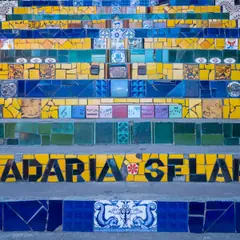
A short distance away, at the foot of Morro da Conceição, the Pedra do Sal tells the other face of the port, that of Little Africa, and in Lapa the Selarón Steps complete the walk through the centre.
The square that lost its viaduct
Praça Mauá
Summary of this stop
Praça Mauá now opens toward the bay, with the MAR and the A Noite building around it, but for decades it lived in the shadow of the Elevado da Perimetral. Construction of that viaduct began in 1957 and its stretch from the square to the Rio-Niterói bridge was delivered in 1978. From 2013, on the decision of mayor Eduardo Paes, it was torn down, and its fall became the subject of one of the museum’s first temporary exhibitions, ‘Perimetral’, curated by Vik Muniz between December 2015 and March 2016.
On the pier opposite, a contract was signed in April 2003 between Cesar Maia’s City Hall and the Guggenheim Foundation of New York for a museum by Jean Nouvel. A popular action secured an injunction that suspended it, and in July that year the president of the STJ, Nilson Naves, upheld it. The Carioca Guggenheim never came.
The square also belongs to the area known as Pequena África, through which some two million enslaved Africans arrived. When the museum opened, activists of the Black movement pointed out the irony of dedicating a museum to the future in a city without one on its slave-owning past, while other voices in the neighbourhood defended its arrival. How that debate and the gap left by the viaduct intersect is what the audio guide reveals in the middle of the square.
A bromeliad dinosaur facing São Bento
Cantilever over the square
Summary of this stop
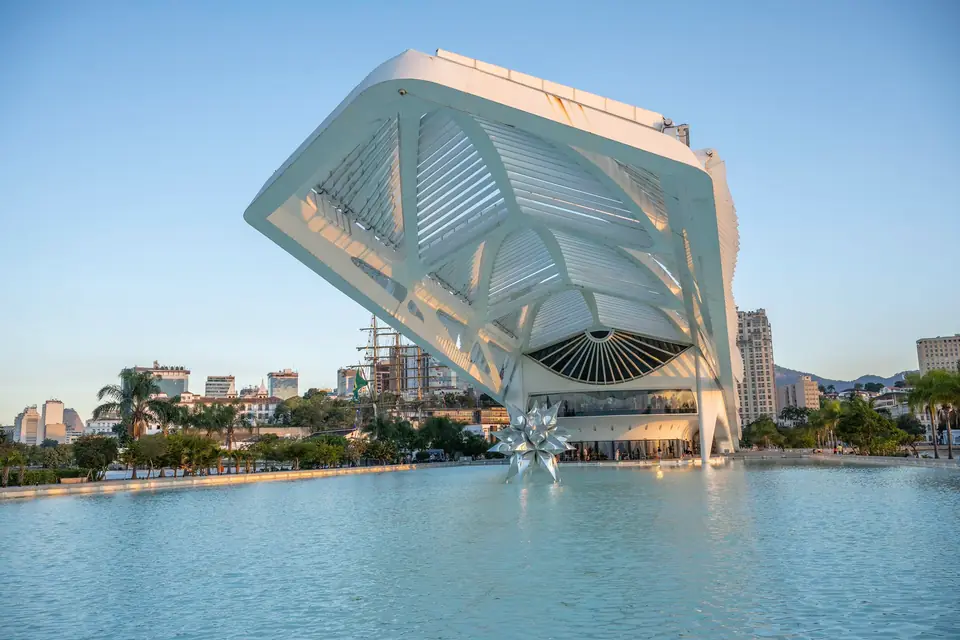
Above the entrance, the museum’s white eave overhangs 75 metres above a 7,600 m² square, held by curved ribs and with a semicircular window over the entrance; toward the sea, the roof extends another 45 metres. In this way the building occupies almost the whole length of the pier with minimal width. Calatrava said he was inspired by the bromeliads of the Jardim Botânico, but since the opening the city has looked for other resemblances: some see a solar-powered dinosaur, a giant air-conditioning unit or the exoskeleton of a prehistoric fish.
At the top of the hill, across Praça Mauá, the Mosteiro de São Bento peeks out. To avoid competing with it and with the other neighbouring monuments, the envelope was limited to 18 metres above the pier, which forced the whole programme to be spread over just two floors; the upper one has a ceiling of more than 10 metres with views of the bay. The figures are not unanimous: other sources cite a somewhat greater height.
The cost did not escape criticism either: the magazine Arquitectura Viva called the expense ‘exorbitant’ and attributed it largely to those cantilevers. And even so, in the first Christmas, in December 2015, thousands of cariocas filled the esplanade until they dubbed it ‘Rio’s new beach’. Why that nickname is the highest praise possible in this city is one of the nods the narration keeps.
The bay that cools the museum
Pier pools and waterfall
Summary of this stop
At the end of the pier, the building seems to float over the reflecting pools around it. They are not just decoration: the air conditioning uses water pumped from Guanabara Bay, which also fills the pools and returns to the sea filtered through a small waterfall at the end of the pier. The gardens of native and restinga species and the perimeter walkway allow one to circle the museum with the bay always in view.
Above, the steel fins of the roof, articulated in 24 modules, carry 5,492 photovoltaic panels that change angle through the day to follow the sun from east to west. In March 2017 the museum won, in Cannes, the MIPIM award for the most innovative green building, ahead of Siemens’ headquarters in Munich, and it was the first museum in Brazil with LEED Gold certification.
In the pool facing the bay stands ‘Puffed Star II’, by Frank Stella: a twenty-pointed metal star six metres across that the museum received as a donation in 2015, before opening. How this whole system of water, sun and steel fits together is understood by listening to it with the sea in front.
A big bang made of film-set sparks
Cosmos Dome
Summary of this stop
On the upper floor begins ‘Do Cosmos a Nós’, the main exhibition conceived by the cosmologist Luiz Alberto Oliveira, which runs through five areas: Cosmos, Earth, Anthropocene, Tomorrows and Us. The first room is a projection dome where an approximately eight-minute 360-degree film is shown, the Cosmic Portal, made by O2 Filmes, Fernando Meirelles’s production company, with Ricardo Laganaro heading the 3D direction after three years of work.
As the team itself told it, even the fire and smoke of the birth of the universe started from real scenes filmed in a studio, so that the animators could copy how a spark really moves. The idea, in Meirelles’s words, was to take the visitor out of Praça Mauá and ‘lower their pulse’. Further on, in the Anthropocene area, six luminous 10-metre totems form a circle with seats in the middle and show human impact on the planet.
A museum designed for 450,000 visits a year received 1.4 million in the first. What handmade film trick lies behind the dome’s big bang is one of the details the audio guide reserves for this point.
The churinga the museum wants to return
The Oca and the churinga
Summary of this stop
The tour ends at the Oca, a large structure inspired by the Brazilian Indigenous house, with a light that imitates dawn and dusk. At its centre, on a base painted by Mana Bernardes, stands a wooden churinga about 180 cm tall: an Australian Aboriginal ritual object from the eighteenth or nineteenth century.
José Roberto Marinho bought it at the Galerie Meyer in Paris on 7 June 2013, and since 2015 it has been on loan to the museum. The museum has now begun its repatriation in dialogue with Australian institutions, so that the area called ‘Us’ culminates in a piece that belongs to another people.
It is an ending on pause for a museum that turned ten on 17 December 2025 and already counts millions of visitors. What question that object leaves open about a tomorrow built on someone else’s memory is the close of the tour.