Temple of football
Maracanã Stadium Audio Guide (Estádio Jornalista Mário Filho)
A stadium built in 665 days on a former racecourse to be the biggest in the world, which fell silent against Uruguay in 1950 and saw Pelé’s thousandth goal. Today it is protected as heritage less for its concrete than for the way its crowd cheers.
- 90 min of audio
- Football history
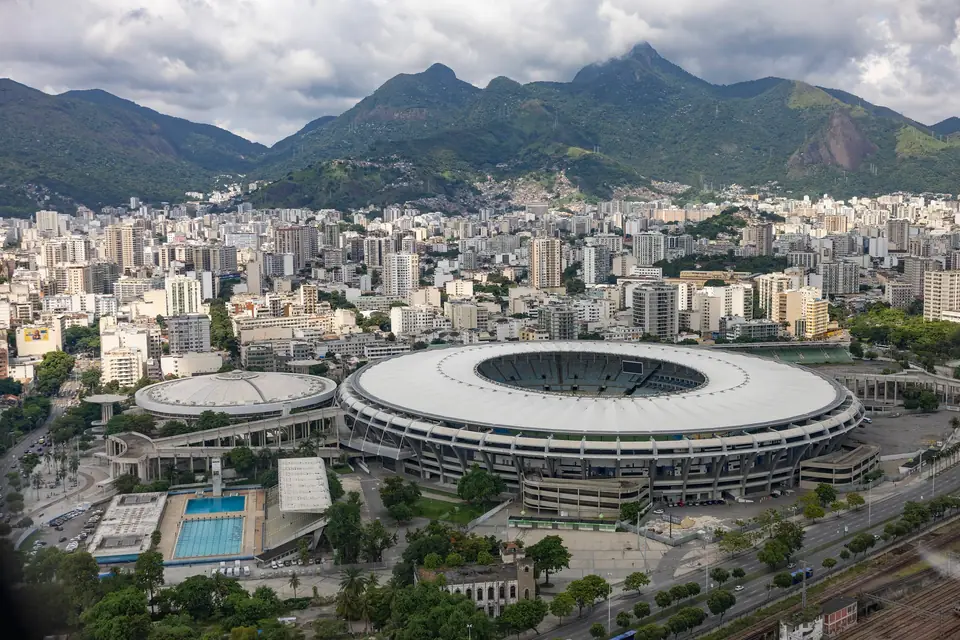
Work on the Maracanã began on 2 August 1948 on the site of the old Derby Club, where horse races were run. After 665 days of building, it opened on 16 June 1950 as the Estádio Municipal with an official capacity of 155,000, ahead of Hampden Park in Glasgow: it was the biggest stadium in the world. Its official name honours Mário Filho, the journalist who defended its construction in the Jornal dos Sports.
Little remains of the 1950 stadium beyond its façade. The 2010-2013 renovation demolished the original two-tier stands and in 2011 its concrete canopy came down. Even so, when IPHAN protected it in 2000, it did so not for its architecture but for the way of cheering and the culture of the torcidas that fill it.
Highlights
- Estátua do Bellini — a 1960 bronze raising the Jules Rimet Cup in front of the main entrance
- Calçada da Fama — footprints of Pelé, Zico, Jairzinho, Eusébio and Beckenbauer
- Membrane roof — a 68-metre overhang above 95% of the seats
- Maracanazo goal — the 2-1 for Uruguay that silenced the stadium in 1950
- Dressing-room tunnel — the route onto the pitch followed by the guided tour
Nobody calls it by its official name. The plaque names the journalist Mário Filho, but all of Rio says Maracanã, like the river that runs through the area and like the maracanãs, birds that were plentiful here before the concrete arrived. The stadium was born of an outsized gamble: a Municipal Stadium of at least 150,000 seats, defended in the Jornal dos Sports against the criticism of the congressman Carlos Lacerda, who denounced the cost and wanted it in Jacarepaguá. It was raised in 665 days on the track of the old Derby Club and opened in June 1950, in time for the World Cup, as the biggest stadium in the world.
What came next explains why Brazil treats it as more than a sports venue: the Maracanazo of 1950, Pelé’s plaque goal in 1961 and his thousandth goal in 1969, Zico’s 333 goals, the tragedy of 1992 and two World Cup finals, the second in 2014. The history of the Maracanã, what is left of its original architecture and what to see in it make sense when walked from the statue at the entrance to the pitch, with documented narration, checked against sources, that places each episode where it belongs.
Outside the stadium, Copacabana Beach and Pedra do Sal, home of samba, complete the portrait of Rio’s popular culture.
A racecourse and a gamble on the biggest stadium in the world
Estátua do Bellini
Summary of this stop
In front of the main entrance stands the bronze everyone knows as the Estátua do Bellini: a player raising the Jules Rimet Cup, the work of Matheus Fernandes, unveiled on 13 November 1960 to celebrate the 1958 World Cup. The name, however, is a nickname from the fans: the figure does not reproduce the features of Bellini, the captain of that team, but an anonymous, symbolic player. Behind it, the grey oval façade, which recovered its original tone in the renovation for 2014, is the protected element that cannot be altered.
Horses once raced beneath this oval. Work started on 2 August 1948 on the Derby Club site and the stadium opened on 16 June 1950 with an official 155,000 seats, ahead of Hampden Park. That figure was the result of a public fight between Mário Filho, owner of the Jornal dos Sports, and Carlos Lacerda, who wanted to spend less and build in another district. Who won is plain to see; how it was won is the first story of the tour.
The footprints of the plaque goal
Calçada da Fama footprints
Summary of this stop
On the ground floor, beside the entrance to the cadeiras especiais, the Calçada da Fama keeps in cement the footprints of Pelé, Zico, Jairzinho, Eusébio, Beckenbauer and other stars. It was opened in 2000, for the stadium’s fiftieth anniversary, and works as an index of everything that has happened on that pitch.
Two of those footprints have a phrase of their own. On 5 March 1961, Pelé scored for Santos against Fluminense a goal so famous that the journalist Joelmir Beting proposed putting up a plaque to remember it: hence the Brazilian expression «gol de placa» for an extraordinary goal. On 19 November 1969, in heavy rain and before 65,157 people, the same Pelé scored his thousandth goal from the penalty spot past the goalkeeper Andrada, in a Vasco-Santos that ended 1-2.
The other name that dominates the place is Zico, the stadium’s all-time top scorer with 333 goals in 435 matches, almost all for Flamengo, and with a statue of his own on the grounds. What Pelé did after being substituted that night in 1969, and in which shirt he reappeared on the pitch, is one of the moments the audio guide keeps for this point.
The canopy that is no longer there
Membrane roof
Summary of this stop
From the upper stand, the great white fibreglass-and-Teflon roof overhangs the stands by 68 metres and protects 95% of the seats. What you cannot see is what was there before: a 30-metre concrete canopy that stretched out without front pillars. According to the story, Antônio Alves Noronha, who did its structural calculations, stood beneath it when the scaffolding was removed to prove to workers and engineers that it would not fall. In 2011, because FIFA required every seat to be covered for the 2014 World Cup, and with authorisation from the IPHAN superintendency in Rio, it was demolished. The demolition is still disputed: some technical reports declared it doomed, while others argued it could have been preserved.
The geral also disappeared, the strip of cheap places where the match was watched standing, at pitch level. It was raised by 25 centimetres in 1983 to improve the view and vanished in 2005, when the stadium closed for the works for the 2007 Pan American Games and was replaced by numbered seats with the pitch lowered.
The giant, moreover, was born half-finished. According to accounts of the popular inauguration party, on 17 June 1950 a crowd estimated at 150,000 people christened it with the canopy’s wooden scaffolding still in the stands, and Jules Rimet, president of FIFA, praised it while lamenting that timberwork. Construction was not declared complete until 1965. Who scored the first goal in its history that day, and what he became eight years later, is told beneath this roof.
The goal of the Maracanazo
Maracanã goal
Summary of this stop
In the front rows, facing one of the goals, the tour reaches 16 July 1950. A draw was enough for Brazil in the decisive match of the World Cup. Friaça scored at the start of the second half, Schiaffino equalised and Alcides Ghiggia made it 2-1 for Uruguay with a low, not very hard shot that the goalkeeper Barbosa could not reach. The stadium fell silent and the defeat came to be called the Maracanazo. How many people witnessed it is still debated: the official figure speaks of 173,850 paying spectators, the stadium’s fact sheet repeats almost 200,000 present and some estimates reach 220,000.
That silence changed even the kit. Brazil played in a white shirt with a blue collar, which after the defeat was branded «unpatriotic»; in 1953 a contest run by the newspaper Correio da Manhã chose the yellow design with green trim by the illustrator Aldyr Garcia Schlee, first worn in March 1954. Moacir Barbosa carried the blame for the goal for decades: in the 1990s he summed up his sentence by saying that the maximum penalty in Brazil was 30 years and he had already paid 45.
A disputed story grew around the goalkeeper: that of some old wooden goalposts that, in 1963, he supposedly ended up with, and that of a man who years later worked a few metres from the pitch without wanting to step on it. What Barbosa did with those posts, according to the version that gave his biography its title, is the story heard in front of this goal.
A heritage made of chants
Dressing-room tunnel to the pitch
Summary of this stop
The guided tour passes through the dressing rooms, decorated with club shirts, and goes out onto the pitch through the players’ tunnel. From there you take in the rebuilt stadium: the 2010-2013 renovation replaced the original two-tier stands with an almost single tier, closer to the pitch, with yellow, blue and white seats and a current capacity of 78,838. In 2014 the Maracanã became the second stadium in the world, after the Azteca, to host two World Cup finals.
What is protected, however, is not this new concrete. On 26 December 2000 IPHAN entered the stadium in the Livro do Tombo Arqueológico, Etnográfico e Paisagístico, and grounded that federal protection in the way of cheering and the culture of the torcidas rather than in the architecture.
One of those rituals is still alive at big Fluminense matches, such as the Fla-Flu: the torcidas throw rice powder when the team comes out onto the pitch and a white cloud covers the tricolor stand. Its origin circulates in two rival versions, one of them spread by Mário Filho himself decades after the events. Which is which, and why the more famous one turns out to be doubtful, closes the tour on the pitch.