Urban beach and seafront promenade
Copacabana Beach Audio Guide (Praia de Copacabana)
Four kilometres of sand that look like nature’s work and almost are not. At Copacabana the name came from Bolivia, the pavement from Lisbon and the width of the beach from a landfill of the 1970s.
- 60 min of audio
- Burle Marx landscaping
Until 1892 Copacabana was an almost uninhabited sandy waste on the other side of the hills. That year a 182-metre tunnel brought the Botafogo tram here, and in 1923 the Copacabana Palace opened facing the sand and turned it into an international luxury summer destination. In between came the Forte de Copacabana, inaugurated in 1914 at the southern end, and in front an avenue that in 1922 saw the end of an armed uprising.
The wide beach you walk on today is artificial. Around 1970 a hydraulic fill directed by the engineer Hildebrando de Goes Filho widened a strip of sand that measured about 55 metres, and Roberto Burle Marx turned the Portuguese-stone waves of the promenade to run parallel to the sea. Beneath the central mosaic, hardly anyone knows, the wastewater of the Zona Sul travels.
Highlights
- Wave promenade — black and white Portuguese stone, turned parallel to the sea by Burle Marx
- Copacabana Palace — the hotel opened in 1923 that made it a luxury destination
- Avenida Atlântica mosaics — about 4.5 km of black, white and red stone
- Posto 4 sand — a beach widened by a landfill around 1970
- Posto 6 — the 1914 fort, the Z-13 Fishermen’s Colony and Drummond’s bench
Before it was called Copacabana, this beach had a Tupi name, Sacopenapã, linked to the socó birds. The present name arrived with a chapel dedicated to Nossa Senhora de Copacabana, a devotion from the Bolivian shore of Lake Titicaca, built on a crag at its southern end. For centuries it was a fishermen’s sandy waste, and even so in June 1874, from the old praia das Pescarias, today Posto Seis, the Brazilian Submarine Telegraph Company of the Baron of Mauá connected Brazil with Europe by submarine telegraph cable. Legend has it that much earlier, in 1858, Emperor Pedro II came with his retinue to see two whales stranded in the shallows, found none and decided to stay and party on the sand.
The history of Copacabana Beach is that of a landscape manufactured layer by layer: a tram tunnel in 1892, a fort in 1914, a luxury hotel in 1923, lifeguard posts numbered since 1936 and a sand fill around 1970. In April 1949, as it is remembered, the beach woke strewn with oranges from the ocean liner Magdalena, split in two off Sugarloaf. What to see at Copacabana, where its pavement architecture comes from and why millions of people dress in white here every New Year’s Eve are best understood by walking the promenade, from the Copacabana Palace to Posto 6, with documented narration that uncovers each layer in its place.
The beach fits into the same day as Sugarloaf Mountain, at the mouth of the bay; on Corcovado rises Christ the Redeemer, the city’s other great postcard, and Maracanã Stadium completes the portrait of Carioca popular culture.
A white palace on an empty sandy waste
Copacabana Palace
Summary of this stop
Facing the sand, on Avenida Atlântica, rises the white façade of the Copacabana Palace. It opened on 13 August 1923 and established the beach as an international luxury summer destination. Its presence suggests a glamour that has always been there, but three decades earlier hardly anyone lived here.
The change began on 6 July 1892, with the inauguration of the Túnel Velho, today the Túnel Alaor Prata: 182 metres opened in eight months by the Companhia Ferro-Carril do Jardim Botânico so that the Botafogo tram could reach Copacabana. With it began the urbanisation of a district that until then was almost uninhabited.
The affectionate nickname the cariocas give their beach, «princesinha do mar» (little princess of the sea), was fixed, according to tradition, by the samba-canção «Copacabana», by João de Barro and Alberto Ribeiro, released in 1946. What that song says about the sand and its sirens, and why no other beach has inspired so many songs in Brazil, is told in front of the hotel.
The corner where the 1922 march ended
Rua Siqueira Campos corner
Summary of this stop
The corner of Rua Siqueira Campos and Avenida Atlântica looks like any junction of traffic and café terraces. The street’s name is the only trace of what happened here: until then it was called Rua Barroso.
On 6 July 1922, after the bombardment of the rebel Forte de Copacabana, Lieutenant Antônio de Siqueira Campos shared out pieces of the national flag among the last rebels and marched with them along the avenue, beside the beach. The final clash took place at this corner, and of the lieutenants only Siqueira Campos and Eduardo Gomes survived.
History remembers them as the «18 do Forte», although the number is disputed: testimonies speak of between 28 and 29 men leaving the fort, of desertions along the way and of a civilian who joined the march, and even the date appears as 5 or 6 July. How a column of rebels ended up walking the most famous beach in Brazil is the story of this stop.
Lisbon waves turned toward the sea
Portuguese-stone wave promenade
Summary of this stop
The pavement is the protagonist here. The strip next to the sand draws waves of black and white Portuguese stone that copy the «mar largo» of Lisbon’s Rossio square, where the motif evokes the meeting of the Tagus’s fresh water with the ocean. It was laid with white calcite and black basalt imported from Portugal and with Portuguese calceteiros, and was established under Mayor Paulo de Frontin in 1919; other sources move the first promenade back to 1906, under Pereira Passos, or push it forward to the 1930s.
Until the renovation of the 1970s those waves ran perpendicular to the beach. With Roberto Burle Marx’s project they became parallel to the sea and their curves were enlarged. Popular memory credits him with the whole design, although the motif and the stone are Portuguese and earlier, and the exact extent of his intervention is described in different ways.
What is entirely his, along with Haruyoshi Ono and José Tabacow, are the other two pavements: between 1970 and 1971 they designed, for the central median and the pavement by the buildings, a large abstract mosaic of black, white and red stone with trees, running for about 4.5 km. Beneath that central mosaic runs a work you cannot see, and its function surprises almost everyone who discovers it at this point of the tour.
Sand refilled for millions
Wide sand at Posto 4
Summary of this stop
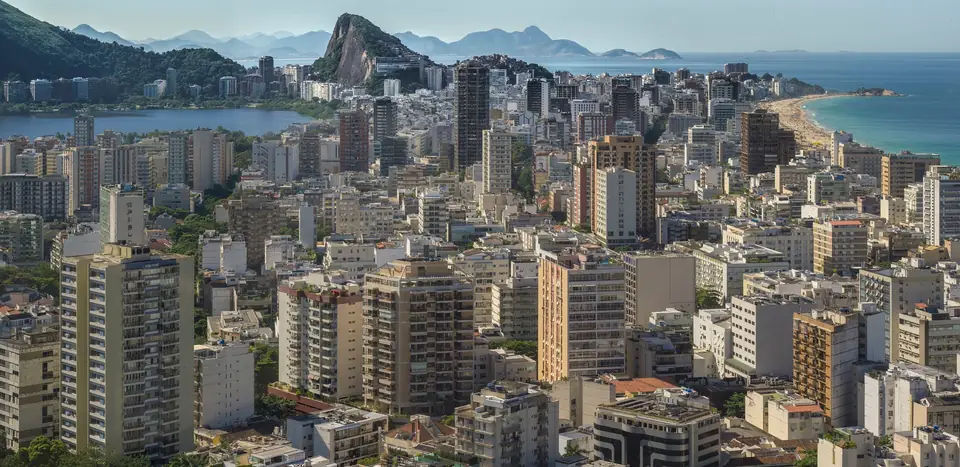
At Posto 4, the width of sand between the promenade and the water is enormous, and it is not natural. Before the works, the beach was about 55 metres wide and the surf sometimes flooded the garages of the buildings. Around 1970 the hydraulic engineer Hildebrando de Goes Filho directed a sand fill that widened the beach and the promenade; part of that sand was dumped out to sea.
That strip won from the sea has since filled with crowds. On New Year’s Eve 2000-2001 an accident with sparks and explosive debris killed one person and injured 49 on the sand, and since the following year the fireworks have been fired from rafts at sea. The Rolling Stones played here for free on 18 February 2006, Madonna closed her Celebration Tour on 4 May 2024 before 1.6 million people according to Riotur, and Lady Gaga drew 2.1 million on 3 May 2025, figures that are official estimates.
Beneath the great spectacle beats an older custom. Every 29 December, around three in the afternoon, followers of religions of African origin arrive in procession from the Mercadão de Madureira, gather at Posto 4 and push out to sea little boats with flowers, candles and champagne for Iemanjá. It is the documented tradition of those who invented New Year’s Eve on this sand and then ran out of room on it, a story the audio guide unpacks on the same sand.
A fort over the chapel that gave the name
Statue of Carlos Drummond de Andrade
Summary of this stop
At the southern end, past Posto 6, the beach ends at the Forte de Copacabana, today the Museu Histórico do Exército. It occupies the crag where the little church of Nossa Senhora de Copacabana stood, the Virgin of Titicaca who gave the beach its name. The chapel was demolished to build the fort: the foundation stone was laid in January 1908 and the building, with walls 12 metres thick facing the sea, was inaugurated on 28 September 1914 in the presence of President Hermes da Fonseca. Different versions circulate about the origin of that chapel, attributing it to seventeenth-century silver merchants or dating it to the eighteenth century.
At the foot of the fort, the boats drawn up on the sand belong to the Colônia de Pescadores Artesanais Z-13, which turned 100 in 2023 and is still active, as if the fishermen’s sandy waste from before the trams had never quite gone away.
Facing Posto 6, Carlos Drummond de Andrade sits with his back to the sea on a bronze bench, a work by Leo Santana installed in October 2002 for the poet’s centenary, with his line «No mar estava escrita uma cidade». His bronze glasses have been ripped off so many times that in October 2022 they were replaced for the fourteenth time. The most unusual episodes of that endless theft close the promenade.