Afro-Brazilian heritage
Pedra do Sal Audio Guide
A grey, worn rock with steps cut into the stone, which was a quay for enslaved people, the first embrace for the Bahians arriving in Rio and the home of samba. Today, at the foot of the Pedra do Sal, Little Africa keeps playing and defending its urban quilombo.
- 30 min of audio
- Samba and Afro-Brazilian memory
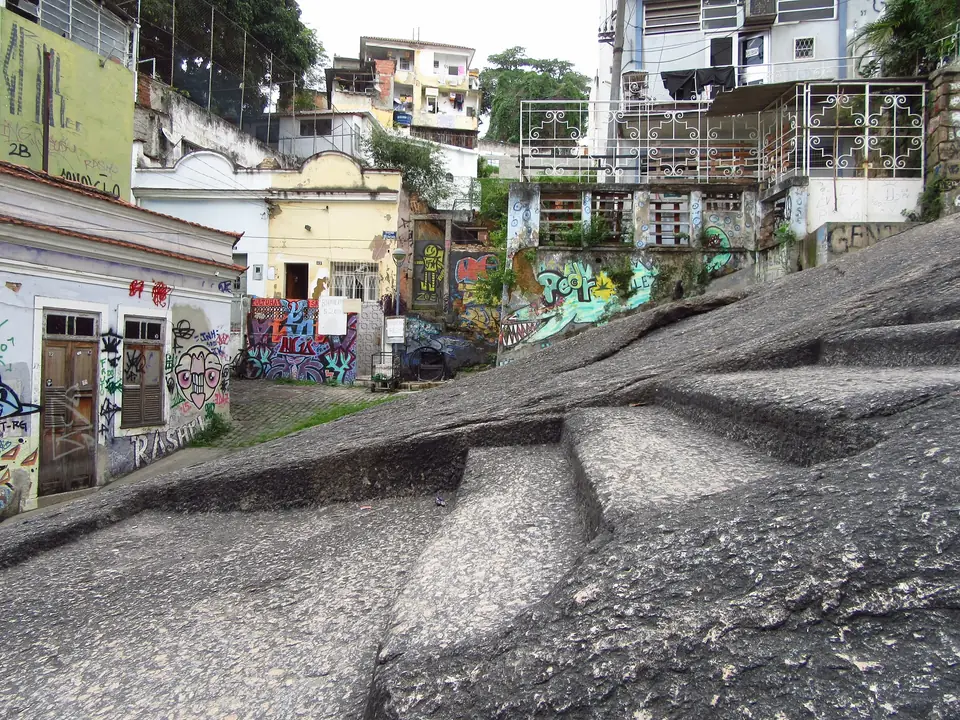
The Pedra do Sal is an outcrop of augen gneiss, the stone of Rio’s great natural monuments, at the foot of Morro da Conceição, in the port district of Saúde. It was once called Pedra da Prainha and stood by the water: on it, enslaved people unloaded the salt that reached the port in colonial times and distributed it to the surrounding trapiches, where it was used to tan leather and preserve meat. A staircase of steps carved into the rock, attributed to enslaved Africans, climbs from Largo João da Baiana to the hill.
In 1984 INEPAC protected it as a historic and religious monument, a pioneering decision in Brazil: until then the city had protected its Catholic temples, but no Afro-Brazilian sacred place. Since 2005 it has also been a certified quilombola community, and every Monday and Friday its square fills with a free roda de samba, with no tickets or chairs, the audience standing around the musicians.
Highlights
- Staircase cut into the rock — steps carved in augen gneiss, attributed to enslaved Africans
- Largo João da Baiana — a free roda de samba on Mondays and Fridays, with the audience standing
- 1818 quay — a work record that names 20 enslaved people one by one
- 1984 protection — the first Afro-Brazilian sacred place protected in the city
- Quilombo da Pedra do Sal — a community certified in 2005 that washes its stone every 2 December
The history of the Pedra do Sal fits in a single stone. On this gneiss rock, which was called Pedra da Prainha before taking its present name, the salt of the colonial port was unloaded; in its alleys dockworkers were recruited and a great slave market operated; from its own mass, in the nineteenth century, blocks were quarried to pave streets and build Rio de Janeiro’s quays. Until a landfill at the start of the twentieth century pushed the shoreline out to sea, the water reached its base.
Then came the music. In the late nineteenth century, the Bahians who landed in the city found a house here that took them in, and through this district passed the tias baianas and the sambistas who shaped Carioca samba. On 20 November 1984, according to most sources (others say 1987), the Instituto Estadual do Patrimônio Cultural protected it as a historic and religious monument, the first time the city recognised an Afro-Brazilian sacred place in this way. The history of the Pedra do Sal, the simple architecture of its staircase and its present as an urban quilombo are best understood by walking it step by step, with documented narration that goes from the square to the top of the steps.
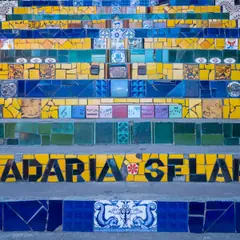
In the same port district stands the Museum of Tomorrow; in Lapa, the Selarón Steps are the other great staircase of the centre, and Maracanã Stadium completes the portrait of Rio’s popular passions.
João da Baiana’s confiscated tambourine
Largo João da Baiana
Summary of this stop
By day, Largo João da Baiana is a quiet little square at the foot of the rock. On Mondays and Fridays especially, it changes completely: the roda de samba takes the centre, with no tickets or reserved seats, and the audience crowds standing around the musicians. In this same square, the Bar João da Baiana operated until the early 2000s.
The square’s name recalls João da Baiana (1887-1974), son of Tia Perciliana, one of the neighbourhood’s tias baianas. In 1908, when samba was persecuted as vagrancy, the police confiscated his tambourine at the Festa da Penha. The response came from a senator, Pinheiro Machado, and with it an object that opened doors for him. Another tia baiana, Tia Ciata, lived next to Praça Onze, and in her house «Pelo Telefone», by Donga and Mauro de Almeida, the first samba recorded on disc, was composed in 1916-1917. That is why the idea of the Pedra do Sal as the «cradle of samba» circulates widely, although other sources regard it as one of several cradles in an open debate.
According to the community’s tradition, those who play here are not just any band: they inherit the title of guardians of the stone, which in the first half of the twentieth century Tia Ciata, Pixinguinha, Donga or João da Baiana himself would have held, and which in this century has passed from group to group, from Samba na Fonte to Batuque na Cozinha. What was engraved on that gifted tambourine is one of the details the audio guide keeps for this point.
A rock of salt, quarry and quay
Bare face of the Pedra do Sal
Summary of this stop
Beside the staircase, the rock shows itself bare: augen gneiss, the same stone that forms Rio’s great natural monuments. Its rough surface and hollows are the trace of its history. The most widespread explanation of the name speaks of the salt that enslaved people unloaded on it and distributed to the salt trapiches around, to tan leather and preserve meat; the historian Milton Teixeira, by contrast, maintains that sugar was unloaded first, and that in fairness it should be called Pedra do Açúcar.
The rock was also a quarry. In the nineteenth century, enslaved people extracted blocks from the Pedra do Sal itself to build the city’s streets and port, so that part of it ended up as paving and quays. In September 1818 work began on the cais da Pedra do Sal, coordinated by Francisco Martins Esteves on the orders of Marshal Manoel de Mello.
What is exceptional is that this work left names. The record of the works lists 20 enslaved people one by one, among them Mariano Mina, Antonio Benguela, Antonio Congo and Vicente Moçambique. The rest of that list, and what it says about the port, is revealed by listening to the narration in front of the stone.
A quay without a sea and a white flag
Staircase cut into the rock
Summary of this stop
From the top of the carved staircase, the landscape gives no hint that there was once a beach here. The rock was called Pedra da Prainha and stood by the water, surrounded by alleys and trapiches, until the port landfill of the early twentieth century moved the shore away: where the sea once broke, streets and buildings now stand.
From here, the residents of Saúde greeted the ships arriving from Bahia with relatives and friends. In the late nineteenth century, a house of Bahians and Africans took in the newcomers, and when the ship was sighted a white flag was raised, the sign of Oxalá; Tia Carmem told it in the first person. The historian Joel Rufino dos Santos, who in 1984 wrote the text that underpinned the protection, compared the stone to Christ the Redeemer: it was the city’s first embrace for those who arrived.
At the top, on Morro da Conceição, according to documented tradition lived Hilário Jovino Ferreira, «Lalau de Ouro», a Bahian who came to Rio in 1872 as a shipyard apprentice. One Epiphany he ran into a rancho and ended up founding his own, the Rei de Ouros. What that neighbourhood gesture set off in Rio’s Carnival is part of the story the audio guide tells from this lookout.
The quilombo that washes its stone
Houses and painted walls of the quilombo
Summary of this stop
Above the staircase, the low houses with coloured façades and the walls painted with the history of the place make it clear that this is not a still monument but a living neighbourhood. The Fundação Cultural Palmares certified the Comunidade Remanescente de Quilombo da Pedra do Sal in 2005, and in 2010 Incra delimited 3,534 m² for about 25 families. Part of those properties is claimed by the Venerável Ordem Terceira de São Francisco da Penitência as an inheritance from dom João VI; Incra maintains there are no documents of that donation, and the quilombo’s association cites a favourable ruling. It is often read that the quilombo is a World Heritage Site, but what UNESCO inscribed in 2017 is the archaeological site of Cais do Valongo, a nomination in which the quilombo was one of the pillars.
Every 2 December, National Samba Day, the community celebrates the lavagem, the ritual washing of the stone, with candomblé groups, the afoxé Filhos de Gandhi, rodas de samba and capoeira.
The name repeated on murals, routes and leaflets, «Little Africa», also has its story. According to a tradition of Tia Ciata’s family, it was a quip by the sambista Heitor dos Prazeres in her house, on seeing the mix of people that fitted under that roof. The exact phrase that named the district closes the tour.