Gothic palace
House of Shells Audio Guide (Casa de las Conchas)
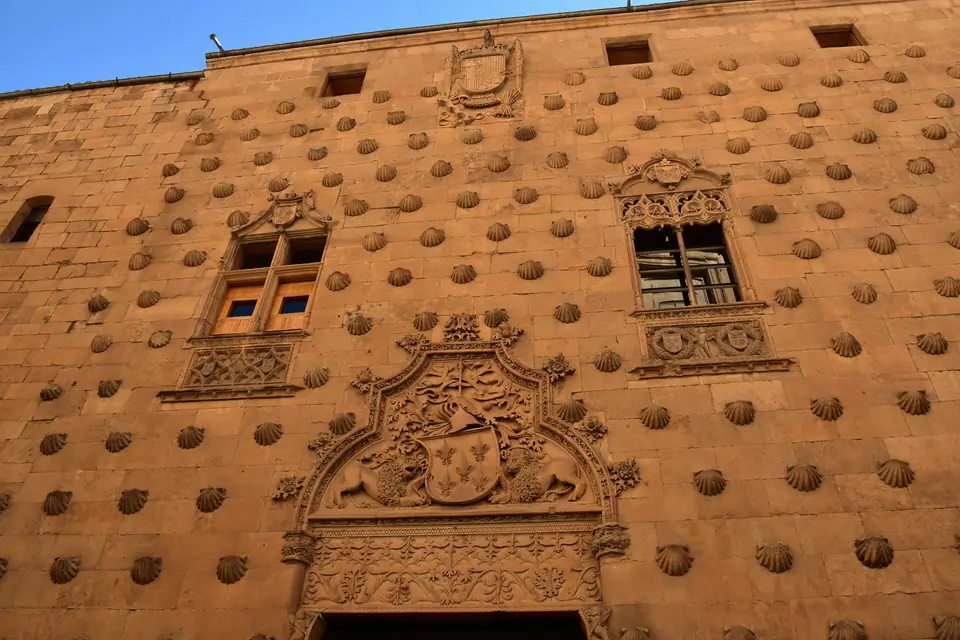
Almost three hundred shells hang from iron hooks on the façade of the Maldonado palace, and legend says only one hides a treasure. Its owners barely lived in it: it was a rented house, a student jail, a tax payment and today it is a public library.
- 25 min of audio
- Civil Gothic
- Treasure legend
The House of Shells was built between the late 15th and early 16th centuries on plots that the cathedral chapter sold in 1486 to Doctor Rodrigo Maldonado de Talavera, councillor, professor at the University, member of the Royal Council and ambassador of the Catholic Monarchs. Its Gothic civil architecture brings together a portal with dolphins, four different windows on the main floor, late Gothic wrought-iron grilles and a courtyard of mixtilinear arches, with 153 coats of arms spread across the whole building.
The façade that made it famous was not in the plan. According to tradition, the shells were added after the founder's son married Juana Pimentel, of a lineage that carried the shell on its coat of arms. A son of that marriage ended on the scaffold as a comunero captain, and the house, handed over in 1967 for one gold peseta a year, ended up in 2005 swapped for a building in Granada.
Highlights
- Shell façade — almost three hundred, set in a staggered pattern with iron hooks
- Coat of arms of the Catholic Monarchs — at the top, a sign of the founder's closeness to the court
- Portal of the dolphins — the Maldonado shield of five fleurs-de-lis between lions
- Mezzanine grilles — Gothic ironwork attributed to Fray Francisco de Salamanca
- Courtyard of mixtilinear arches — fantastic gargoyles and the Clerecía framed from above
In 1486 the chapter of Salamanca cathedral sold four pairs of houses next to the Puerta del Sol to Rodrigo Maldonado de Talavera, Doctor Talavera. In 1493 he bought neighbouring ones, and on those plots the city’s most recognisable palace began to grow. Its owner was no ordinary nobleman: professor, councillor, royal adviser and ambassador, in June 1494 he was, according to the documented tradition, one of the three Castilian representatives who signed at Tordesillas the division of the ocean with Portugal.
The history of the House of Shells also has its own disputes. Construction is usually dated between 1493 and 1517, although some move it earlier to the last decade of the 15th century and others to the early 16th, and not all sources agree on whether the work is by the father or the son, Rodrigo Arias Maldonado, who would have finished and remodelled it. There is no agreement either on the meaning of its shells. The route goes around the corner of the tower, stops before the façade and the portal and enters the courtyard, today part of a public library. The audio guide, documented and checked against historical sources, reads that scaly wall as the diary of a family that brushed against the court and the scaffold.
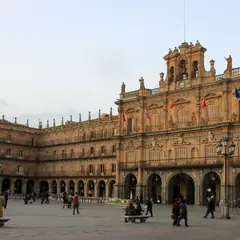
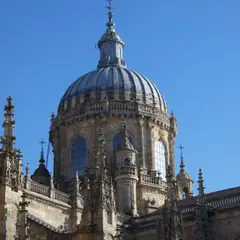
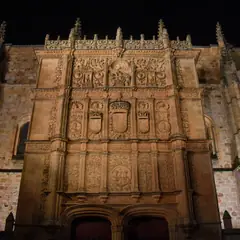
Very close by stands the historic building of the University of Salamanca, whose students could end up in the jail that this house came to hold, and a few minutes to the north the Plaza Mayor gathers between its arches the medallions of those who ruled Spain.
A tower twenty-three courses short
Lowered corner tower
Summary of this stop
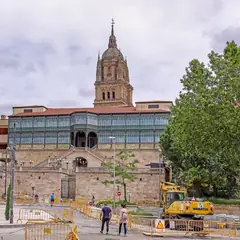
On the corner of the Rúa Mayor and Calle Compañía rises the only tower the house still has, and a careful look is enough to notice something is missing. There were two towers flanking the Rúa façade. A report by the architect Gavilán Tomé recorded leaning and cracks, and in 1772 the corner one was lowered by 23 courses while the other was almost completely demolished.
That was not the only loss. The Rúa façade collapsed in the early 18th century, and in 1701, with the house in the hands of the Count of las Amayuelas, Pedro de Acosta built an extension towards that street, plainer, behind which the library’s five floors are arranged today. The highest part of the main façade, also rebuilt in the 18th century, does not even have shells.
Two explanations circulate about the tower and they do not match. One is that of the papers and the cracks. The other, tradition, speaks of a royal punishment with a name attached, and at this first stop the narration sets the two versions against each other.
Shells hung from iron hooks
House of Shells
Summary of this stop
Facing the Compañía façade appears the wall that gives the house its name: almost three hundred shells arranged in a staggered pattern, following the old Mudéjar tradition of diamond decoration. They are not carved into the ashlars, but attached to the stone with iron hooks, a detail that changes the way of looking at them. At the top, the coat of arms of the Catholic Monarchs recalls Doctor Talavera’s closeness to the court.
Why there are shells is a question with several answers. Tradition attributes them to the marriage of Rodrigo Arias Maldonado to Juana Pimentel, of the lineage of the counts of Benavente, whose emblem was the shell. Other readings link them to the Order of Santiago or to the passing of the Camino, although against the first it is argued that the Santiago cross already appears elsewhere on the façade.
And then there is the treasure. According to the most widespread legend in Salamanca, the family hid its jewels under one of the shells and noted down the amount, but not which one it was. The rules for searching for it turn the wall into a curious gamble, and the audio guide reveals them in front of the façade, with almost three hundred candidates in view.
Fleurs-de-lis over a comunero door
Portal of the dolphins
Summary of this stop
The main portal is lintelled, with dolphins and plant motifs on the lintel. On the tympanum, beneath a mixtilinear arch, the Maldonado shield appears between lions, with helm, sceptre and a banderole with the Ave Maria. Its five fleurs-de-lis are repeated throughout the house: 153 coats of arms have been identified in the building, those of the Maldonado with their lilies and those of the Pimentel with their shells. At the sides, the four windows of the main floor are all different.
The mezzanine grilles, of late Gothic wrought iron, are attributed to Fray Francisco de Salamanca. They mix plain bars and twisted ones, foliage, mixtilinear arches and small turrets, and one of them carries on a frieze the full Latin salutation to the Virgin. Over the shield on the door there also weighs a family legend that would explain the surname Maldonado itself.
Behind so much heraldry there is a dark chapter. The founder was grandfather of the comunero captains Francisco and Pedro Maldonado. Francisco was executed after Villalar; Pedro, son of the marriage of the shells, was executed in 1522. How a family tie saved his life for a year and why it was not enough, and where the family’s chiselled coats of arms are today, is told by the narration at this door.
A courtyard rented since 1529
Courtyard of mixtilinear arches
Summary of this stop
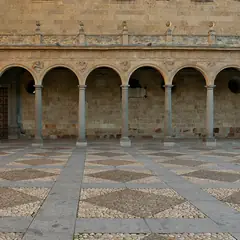
The courtyard, of two floors and off-centre from the door, measures about 18.80 by 16.80 metres. Below, mixtilinear arches on pillars with shields beneath lion protomes; above, marble columns and parapets of honeycomb and basketwork; and as a crown, a crest of fleurs-de-lis with gargoyles of fantastic beings. On the staircase, a dog holds the Pimentel shield and a lion that of the Maldonado, beneath a Renaissance coffered ceiling in white, blue and gold.
The most surprising thing is the house’s biography. In 1529, just finished, it was already being rented. It was the jail of the Estudio, with cellars where students served the sentences of the maestrescuela, and later a museum, an academy and the residence of the steward of the Count of Santa Coloma. In 1967 a Count of Santa Coloma, Enrique de Queralt, handed it to the Town Council for one gold peseta a year for 99 years; after some twenty years unusable, the restoration by Víctor López Cotelo and Carlos Puente reopened it in 1993 as the State Public Library, with a Europa Nostra diploma in 1994. Between 1996 and 1997 it passed to the Junta de Andalucía as a tax payment, and in 2005 it was swapped with the State for the Bank of Spain building in Granada.
From the upper gallery the towers and bell gable of the Clerecía can be seen, much better than from the street. That view, according to tradition, is owed to an offer the Jesuits made to the owner of the house and to a reply that the audio keeps for the end of the route.