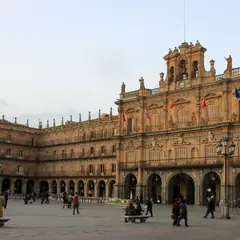
Dominican convent
San Esteban Convent Audio Guide (Convento de San Esteban)
Behind a honey-coloured stone façade, the Dominicans of San Esteban lodged Columbus, buried Francisco de Vitoria and Domingo de Soto and asked themselves, before almost anyone, whether the conquest of America was just.
- 60 min of audio
- Salamanca Plateresque
- School of Salamanca
The San Esteban Convent is Salamanca's great Dominican house. The friars arrived on this hill around 1256, when a flood of the Tormes made their first church by the river unusable. In 1524 Cardinal Fray Juan Álvarez de Toledo, son of the Dukes of Alba, ordered the old convent demolished and the present one built. Juan de Álava, Fray Martín de Santiago and Rodrigo Gil de Hontañón worked on it, and the church was not consecrated until 1610.
The theologians of the School of Salamanca lived here. On 1 January 1539 Fray Francisco de Vitoria delivered his relectio De Indis, in which he examined which titles could justify the conquest of America and which could not. Almost five centuries later, the convent is still a house of study: since 1947 it has housed the Pontifical Faculty of Theology of San Esteban.
Highlights
- Plateresque retable façade — Martyrdom of Saint Stephen and Ceroni's Calvary beneath a triumphal arch
- Cloister of the Kings — 16 medallions of prophets in the lower gallery
- Pantheon of Theologians — tombs of Francisco de Vitoria and Domingo de Soto
- Soto Staircase — cantilevered stone resting only on the walls
- Churriguera high altarpiece — about 24 m tall with a hundred trunks from the House of Alba
At the end of 1486 or the beginning of 1487, a board of churchmen met in the Dominican convent of San Esteban to examine the project of a Genoese navigator called Christopher Columbus. It rejected it. Even so, the friars gave him lodging and food and paid for his days there, and among his backers was the Dominican Diego de Deza. Half a century later, in that same house, another friar asked aloud by what right the continent opened by that voyage had been conquered.
The history of the San Esteban Convent is that of a community of theologians who thought through the new world from a hill in Salamanca. Its architecture tells of well over a century of works: a convent demolished in 1524, a succession of masters, a lawsuit with the heirs of the founding cardinal between 1558 and 1566 over the tower, the grilles and the altarpieces left unfinished, and a church consecrated in 1610. In the 19th century the exclaustration turned it into the Santo Domingo barracks; today the Dominicans teach theology again within its walls.
The visit covers the portal, the main cloister, the pantheon of the theologians, the Soto staircase and the nave of the high altarpiece. The audio guide, documented and checked against historical sources, separates at each stop what truly happened from what tourist legend has added.
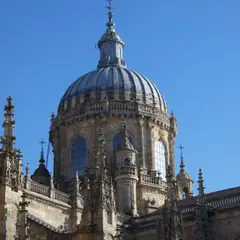
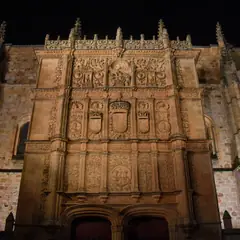
About five minutes to the west stand the New Cathedral, built between 1513 and 1733 beside the Romanesque one, and the historic building of the University of Salamanca, with the city’s other great Plateresque façade.
A stone altarpiece finished a century later
Plaza del Concilio de Trento
Summary of this stop
From the Plaza del Concilio de Trento, the church façade presents itself as a retable carved in stone, sheltered beneath a great triumphal arch. Saints, grotesques and coats of arms, among them that of the Catholic Monarchs, surround the central axis, where the relief of the Martyrdom of Saint Stephen carries a Calvary above it. Those two scenes were sculpted by Juan Antonio Ceroni in the early 17th century, almost a hundred years after the work began in 1524. Who designed the portal is still debated: some sources attribute it to Rodrigo Gil de Hontañón and others to Juan de Álava, author of the initial plan.
There is an explanation for why the convent is here and not beside the Tormes. The first Dominican house in Salamanca was San Juan el Blanco, outside the walls and on the riverbank, until a flood made it unusable around 1256 and the cathedral canons gave the friars a church on this site.
The door also holds a living ritual, of documented tradition. Every Good Friday, at five in the morning, the Hermandad Dominicana sets out from here with the Cristo de la Buena Muerte and Nuestra Señora de la Esperanza under a canopy. What the mantle of that Virgin is made of, and what three Salamanca bullfighters have to do with it, is a detail the narration reserves for this point.
The cloister Columbus never set foot in
Cloister of the Kings
Summary of this stop
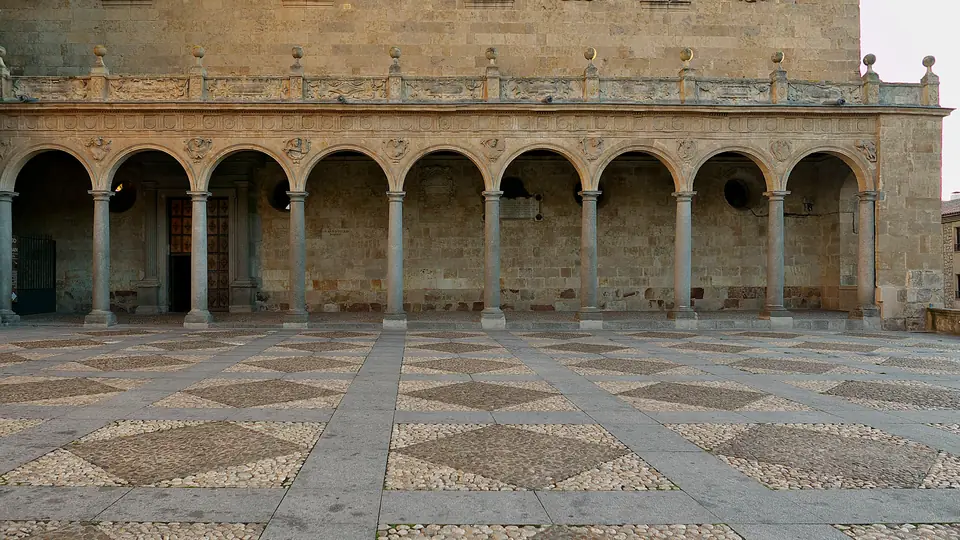
The main cloister, called the Cloister of Processions or of the Kings, was built between 1533 and 1544 under the direction of Fray Martín de Santiago. It has two floors: below, round arches with three mullions, rib vaults and 16 medallions of Old Testament prophets alongside scenes of Christ’s childhood; above, forty arches with grotesque capitals and a wooden roof. Its name is also disputed: some guides attribute it to the Catholic Monarchs, while other sources explain it by the kings of Israel depicted in it.
Tourist tradition usually places Columbus’s conversations with the friars here. The facts complicate the scene. The board of 1486-1487 was a commission of churchmen led by the prior of Prado, unconnected with the University of Salamanca, and it met in the original convent, the one demolished in 1524. The Salón de Profundis, another of the settings attributed to him, was built between 1492 and 1497, after that meeting.
What does withstand comparison with the sources is the house’s hospitality to the future admiral. How the image of Columbus before the scholars of the University came undone, and how much of that story remains true, is told in the lower gallery.
Tombs of those who questioned the conquest
Pantheon of Theologians
Summary of this stop
The old chapter house is an austere room, with benches fixed to the walls. In its highest part, reserved for the most distinguished members of the convent, were buried Fray Francisco de Vitoria, who died in 1546, and Fray Domingo de Soto, who died in 1560; the rest of the friars lay in the lower part. It is the so-called Pantheon of Theologians.
Vitoria, a Dominican of this house and professor of Theology at the University from 1526, delivered his relectio De Indis on 1 January 1539. In it he put to the test the titles used to justify the conquest of America, and not all of them passed. That moral tension runs through this stop.
The community had a precedent of its own. Fray Antonio de Montesinos professed at San Esteban on 1 July 1502 and, according to the documented tradition, on 21 December 1511 delivered in Hispaniola an Advent sermon against the abuses of the colonists that later moved Bartolomé de las Casas. He died in Venezuela in 1540 and how is not known. What the convent noted next to his name is left for the narration.
A staircase that flies without pillars
Soto Staircase
Summary of this stop
The Soto staircase was built between 1553 and 1556 under the patronage of Fray Domingo de Soto, confessor of Charles V, and is attributed to Rodrigo Gil de Hontañón. It is a cantilevered staircase with an open well, in Villamayor stone, resting only on the walls, with no other support, and it joins the ground floor of the cloister with the upper one. Flowered coffers, Soto’s coat of arms and a polychrome relief of Mary Magdalene accompany the climb.
At the top, beside the choir and the museum, a decidedly untheological surprise awaits. San Esteban had its own pharmacy from the early 16th century, and according to the documented tradition the first apothecary on record is Antonio Torres, in 1506. That convent pharmacy disappeared after the confiscation of 1835.
Since December 2014 the convent has displayed in its place a 19th-century pharmacy from La Alberca, with prescription books, glass jars, balances and more than 300 products. Why the structure of this staircase still astonishes almost five centuries later is explained at the foot of the first step.
An altarpiece with a hundred Alba trunks
Churriguera high altarpiece
Summary of this stop
The church has a single nave 14.5 metres wide and 27 high, with chapels between buttresses and Gothic rib vaults. Over the crossing, Rodrigo Gil de Hontañón’s Renaissance lantern rises to 44 metres. At the west end, over a great segmental arch, the upper choir holds the Triumph of the Church by Antonio Palomino.
The far end is filled by the high altarpiece that José Benito de Churriguera designed in 1692: about 16 metres wide by 24 high, six great Solomonic columns and, at the very top, a canvas by Claudio Coello with the martyrdom of Saint Stephen. It was made with pine from Balsaín and Soria, plus a hundred trunks that the House of Alba sent from Piedrahíta.
The family of the founding cardinal left here something more than wood. In 1619 the remains of Fernando Álvarez de Toledo, 3rd Duke of Alba, arrived from Alba de Tormes and since 1983 have rested in a mausoleum by Chueca Goitia paid for by the Salamanca Provincial Council. How this house went from barracks to theology faculty, and what links that duke to the altarpiece, closes the route.