Baroque square
Plaza Mayor Audio Guide
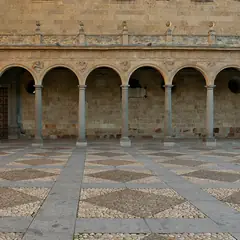
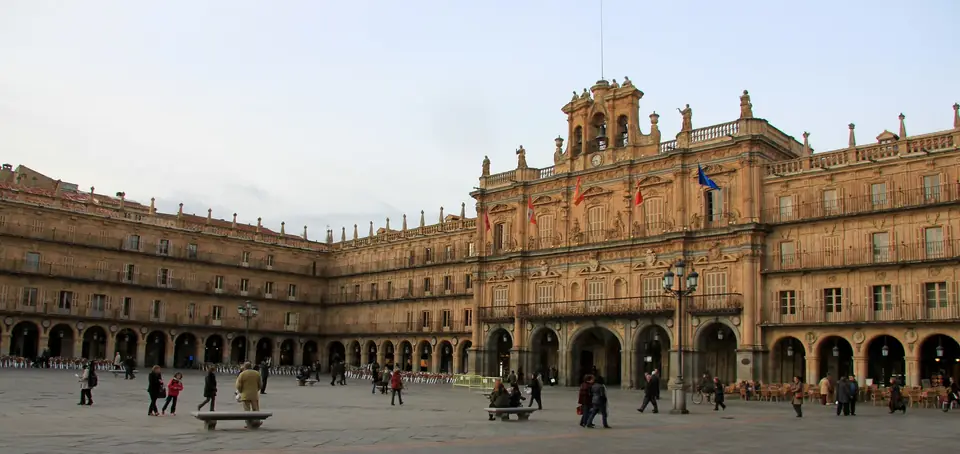
Four façades of golden Villamayor stone, closed between 1729 and 1755 and, between their arches, a gallery of medallions where Salamanca has spent almost three centuries carving, chiselling away and removing whoever rules Spain.
- 30 min of audio
- Churrigueresque Baroque
- Stone medallions
Salamanca's Plaza Mayor was born as a cutting: it occupies only part of the medieval Plaza de San Martín, a daily market almost four times larger that was split in three when the quadrangle was closed in 1755. The corregidor Rodrigo Caballero y Llanes drove the project, Alberto de Churriguera drew the Pabellón Real and Andrés García de Quiñones directed the final phase and the Town Hall. Along the way, a lawsuit with the Count of Grajal halted work for years and left the façades shorter than planned.
What looks like a festive salon is, seen up close, a stone register that is still open. Students chiselled away Godoy's bust in 1808, Franco's left for a museum in 2017 and in 2023 that of Alfonso IX of León, founder of the University, was unveiled. Twenty-one empty spandrels still wait for someone to fill them.
Highlights
- Pabellón Real — designed by Alberto de Churriguera, it was also the retaining wall that levelled the square
- Arco de San Fernando — the Bulls' Gate, with an inscription and a cross of 1838 on its pillar
- Spandrel medallions — 67 carved busts and 21 empty spaces, one of them Franco's blank ashlar
- Town Hall — a bell gable of 1852 with the clock where half the city arranges to meet
- Godoy's chiselled medallion — cut down by students after the Dos de Mayo of 1808
Before the Plaza Mayor there was another square on this very spot, the Plaza de San Martín, a daily market since the 15th century and so vast that when Hernán Cortés wanted to explain to Charles V the size of the great market of Tenochtitlan, according to his second letter, he used Salamanca as a yardstick. On part of that space, the Andalusian corregidor Rodrigo Caballero y Llanes launched in 1729 the Baroque square known today. The most accepted start date is 10 May of that year, the one on the plaque of the Pabellón Real, although other authors give earlier years depending on whether they count the royal decree or the levelling of the ground.
The history of Salamanca’s Plaza Mayor is not only that of a golden piece of architecture with arcades. It was a bullring for up to 20,000 spectators, a scaffold, a target for Napoleonic artillery in 1812, a promenade garden where people walk in opposite directions and the setting for the proclamation of the Second Republic. The audio guide, documented and checked against historical sources, covers it in five stops, starting outside and ending at the medallions that are still waiting for someone to fill them.
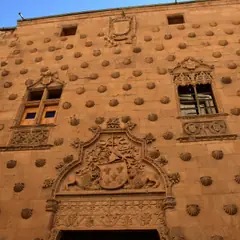
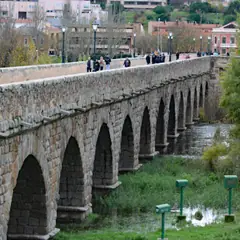
Down the street, on the way to the Tormes, lie two other pieces of the same stone city: the House of Shells, the Maldonado palace with almost three hundred shells on its façade, and the Roman Bridge, through which for centuries anyone arriving from the south entered Salamanca.
The high back of the square
Plaza del Mercado
Summary of this stop
The route starts outside, in the Plaza del Mercado, facing the back of the Pabellón Real. From here the building looks taller than from inside, and that difference in level tells how it all began: the east side, designed by Alberto de Churriguera, went up first because it served as a retaining wall to level sloping ground.
This corner is also a fragment of the old Plaza de San Martín, which spread across today’s Plaza del Mercado, Plaza del Corrillo and Plaza del Poeta Iglesias and had almost four times the area of the Plaza Mayor. When the Baroque quadrangle was closed in 1755, that medieval space was split in three. Its scale is explained, according to the documented tradition, by a conqueror on the other side of the ocean; what exactly Cortés compared and what figure he gave for the people buying and selling there is left for the narration.
The Bulls’ Gate and its cross of 1838
Arco de San Fernando
Summary of this stop
Beneath the Arco de San Fernando, with the great effigy of Ferdinand III under a canopy, the bulls entered when the square was a bullring. Hence the nickname Bulls’ Gate, and hence also the bull’s head carved on the neighbouring arch. On 12 September 1808 a bull killed eight people here, among them the bullfighter Juan Gaspar Romero, in a bullfight in which the bandit Tragabuches also fought. From 1840 the bulls moved to another square, with exceptions until the last bullfight, on 13 June 1992.
On the pillar of the main arch leading out to the Mercado there is an engraved cross and a text of 1838 asking for prayers for a woman who was «killed» there. The phrase has sometimes been told as a murder turned legend, but it may allude to a suicide or an accidental death, and it was customary to ask for prayers for sudden deaths without last rites.
According to the documented tradition, this ground was once a scaffold: a Bohemian traveller saw criminals hanged in 1466 and in 1810 fourteen bandits were executed. What fell from the sky onto the square in June 1812 completes, in the narration, the darker side of the salon.
Stone kings and a blank space
Pabellón Real medallions
Summary of this stop
The slate plaque beneath San Fernando dates the start to 10 May 1729, in the reign of Philip V, and the completion of the twelve houses of the Pabellón Real to 3 March 1733. Above the arches, in the spandrels, runs the series of medallions that Rodrigo Caballero himself devised as a programme: kings on this side, conquistadors and military men on the San Martín side, scholars on the Petrineros side and saints on the Town Hall side. Alejandro Carnicero carved the first ones between 1730 and 1733, polychromed and gilded, and over the centuries the original arrangement became mixed up.
On the corner towards Calle Toro, the first medallion of the Pabellón Real is a smoothed, empty ashlar. There stood the bust of Francisco Franco, carved during the Civil War, which stayed for about eighty years, received red paint every November from the 1980s and was removed in June 2017 to the Domus Artium 2002 museum. Why that blank space is the last correction to a programme conceived in the 18th century is best understood in front of the stone.
The balcony that sees off regimes
Salamanca Town Hall
Summary of this stop
The Pabellón Consistorial, on the north side, has two storeys instead of three and a central balcony. Andrés García de Quiñones directed the final phase, although the authorship of that stage is disputed and some sources attribute it to Manuel de Larra Churriguera. The two side towers of the project were never built for fear that the structure would not bear their weight: they exist only in a wooden model. The bell gable with clock was added in 1852, to a design by Tomás Cafranga, and every 25 July La Mariseca hangs from it to announce the September festivities.
From that balcony Miguel de Unamuno spoke on 14 April 1931, just back from exile, to a full square celebrating the Second Republic. On the same façade, two empty niches keep, according to the documented tradition, the memory of two pairs of kings who vanished with two revolutions. Who occupied those niches and when they left is part of what the narration tells beneath the clock, the meeting point of the whole city.
Godoy chiselled away and the empty spandrels
Godoy's chiselled medallion
Summary of this stop
Next to the exit towards the Corrillo, on the Petrineros side, one spandrel looks thinner than those that were never carved. It is the medallion of Manuel Godoy, which Salamanca’s students chiselled away after the uprising of the Dos de Mayo of 1808. Once the city was liberated in 1812, it was agreed to dedicate a medallion to the Duke of Wellington.
The square was contested from its origin. The objections of the Count of Grajal, who considered his palace better designed than the planned façade, halted work in the autumn of 1738; Churriguera left Salamanca and the closure did not come until 29 April 1755, with façades shorter than on the plan. And work continues: on 4 August 2023 the medallion of Alfonso IX of León was unveiled, carved from the foot of the scaffolding by Óscar Alvariño. With it, 67 are carved and 21 empty spandrels remain, waiting for someone to decide who deserves the stone.