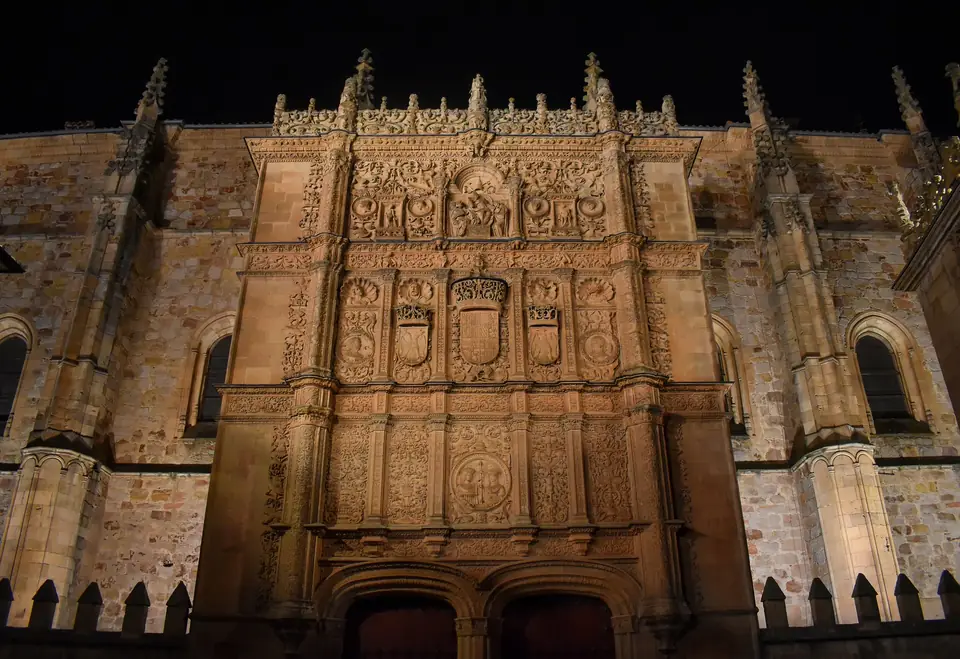
Plateresque façade
University of Salamanca Audio Guide (Escuelas Mayores)
A façade of golden stone carved to be seen from a narrow street, a tiny toad that half the city calls a frog and, behind it, Fray Luis de León's classroom and the Paraninfo where Unamuno stood up to Millán-Astray in 1936.
- 60 min of audio
- 15th-century university
- Fray Luis and Unamuno
The Escuelas Mayores are the historic building of the University of Salamanca. In the early 15th century lessons were spread between the cathedral cloister, churches and rented houses, until the Constitutions of 1411 of Pope Luna set a home of its own in motion: a single storey around a courtyard 30 metres on a side, finished between 1418 and 1420. On top of that core were added the Plateresque façade, the Renaissance staircase, the Baroque chapel of San Jerónimo and an 18th-century library that is still in use.
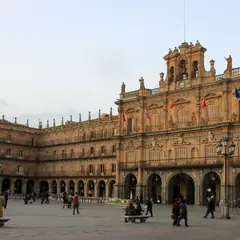
Salamanca's most photographed façade was not conceived for the square that now frames it. The small square of the Patio de Escuelas was not opened until 1609-1611, with permission from Philip III; before that, anyone looking at it did so from a narrow street. That is why the relief gains depth as it rises, from low relief below to high relief above, so that the figures of the top storey could be read from the ground.
Highlights
- Fachada Rica — a three-storey Plateresque portal with a relief that deepens upwards
- Toad on the skull — the tiny figure students look for without help in order to pass
- Fray Luis de León's classroom — furniture and lectern preserved next to the lower cloister
- Paraninfo — the setting of the clash between Unamuno and Millán-Astray on 12 October 1936
- Historic General Library — a 41-metre hall with Baroque shelves of 1749 and armillary spheres
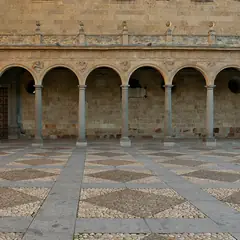
For its first centuries the University of Salamanca had no home. The statutes that Alfonso X gave it in 1254 already created the post of librarian, but in the early 15th century lessons were still given in the cathedral cloister, in churches and in rented houses. The Constitutions that Benedict XIII, Pope Luna, granted in 1411 changed that: they set in motion a building of its own, of a single storey around a courtyard 30 metres on a side, which was finished between 1418 and 1420. That cloister is the heart of the Escuelas Mayores, and around it a good part of the history of the University of Salamanca came to be written.
Within these walls Fray Luis de León taught before and after spending almost five years imprisoned by the Inquisition, and in its Paraninfo Miguel de Unamuno confronted a general in the middle of a war in 1936. Here too is remembered Lucía de Medrano, who in the early 16th century lectured in the Chair of Canon Law according to a single note in Latin giving day and hour; whether she became the first woman professor in Europe or only gave one exceptional lecture is something historians still debate, and since 2015 the Salón de Claustros has borne her name. The route runs from the façade to the upper cloister and presents the history of the University of Salamanca as a succession of words that had to defend themselves against power.
The audio guide, documented and checked against historical sources, follows that thread stop by stop: from the stone that teaches from outside to the classrooms, the chapel and the library where those voices held out.
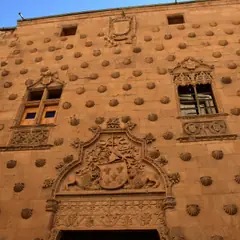
The friars of the School of Salamanca, Francisco de Vitoria and Domingo de Soto, lived and are buried in the San Esteban Convent, and a few steps from the Escuelas stand the New Cathedral and the House of Shells, which at one point served as a prison for students.
A façade carved for a narrow street
Patio de Escuelas
Summary of this stop
From the middle of the Patio de Escuelas, beside the statue of Fray Luis de León that Nicasio Sevilla signed in 1869, rises the Fachada Rica: three storeys of stone covered in grotesques, with five bays in the two lower ones. It is usually dated to 1529, although the dating oscillates between that year and a range of c. 1512-1533, and a 2014 study proposes attributing it to Juan de Talavera. The architecture of the Escuelas Mayores is understood here the opposite way to usual: the relief gets deeper the higher it goes, because it was carved to be seen up close from a narrow street, long before this small square was opened in 1609-1611.
The façade is read by floors. In the central bay of the first, a medallion shows Ferdinand and Isabella holding a sceptre, surrounded by a Greek inscription that says roughly «The Monarchs to the University and the University to the Monarchs»; when it was carved, Isabella was already dead. On the second, the great coat of arms of Charles V rules between two eagles, with medals at the sides, one of them female whose identity is also disputed.
Above, on the third storey, a pope speaks from his chair to six men between the figures of Hercules and Venus, the scene reproduced in the university’s present coat of arms. Who that pope is and who the men listening are are questions with more than one answer, and the narration raises them in front of the stone.
The toad everyone calls a frog
Toad on the skull
Summary of this stop
Beneath the right side of the façade there is always someone with their head raised. They are looking for a fingernail-sized figurine perched on a skull, high up, among hundreds of motifs. Popular belief, much later than the carving, says that whoever finds it without help will pass their exams; other versions promise a return to Salamanca or luck in whatever one sets out to do. Almost everyone who tries ends up asking for a hint.
The curious thing is that it is not a frog but a toad, and that its place on a skull is no accident: it served as a warning against lust joined to death in a city that in the 16th century had some 6,000 students, all of them men. One theory links its nickname, «Parrita», to the physician of Prince John, son of the Catholic Monarchs.
For anyone who trusts the talisman too much, student tradition keeps an old Latin saying that elegantly refutes it. What it is, and why searching without help has become the only free exam in the city, is part of this stop.
The classroom Fray Luis returned to
Fray Luis de León's classroom
Summary of this stop
Next to the lower cloister, the courtyard of 1411 that at last gave the university a home of its own, Fray Luis de León’s classroom is preserved with its furniture and the professor’s lectern. It is one of the plainest rooms in the building and also one of the most charged.
Fray Luis was a professor in these classrooms until the Inquisition imprisoned him in Valladolid from 27 March 1572 to 7 December 1576. The main charge was having translated the Song of Songs into Spanish without permission. He was acquitted and in January 1577 received a chair of Theology.
The phrase with which, as is often repeated, he resumed his classes, «As we were saying yesterday», circulates as fact, but is considered a later invention. What this room does keep, and the way history has preferred legend to silence, is the centre of the narration at the classroom door.
To win and to convince in the Paraninfo
Paraninfo
Summary of this stop
The Paraninfo is the university’s hall for solemn ceremonies, and in it took place one of the best-known episodes of 20th-century Spanish history. On 12 October 1936, at the Día de la Raza ceremony, the rector Miguel de Unamuno clashed with General José Millán-Astray and replied that to win was one thing and to convince another.
The documented tradition preserves details of the presiding table that are more chilling than the phrase: a rector taking notes on the back of someone else’s letter, a Filipino name that inflamed the general and an escorted exit between raised fists. Two days later, the university withdrew its support for him as rector.
The exact words of that morning are disputed: a good part comes from an account published in 1941 by someone who was not in the room, some historians consider them invented and others maintain that the clash was real. The audio guide separates the scene from its legend at the very entrance to the Paraninfo.
The chapel that lost its sky
Chapel of San Jerónimo
Summary of this stop
The chapel of San Jerónimo was rebuilt between 1761 and 1767 to a design by Simón Gabilán Tomé, who also made its altarpiece. Above the entrance rises the Baroque organ of 1709 by Pedro de Liborna Echevarría, and since 1858 the chapel has held the remains of Fray Luis de León, so the thread of the classroom closes here.
This space once had another life: it was the old library, covered by an astrological vault that Fernando Gallego began to paint in 1483. Two thirds were lost, on a date some place in 1664 and others around 1750, and the surviving third spent centuries hidden above a false ceiling. It was rediscovered in 1901 and in 1952 moved to the Escuelas Menores, where it is displayed today as the Cielo de Salamanca.
Some have wanted to see in those stars the sky of one specific day in August 1475, a hypothesis considered speculative. How what remains of that ceiling was saved is a story the narration tells looking upwards, beneath the organ.
The spheres of the astrologer professor
Historic General Library
Summary of this stop
In the upper cloister, up a Renaissance staircase with carved parapets and beneath a coffered ceiling of 1531-1535 with muqarnas, a Gothic doorway closed by an iron grille of 1526 leads to the Historic General Library. It occupies a hall of 41 by 11.5 metres, right behind the façade. Its Gothic roof fell into ruin in 1664 and in 1749 the vault was rebuilt and the two-tier Baroque shelves were made, to a design by Manuel de Lara Churriguera, and they are still in use.
Among its holdings are manuscripts such as the Libro de buen amor and the Liber Canticorum of Queen Doña Sancha, from the mid-11th century. In the hall there are also armillary spheres that the professor Diego de Torres Villarroel bought in England, Holland and Germany and which have occupied their place since 1758.
Torres Villarroel is the great character of this stop: according to his own highly romanticised autobiography, he was a hermit, dancer, bullfighter and quack healer before winning the Chair of Mathematics, and became famous as «the Great Piscator of Salamanca» with almanacs of predictions in which he did not much believe. Which prediction in the almanac of 1724 came true, and which others were attributed to him afterwards, closes the route.