Bridge on the Vía de la Plata
Roman Bridge of Salamanca Audio Guide (Puente Romano)
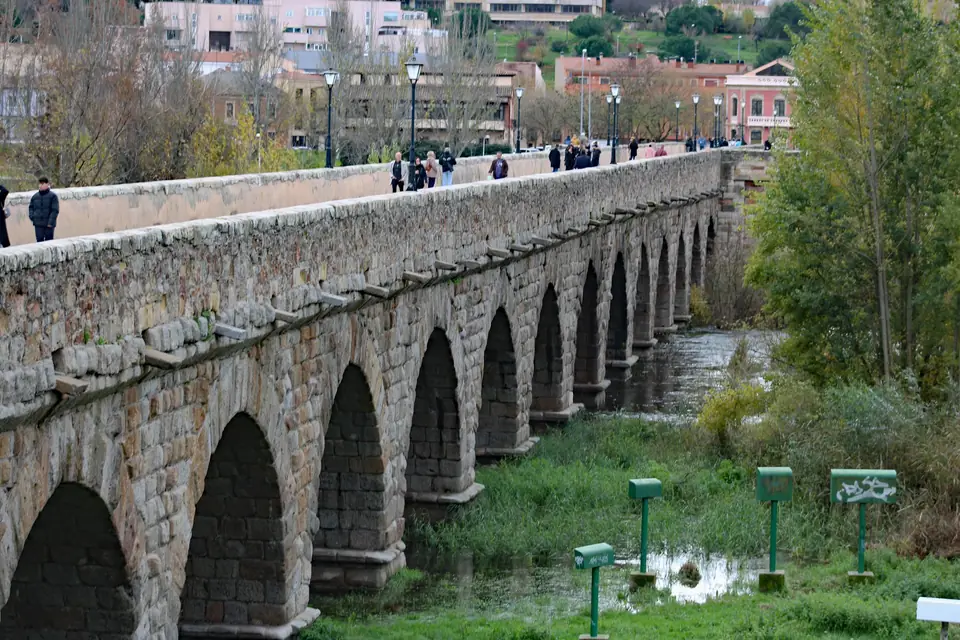
A headless stone bull guards the entrance and a small tower splits the bridge into two ages: fifteen Roman arches on the city side and eleven rebuilt every time the Tormes carried them away.
- 25 min of audio
- Vía de la Plata
- San Policarpo flood
Salamanca's Roman Bridge was built, according to the most accepted dating, between the reigns of Augustus and Vespasian, so that the Vía de la Plata, the road from Mérida to Astorga, could cross the Tormes. Its Roman section, 201.20 metres long, is of granite ashlar. It was the only access to the city from the south until the early 20th century, carried heavy traffic until 1973 and has been crossed on foot since.
Only half the bridge is Roman. The floods of the Tormes brought down the suburb side again and again, and on the night of San Policarpo in 1626 its arches fell one after another until the central tower stopped the collapse. The Roman section held. At the entrance, a Vettonian verraco of the Iron Age survived its own shipwreck: in 1834 it was thrown into the river.
Highlights
- Entrance verraco — a 2.10 m granite Vettonian bull, the oldest statue in Salamanca
- Roman section — fifteen granite ashlar arches with cutwaters and gargoyles on the keystones
- Lifting sockets — marks of the iron tongs used to hoist the ashlars
- Central tower — the point where the chain collapse of 1626 stopped
- Suburb pilasters — almost 5 m of stone with the royal arms of Philip IV and those of Salamanca
For almost two thousand years, anyone arriving in Salamanca from the south came in this way. The Roman Bridge was built so that the Vía de la Plata, the Iter ab Emerita Asturicam between Mérida and Astorga, could cross the Tormes, and the most cited range places it between Augustus (27 BC-AD 14) and Vespasian (69-79). There is no conclusive proof: other proposals take it to Nero, or to Trajan and Hadrian because of its resemblance to the Aqueduct of Segovia, and popular belief even attributed it to Hercules. It was the only way into the city from the south until the early 20th century, carried heavy traffic until 1973 and today is pedestrian.
The history of Salamanca’s Roman Bridge is that of a work the river broke again and again and that the city ended up carrying on its coat of arms. Of its 26 arches, the usual figure counts the 15 nearest the city as Roman, although the fifteenth is only partly so and some authors count 14. The other 11 were rebuilt after floods, and a central tower separates the «old bridge» from the «new bridge». Even its total length is disputed depending on the source. The route crosses from the city to the suburb in a few hundred steps, and the audio guide, documented and checked against historical sources, reads each section in its own age.
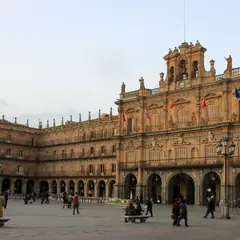
On the way back to the city, Casa Lis shows its iron-and-glass façade over the wall, and the climb ends at the Plaza Mayor, the Baroque centre that was closed between 1729 and 1755.
A headless Vettonian bull at the entrance
Roman Bridge verraco
Summary of this stop
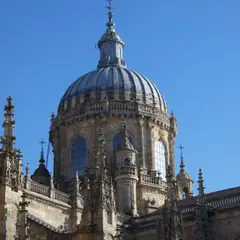
At the head of the city side, with the cathedrals in the background, stands the oldest statue in Salamanca: a verraco, a granite bull carved by the Vettones in the Iron Age. It measures 2.10 metres long and 1.57 high, has lost its head and its body looks pieced back together. It is the same bull that appears on the bridge in the first quarter of the city’s coat of arms, and a popular legend explains why: a shepherd saw a bull pawing at the foot of a tree beside the Tormes and, on approaching, found the remains of an old bridge. Bull, tree and bridge thus entered the arms of Salamanca.
Literature made it famous. In the Lazarillo de Tormes, of 1554, the blind man tells Lázaro to put his ear to the stone bull at the entrance of the bridge and smashes his head against it, to teach him that a blind man’s boy must know more than the devil.
Its life after the novel was almost as eventful. On 10 October 1834 the politician José María Cambronero had it thrown into the river, convinced that the bull was a symbol imposed by Charles I after the Comuneros revolt. It was left broken in three pieces. How and when it returned to its place, and which anniversary the city chose to put it back, is the first surprise of the walk.
Roman granite marked by iron tongs
Ashlars of the Roman section
Summary of this stop
From the parapet of the Roman section, and better still from the riverside path, the round granite ashlar arches can be made out, with triangular cutwaters upstream and drainage gargoyles on the keystones. It is the architecture of Salamanca’s Roman Bridge in its purest form: the stretch that the road from Mérida to Astorga needed to cross the Tormes, measuring 201.20 metres.
The stone keeps the trace of how it was raised. Many ashlars retain hollows carved for the ferrei forceps, the iron tongs used to hoist the blocks, and notches where levers were fitted to move them. They are small marks, easy to overlook, that turn every stone into a construction record.
Nor is the ground what it seems. The present paving is not the original: archaeological test pits found the Roman pavement, of large slabs, about 50 centimetres below, and only on this side of the bridge. What those excavations revealed about the road is told at the parapet.
The tower that stopped the flood of 1626
Central tower
Summary of this stop
At mid-length, a widening separates the two ages of the bridge. It is the central tower, and it marks the exact place where a collapse stopped. The suburb section had already suffered before: the Flood of the Dead of 1256 left the southern part impassable, and the «new bridge» on that bank is a work of the 12th and 13th centuries, although there is no agreement on whether it was built before or after that flood.
On the night of 26 January 1626, the flood of San Policarpo brought down arches of the new section and then the following ones, in a chain, until the tower stopped the collapse. The Roman section held. According to accounts of the time, the Tormes rose in under five hours after a winter of snow and rain, caught the people of the floodplain in the middle of the night and killed 142 people. More than fifteen hundred homes were damaged, the church of San Lorenzo disappeared and Salamanca was cut off from the south.
It remains the greatest natural catastrophe in the city’s history. From the tower, the contrast between the Roman and the rebuilt arches is easy to read; what remained of that night, and where it can still be seen, is revealed by the narration at this point.
Two royal pilasters at the south gate
Pilasters of Philip IV
Summary of this stop
At the exit towards the suburb rise two rhomboid pilasters of almost five metres, with the royal arms of Philip IV, those of Salamanca and the cartouche «Puente Mayor del Tormes». They recall the great repair of 1627, with Diego de Pareja Velarde as corregidor, in which the central tower and the battlements that Anton van den Wyngaerde still drew in 1570 disappeared. Its inscription, curiously, ends with a date of 1622, before the flood and the work with which they are associated, and another almost illegible one gives 1681: a small riddle that remains open.
The bridge came close to changing its appearance again. In 1891 the Highways Department proposed widening it with cantilevers for cars. Through the efforts of councillor Enrique Estevan an iron bridge was built upstream instead, inaugurated on 22 October 1913, and the Roman one was spared the reform.
These banks also have their own festival. On Lunes de Aguas, the Monday after Easter Monday, the people of Salamanca go out to picnic on hornazo beside the Tormes, and the Roman Bridge is one of the busiest spots. Tradition links it with an order attributed to Philip II and a priest with a memorable nickname; what return along the river is really celebrated every spring is the story with which the route takes its leave.