Gothic cathedral
New Cathedral Audio Guide (Catedral Nueva)
It took 220 years to finish and never stopped being Gothic, even though by mid-construction the Baroque was in charge: Salamanca's New Cathedral stands attached to the Old one it was meant to demolish, with a tower held together by chains since the earthquake of 1755.
- 75 min of audio
- Late Gothic
- Lisbon earthquake
The New Cathedral was born of a complaint: the university city of Salamanca in the 16th century found its Romanesque cathedral small, dark and low. In 1509 Ferdinand the Catholic sent Antón Egas and Alonso Rodríguez to design a new church, whose construction began in 1513 and was not inaugurated until August 1733. Its scaffolding saw the Gil de Hontañón family, Juan de Álava, Pantaleón Pontón, the Churriguera brothers and Sagarbinaga, and the Chapter obliged all of them to follow the same late Gothic.
The cathedral's most famous view is an accident. Its north façade was never meant to be seen: it was hidden by a block of houses that the occupying French army demolished around 1812 to open the Plaza de Anaya. The main portal, the richest, ended up instead on a narrow street, and at the north door a stone astronaut has been waiting since 1992.
Highlights
- Puerta de Ramos — an astronaut, a lynx and a dragon with an ice cream carved in 1992
- Bell tower — bound with eight chains after the Lisbon earthquake
- North façade — exposed since the French opened the Plaza de Anaya around 1812
- Churriguera choir — two-tier stalls in the middle of the nave
- Main chapel — without an altarpiece since 1743, beneath Sagarbinaga's dome of 1765
The history of the New Cathedral begins in 1509, when Ferdinand the Catholic sent to Salamanca Antón Egas and Alonso Rodríguez, two architects seasoned in Toledo and Seville. The city, grown up in the warmth of the University, wanted a church worthy of it. Work began in 1513, the first half was completed and consecrated in 1560, the east end was not undertaken until the 1580s and almost the whole 17th century passed with the scaffolding standing idle. The inauguration came in August 1733. Bishop Francisco de Bobadilla, who blessed the first stone, rests in the north arm of the transept.
The plan was to demolish the Old Cathedral as soon as the new one was ready. It stayed open for worship during the works and, when they ended, nobody dared pull it down. That is why the architecture of the New Cathedral can only be understood alongside its neighbour: its south wall rests on the north wall of the Romanesque one. Two centuries of building, an earthquake and a square opened by a foreign army explain how it looks today. The audio guide, documented and checked against historical sources, covers the exterior and the nave in five stops, from the Plaza de Anaya to the high altar.
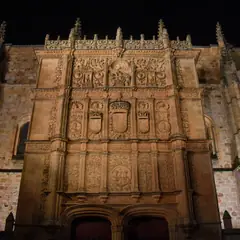
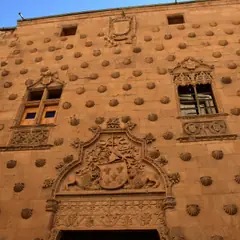
A step away, the Plateresque façade of the University of Salamanca was carved to be seen up close, and a few minutes to the east the San Esteban Convent raises its retable façade; going down towards the river, Casa Lis leans out over the city wall with its iron-and-glass little palace.
Plaza de Anaya, the face that was never meant to be seen
Plaza de Anaya
Summary of this stop
The postcard image of the cathedral, with its flying buttresses, buttresses and Gothic pinnacles in the open air, is that of the north façade seen from the Plaza de Anaya. Nobody designed it to show off: until around 1812 a block of houses hid it. It was the occupying French army that demolished them and opened the square, and since then the back face has served as the main façade in almost every photo.
The square is also the stage of a living rite. Every 31 October, the eve of All Saints, a man dressed as a charro, with bagpipe and tamboril, climbs the roughly 200 steps of the tower, comes out through a window next to the clock hands and plays from on high before the packed square. He is «el Mariquelo», a custom the Chapter fixed after the earthquake of 1755. For generations the same family carried it out; since 1985 it has been kept up by Ángel Rufino de Haro, who in 2026 completed his fortieth climb.
The original meaning of that climb had little of the festival about it. What the first Mariquelo went up to check at the top of the tower, and why his bagpipe still sounds as a thanksgiving, is told in the narration from the middle of the square.
An astronaut at the Puerta de Ramos
Puerta de Ramos astronaut
Summary of this stop
The Puerta de Ramos, opposite the Palacio de Anaya, shows the Entry of Jesus into Jerusalem. On its left flank, among the decoration, an astronaut floats. It is no mystery of the centuries: it was carved in 1992 by the stonemason Miguel Romero during the restoration before Las Edades del Hombre of 1993, as a signature of his time, although one source places those additions in 1993 and a belief circulates online that it is an unexplained ancient carving. In 2010 it appeared with its right arm torn off by an act of vandalism.
The astronaut is not alone. The same restoration left a lynx at his feet, a bull and a dragon smiling with a three-scoop ice cream, and beside the door a crayfish, a stork and a hare representing the water, sky and land of Salamanca. Finding them all in the stone has something of a game about it.
The hare has ended up with a fame of its own: people call it the «lucky rabbit» and touch it on entering and leaving, so much that the rubbing is wearing it away. Where exactly each intruder of 1992 hides is left to the audio guide.
A tower held with chains
Nativity Portal
Summary of this stop
The west façade, the Nativity Portal, is the most profuse of the church: reliefs of the Nativity and the Epiphany above the doors, a great ogee arch and a Calvary between Saint Peter and Saint Paul, with sculpture of the 16th and 17th centuries. Paradoxically, it is seen from a narrow street, without the distance it deserves.
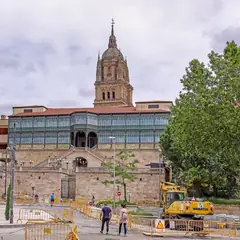
Above it rises the bell tower, which keeps the cathedral’s most visible scar. The Lisbon earthquake of 1 November 1755 left it leaning and at risk of ruin. Some architects advised demolishing it; Baltasar Dreveton chose to bind it with eight tensioned chains and wrap it in a stone batter up to the bell chamber, some 40 metres above the ground. That thickening of the base and a slight lean are still visible.
Tradition says that morning the townspeople ran to shelter in the cathedral and that the bells rang by themselves. The tower, moreover, does not rest only on its chains: it rises on top of that of the Old Cathedral. What that union says about two cathedrals that never quite separated is revealed in front of the portal.
Two centuries pretending to be Gothic
Churriguera choir
Summary of this stop
Inside, the first thing that surprises is the light. The very tall, bright naves were the answer to an old cathedral that the Salamanca of 1509 considered small, dark and low. In the vaults, tiercerons and liernes draw a different star in each bay, and two galleries run along the walls at two heights with medallions and coats of arms.
What is disconcerting is the date of much of that Gothic. Throughout the whole project, from 1513 to 1733, the Chapter imposed on every master the obligation to keep the late Gothic style, so that sections built in the full Baroque period follow Gothic designs. Through the works passed Juan and Rodrigo Gil de Hontañón, Juan de Álava, Pantaleón Pontón, the Churriguera brothers and Juan de Sagarbinaga.
In the centre of the main nave, in the Spanish manner, stands the enclosed choir of the canons, with stalls in an upper and a lower choir and a screen by the French ironworker Duperier. According to the cathedral’s website it was made from 1710 to 1733 to designs by Joaquín and Alberto de Churriguera, although other sources dispute dates and authorship. How, looking closely, one can tell that the Baroque was already around the corner is what the narration helps to discover.
A new dome over an empty altar
Crossing dome and main chapel
Summary of this stop
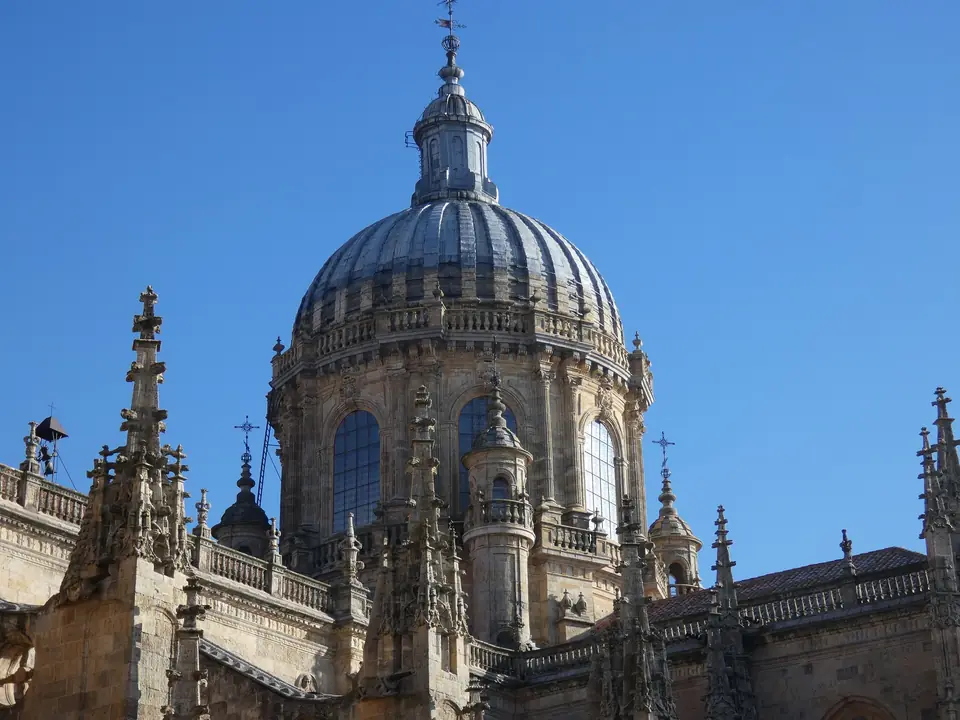
Beneath the crossing, light falls from a drum with wide windows and a hemispherical dome that is not the original. Joaquín Churriguera’s Baroque lantern, finished in 1725, was cracked by the earthquake of 1755 and Juan de Sagarbinaga replaced it with the present one, completed in 1765. The cathedral had been consecrated again in 1762, after repairing the damage of the quake.
Below, the main chapel surprises by what it lacks. Alberto Churriguera’s altarpiece was dismantled in 1743, only eleven years after it was finished, and the marble tabernacle that Ventura Rodríguez designed in its place was never built because of its cost. Today it is presided over by an Assumption by Esteban de Rueda of 1624, beneath a canopy of crimson velvet.
On either side rest two silver urns. One holds, according to tradition, the remains of Saint John of Sahagún, the Augustinian friar credited with pacifying the noble factions that bloodied Salamanca in the 15th century, patron of the city. Which miracles the city attributes to him and why two of its streets bear his mark is told at this last stop.