Museum and former convent
Amber Museum of Chiapas Audio Guide (Museo del Ámbar de Chiapas)
The first convent of Ciudad Real, later a jail, today keeps the fossil resin of Simojovel that gleams in every shop window in San Cristóbal, and with it a scorpion of which no other specimen is known anywhere in the world.
- 50 min of audio
- Fossil amber of Simojovel
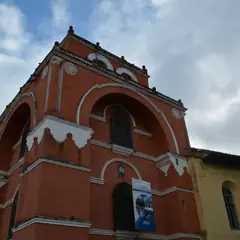
In 1537 four Mercedarian friars who had come from Guatemala founded La Merced, the first convent and church of Ciudad Real, today's San Cristóbal de las Casas. The building later served as the municipal jail, from which it inherited the tower that defines its silhouette, and since 4 December 2000 it has housed the Amber Museum of Chiapas, with more than 300 pieces of a resin that came not from pines but from extinct legumes related to the guapinol.
Behind every honey-coloured bead lie a forest from millions of years ago, a craft that goes back to the Zinacantec mines and a dark gallery in Simojovel, the municipality that produces 95% of Chiapas amber. A piece of 12.8 kilos left there for 16,000 pesos and years later was worth more than 12,000 dollars.
Highlights
- Tower of the former convent — the tower added when the Mercedarian convent served as the municipal jail
- Cloister courtyard and galleries — some 800 m² of the convent founded in 1537, around which the rooms are arranged
- Inclusion display cases — insects, plants and a scorpion of a species described in 2015, seen through a magnifying glass
- Amber sculptures — a marimba, the head of a Maya dignitary and an Indigenous mother, some of them prize-winning
- Colour sampler — raw and carved amber in yellow, red, cognac, green and pink
The story of the Amber Museum of Chiapas begins four and a half centuries before the museum. In 1537 four friars of the Order of Mercy arrived from Guatemala and founded La Merced, the first convent and church established in Ciudad Real, as San Cristóbal de las Casas was then called. The convent later served as the municipal jail, and on 4 December 2000 a museum devoted to the fossil resin of Chiapas opened in it, with more than 300 pieces, in a building that the Patronato Pro Reconstrucción del Ex Convento de La Merced continues to restore.
The date coincides with another. Nineteen days earlier, on 15 November 2000, the Diario Oficial de la Federación had published the declaration protecting the Denominación de Origen Ámbar de Chiapas, which the technical standard NOM-152-SCFI-2003 later developed. Some popular accounts date the designation to 2003, the year of that standard, but the declaration is from 2000.
What to see at the Amber Museum of Chiapas runs from the atrium and the tower to the cloister, and from the inclusion display cases to the carvings by master artisans and the shop. Among the pieces the museum keeps in its care is “Luna”, a complete lizard of the genus Anolis, with remains of skin, found around 2013 in the Simojovel deposits. The audio guide covers the whole in 50 minutes, documented and checked against historical sources, to read each amber bead as what it is: a vanished forest, an Indigenous craft and a mine without light.
The market that stood beside this former convent was moved, in the time of Governor Castillo Tielemans, to the present Castillo Tielemans Market, and the nuns of the Encarnación, the other great convent of the colonial city, raised in 1677 the bell tower of the Arco del Carmen.
A convent that ended up as a jail
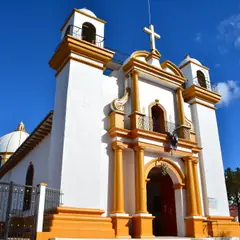
Church of La Merced
Summary of this stop
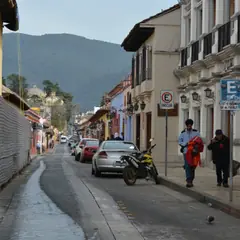
The route starts at the raised atrium of La Merced, the esplanade where artisans set up in front of the church. From here the architecture of the former convent reads as a superposition of three lives: the Mercedarian foundation of 1537, the municipal jail that added the tower that now identifies the building from the street, and the museum that has occupied its rooms since 2000.
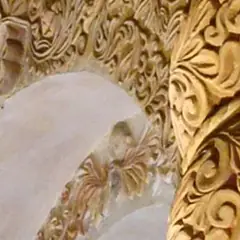
The façade seen is not colonial. The church of La Merced was rebuilt almost entirely in the early 20th century, during the Porfiriato, with a front of columns in stacked storeys and a neoclassical interior. Of the colonial church only the sacristy survived, with a polychrome 18th-century arch populated by rampant lions, mermaids, plumed masks, the sun, the moon and the Habsburg double-headed eagle. Its inscription is dated to 1757 in a detailed description of the arch, although a tourist leaflet places it in 1759.
The neighbourhood also has one of the most exuberant festivals in the city. According to documented tradition, from 22 to 24 September the Virgin of La Merced goes out in procession followed by the panzudos, heirs of the old Moors. What they carry under their shirts and why a gunpowder fuse runs down the street on the third day is what the narration tells at the atrium.
A sober cloister for friars of the Spaniards
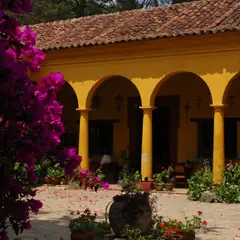
Courtyard of the La Merced cloister
Summary of this stop
Crossing into the central courtyard, the noise of the street gives way to the silence of some 800 m² of conventual galleries, around which the museum’s rooms are now arranged. The plainness of this architecture has a historical explanation: the Mercedarians of Ciudad Real ministered mainly to the Spanish residents and not to the Maya Indigenous quarters, and their slight influence on the civil and religious life of the province resulted in buildings without great flourishes.
That austere cloister is the one that received the amber in 2000, the same year Chiapas resin obtained its designation of origin. The reconstruction of the former convent has not been declared finished: the board that manages it keeps it under continuous works.
How a convent of friars of the Spaniards fits with a stone that Indigenous hands worked for centuries is the question this stop leaves open, and the narration answers it in the courtyard itself.
The unique scorpion trapped in resin
Inclusion display cases
Summary of this stop
In the inclusion display cases amber stops being jewellery and becomes an archive. Insects, plants and small animals were trapped in a resin that does not come from pines but from extinct legumes related to the guapinol; in January 2026 the UNAM described one of them, Hymenaeaphyllum mirandae, which lived in Simojovel 23 million years ago. The exact age of Chiapas amber remains under discussion: the museum speaks of 25 to 30 million years, and other sources place it in the early and middle Miocene.
Simojovel, 130 kilometres from Tuxtla Gutiérrez, produces 95% of Chiapas amber, and there are other mines in Huitiupán, Totolapa, El Bosque, Pueblo Nuevo Solistahuacán, Pantelhó and San Andrés Duraznal. From one of those pits, dug by hand near Simojovel, came a lump of cloudy amber with a whole adult male scorpion inside.
That piece, viewed through a magnifying glass, is the one described in 2015 in PLOS ONE as a new species, Tityus apozonalli, and of which no other specimen is known. How it got from the pit to the display case, and where its name comes from, is the episode the narration keeps for this stop.
From the Zinacantec mines to rosaries
Amber sculpture room
Summary of this stop
The sculpture room brings together amber carvings by master artisans: a marimba, the head of a Maya dignitary and an Indigenous mother with her children, some of them winners of the ExpoÁmbar competitions that San Cristóbal holds every July and August. Next to them are replicas of pre-Hispanic ornaments and a comparison between Baltic and Chiapas amber.
They are the last link in a very long chain. In Tsotsil amber is called pauch; in pre-Hispanic times the Zinacantecs discovered and worked the mines, and the Mexica, who called it apozonalli, came to Chiapas to seek it. In 1722 fray Francisco Ximénez described the amber of Totolapa carved by the Indigenous people into rosaries and images, the main colonial use of this resin. And in 1922 the Danish archaeologist Frans Blom, based in San Cristóbal, travelled to Simojovel and described amber crosses, hands and teardrops used as amulets to protect children from the evil eye.
That protection is not a thing of the past. In San Cristóbal it is still common to see children wearing amber bracelets, and popular belief attributes to the beads a very particular behaviour when they do their job. What happens to an amber bead that swallows the evil is what is told in front of the display cases.
Bright jewels, mines without light
Amber Museum shop
Summary of this stop
The route ends at the counters of the museum shop, the point where amber heads out to the jewellers of the centre. It is not a new or clean business: in a travel account published in 1974, the German geographer Karl Helbig noted that most of the pieces offered in the San Cristóbal market were plastic imitations.
The fever came later. According to testimonies gathered in 2011, in 2000 there were four amber jewellers in the city and eleven years later there were more than 30, while in Simojovel people worked in caves without light or helmets. Around 2013 buyers appeared from Korea, China and Taiwan, and the price per gram went from between 20 and 30 pesos in 2013 to between 115 and 500 pesos in 2015, with 93% of the inhabitants of Simojovel still in poverty. That jump also reached the artisan jewellers of San Cristóbal.
Around La Merced, several jewellers have appropriated the name of museum, and the staff of the former convent teach how to tell real amber from fake. What tests the trade uses, and what happened to the stone of almost thirteen kilos that left Simojovel for 16,000 pesos, is the story that closes the visit.