Shrine and viewpoint
Guadalupe Church Audio Guide (Templo de Guadalupe)
It began as a chapel on the outskirts, between a toll post and a cemetery. Seventy-nine steps from the centre, the devotion of San Cristóbal kept enlarging it until it became its neighbourhood Tepeyac: a viewpoint over the city and the goal of torch-runners from all over Chiapas.
- 35 min of audio
- Guadalupan devotion
On the old "labor de Guadalupe", a hill east of San Cristóbal still almost uninhabited, a small chapel dedicated to the Virgin was built in the early 1830s. Bishop Carlos María Colina y Rubio improved it between 1854 and 1864, around 1880 it took on the look of a proper church, and in the early 1930s, for the 400th anniversary of the Tepeyac apparitions, it was enlarged and given its half-orange dome. It is one of the most important works of the San Cristóbal architect Carlos Z. Flores.
The sculpture presiding over its side chapel arrived by will in 1855, together with 500 pesos meant to pay for Masses. That money ended up buying the land of the hill. And the church's most recent history is also its hardest: in October 2024 the parish received here the coffin of its priest, shot dead one Sunday on his way to Mass.
Highlights
- Stairway of 79 steps — rising from the end of Calle Real de Guadalupe, with small chapels and benches for resting
- Atrium viewpoint — the tree-lined square at the top, with the rooftops of San Cristóbal and the mountains of the valley
- Half-orange dome — with lanterns, raised for the 400th anniversary and blessed in August 1931
- Guadalupe altar — a simple copy of the altar of the old Basilica of Guadalupe in Mexico City
- Carved image of the Virgin — the roughly 1.25 m sculpture that Lino García bequeathed in 1855
The story of the Guadalupe Church does not fit into a single date. Tourist guides usually say the church was built in 1834, but the diocesan documentation describes a building made in layers: a chapel of the early 1830s on an almost empty hill, the improvements by Bishop Carlos María Colina y Rubio between 1854 and 1864, the look of a proper church around 1880, with a bell bought by the neighbours themselves, and the enlargement with a dome in the early 1930s. Some describe it as neoclassical, from the mid-19th century, and others attribute it to the architect Carlos Z. Flores, active between the late 19th and early 20th centuries; both readings coexist.
What is beyond dispute is its place in the city. It has been a parish since 2001, and every December, from the 1st to the 12th, the Guadalupe festival spills out of the nave into the little square and the pedestrian lane. The Virgin of the hill even has her own wardrobe: according to a documented tradition, the women of the Junta de Señoras go round the neighbourhoods and districts from 10 May looking for someone to donate the dresses she will wear for her novena, and the diocese keeps inventories of a jewel box of fulfilled vows that reached some fifty pieces in 1998 and then began to dwindle.
What to see at the Guadalupe Church is ordered from the bottom up: the stairway, the atrium, the nave under the dome and the chapel of the carved Virgin. The audio guide covers it in 35 minutes, documented and checked against historical sources, to understand how a hermitage on the outskirts became the devout heart of San Cristóbal de las Casas.
To the west, in the city centre, stands the San Cristóbal Cathedral, and to the northwest of the hill the Casa Na Bolom keeps the archive of the Lacandon people and their jungle.
Seventy-nine steps of torches and Juan Diegos
Stairway of 79 steps
Summary of this stop
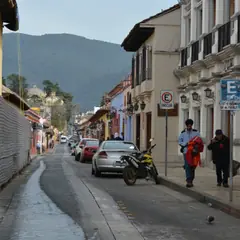
The route begins where Calle Real de Guadalupe ends, at the foot of a 79-step stairway that was built after the church. Small chapels and benches line the climb to the atrium, and at first sight it seems only the price of a good viewpoint.
In December the staircase changes direction. On 30 November the “Misa de Envío” sends off from the church the torches of the city, organised by neighbourhoods and districts, and from 8 to 12 December groups arrive from half of Chiapas, from Tuxtla, Tapachula, Chamula, Tenejapa, Ocosingo or Zinacantán: many barefoot, singing, with banners, flowers and the Virgin printed on their T-shirts. On leaving they climb again to light the torch for the return. On 10 December comes the “children’s climb”, with the little ones dressed as Indigenous people of the region or as Juan Diego, in huaraches and painted moustaches or in huipiles and braids, throwing petals and confetti at the Virgin’s feet.
On those days the pavements of the neighbourhood become open-air dormitories and the church is entered shouting cheers as in a stadium. What those cheers are, and what exactly is heard when a group reaches the last step, is told by the narration at the foot of the stairs.
A hermitage on the edge of the city
Guadalupe Church
Summary of this stop
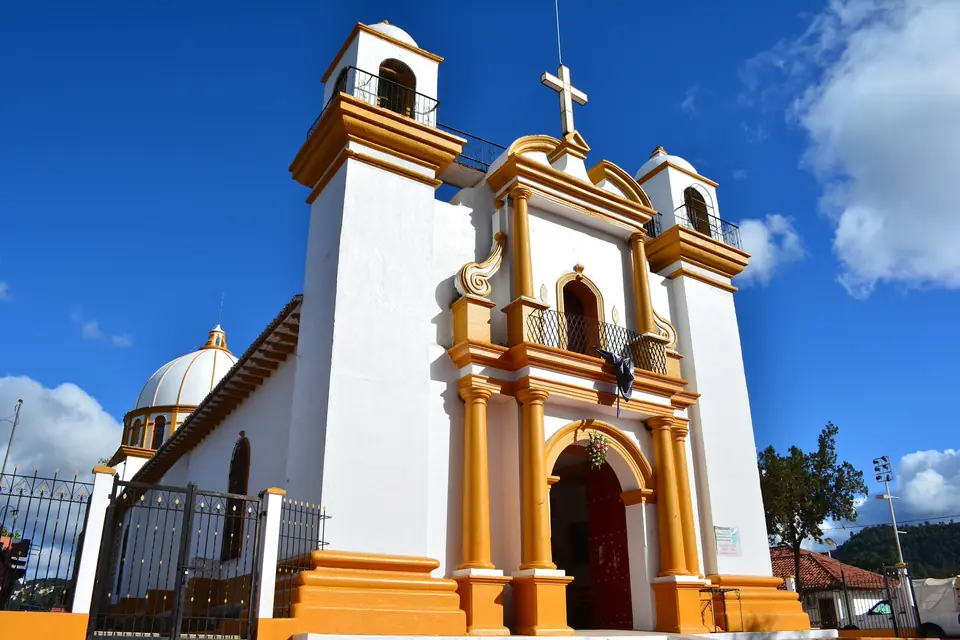
From the atrium, the small tree-lined square at the top, the rooftops of San Cristóbal and the mountains of the valley open out. Opposite stands the whitewashed façade, with yellow and red details and its bell tower. Today it is a viewpoint; for much of the 19th century it was the frontier of the city.
Behind the church stood the Guadalupe toll post, one of the entrances through which traders from the Indigenous villages of the Chiapas Highlands arrived; together with those of San Diego and La Merced, its transit fees were a basic income for the municipal Treasury. In 1879 part of the hill was used as a cemetery, and in 1921, after a flood, the municipality wanted to bury people there again: the neighbours protested to the governor with a letter of more than forty signatures and a colour map of the neighbourhood.
The oldest Guadalupana in the city, moreover, is not the one on the hill but the one in the Sagrario chapel of the cathedral. According to a documented tradition, when the neighbourhood asked for its own parish, the diocese replied in 1896 that it was “not only difficult but to a certain extent impossible”. How that hierarchy was inverted, to the point that every 12 December the image below is left almost alone, is unravelled before the façade.
The dome of the 400th anniversary and the murdered priest
Guadalupe altar under the dome
Summary of this stop
Inside, the wooden choir loft on slender pillars and the roof ties mark the depth of the nave, which ends in a presbytery crowned by a half-orange dome with lanterns. It was raised in the early 1930s, for the 400th anniversary of the Tepeyac apparitions, and on 23 August 1931 Bishop Gerardo Anaya y Diez de Bonilla blessed works that were not yet finished. The Guadalupe altar, with a canvas of the Virgin, is a simple copy of that of the old Basilica of Guadalupe in Mexico City.
That 1931 often causes confusion: the Guadalupana crowned in San Cristóbal that year was the canvas in the cathedral chapel, not the image on the hill, which was then receiving its enlargement.
This altar also holds a very recent memory. On Sunday 20 October 2024 the parish priest of Guadalupe, Father Marcelo Pérez Pérez, was shot dead: a Tsotsil priest from San Andrés Larráinzar known throughout Chiapas for mediating in conflicts and leading peace marches, whom the diocese had moved to this parish because of the threats he received. His coffin returned to the church amid cries of “Justice!”. What happened then before the altar is told in the nave, with the care demanded by a wound that remains open in the city.
Lino García’s Virgin and her 500 pesos
Carved image of the Virgin
Summary of this stop
In the side chapel waits the sculpture of the Guadalupana, a carved “de bulto” image a vara and a half tall, about 1.25 metres, with its camarín. It arrived through the will of Lino García, dated 29 June 1855, although one guide places it in 1850 and not all sources agree on the title given to the donor. It is the same image the church preserves today.
The bequest included 500 pesos to pay, with their interest, for a novena of Masses, but the money had another fate: it was used to buy the “labor de Guadalupe”, the land that Ramón Franco was selling. Beside it is the votive-candle chapel, a former courtyard between the church walls and the sacristy; in 1991 the Junta de Señoritas asked the INAH for permission to replace its sheet-metal roof with a concrete slab and open a chimney to carry off the smoke of the candles.
The route ends here, in the parish that the hill had to wait until 2001 to have. What it means that Masses never said ended up paying for the ground that thousands of pilgrims tread today is the last turn the narration gives this story.