Baroque cathedral
San Cristóbal Cathedral Audio Guide (Catedral de San Cristóbal Mártir)
It was born with the conquistadors' city in 1528 and yet it does not face its main square: time and again, the yellow cathedral of San Cristóbal has been the trench of the bishops who defended the Indigenous peoples against that very city.
- 40 min of audio
- Colonial Baroque
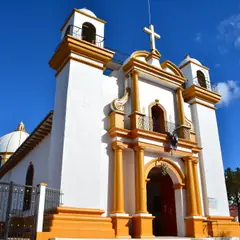
It was the first church of Villa Real de Chiapa: construction began around March 1528, the same month Diego de Mazariegos founded the city. First dedicated to a Marian title, it was consecrated to Saint Christopher in 1538, and in 1539 Paul III's bull Inter multiplices erected the diocese of Chiapas. The façade seen today, Baroque and painted yellow, was finished in 1721 in the manner of an altarpiece, with Solomonic columns and white plasterwork.
Its walls have lived through both the colonial era and Mexico's most recent history. In 1545 Bartolomé de las Casas denied absolution to the encomenderos from here; in 1994 the nave hosted the first peace talks between the Government and the EZLN, and in 2011 it received the burial of Bishop Samuel Ruiz, whom the Indigenous peoples called jTatic.
Highlights
- 1721 altarpiece façade — three levels and three bays with pairs of Solomonic columns, saints' niches and white plasterwork
- Plaza de la Paz — the atrium with its cross, renamed after the 1994 talks with the EZLN
- Gilded high altarpiece — dedicated to the Virgin of the Assumption and to Saint Christopher the Martyr, patron of the city
- Choir, organ and bell gable — completely rebuilt after the collapse in the 2017 earthquake
- Tomb of Samuel Ruiz — the jTatic bishop, at whose grave Pope Francis prayed in 2016
The story of the San Cristóbal Cathedral begins in the same month as that of the city. On 31 March 1528 Diego de Mazariegos founded Villa Real de Chiapa as a base for conquering the province, and around those same dates its first church began to rise. It was originally dedicated to a Marian title (the Annunciation, according to the INAH record; the Assumption, according to other sources) and in 1538, when it was raised to cathedral, its dedication changed to Saint Christopher. A year later, on 19 March 1539, Pope Paul III’s bull Inter multiplices erected the diocese.
It is wise not to take literally the “built in 1528” repeated by guides and leaflets: that date belongs to the first church, and the present building is the result of later reconstructions, with the façade finished in 1721 and touch-ups in the 20th century. After the 2017 earthquake the cathedral stayed closed for five years and reopened on 2 October 2022, after a restoration costing 50 million pesos.
What to see in the cathedral fits into four scenes: the flank facing the Zócalo, the yellow façade over the Plaza de la Paz, the nave of gilded altarpieces and the tomb of a bishop. The audio guide covers them in 40 minutes, documented and checked against historical sources, to read the church as what it has been for almost five centuries: the religious heart of the conquistadors’ city and, at the same time, the refuge of those who stood up to it.
To the north, the Santo Domingo Church preserves the convent founded in 1546 by the friars of Bartolomé de las Casas; to the south rises the bell tower of the Arco del Carmen, and to the east the Guadalupe Church crowns its hill.
The first church turns its flank to the Zócalo
Plaza 31 de Marzo
Summary of this stop
The route starts at Plaza 31 de Marzo, the Zócalo, the founding square whose name recalls the day in 1528 when the city was born. Square and first church seem made for each other, but the cathedral lies to the north and offers it only its flank: its main façade does not face the Zócalo, but its own atrium. On the same square stands the Palacio Municipal, the building the EZLN took on 1 January 1994.
The city’s name holds another paradox. Fray Bartolomé de las Casas, the first bishop to occupy the see, took possession in 1545, and on 20 March of that year he signed a pastoral letter denying absolution to slave owners and encomenderos. He was not the first parish priest, as some guides say, but a bishop, and the first to occupy the seat because his two elected predecessors never took possession.
The Spaniards of Ciudad Real loathed him so much that in 1547 he resigned and returned to Europe. Why the city ended up bearing the name of the man its own neighbours drove out is the thread the narration lays out at this first stop.
An altarpiece façade that was a trench in 1995
Plaza de la Paz
Summary of this stop
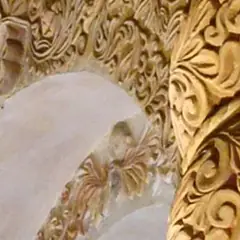
Turning the corner, the main façade appears, finished in 1721 and painted yellow. It is conceived as an altarpiece in stone: three horizontal levels and three vertical bays separated by pairs of Solomonic columns, niches with saints and white plasterwork showing Oaxacan and Guatemalan influence. Above the choir window, a worn relief shows Saint James on horseback with his sword raised. Higher up, the bell gable looks restored: in the magnitude 8.2 earthquake of 7 September 2017 it collapsed onto the choir and the organ.
The deepest wound on this front, however, is a human one. The atrium, with its cross, is called Plaza de la Paz today because from 21 February to 2 March 1994 (dates from the SIPAZ chronology; one source places the delegation’s arrival in March) the cathedral hosted the first talks between Subcomandante Marcos, 18 commanders of the Clandestine Revolutionary Indigenous Committee and the commissioner Manuel Camacho Solís, with Bishop Samuel Ruiz as mediator. The Government put forward 34 proposals; on 12 June the EZLN rejected them with 98% of the votes of its base.
A year later, according to the chronicles of the time, this same façade was the target of stones, sticks and eggs. On 19 February 1995 hundreds of ranchers and merchants who called themselves “authentic coletos” marched against the bishop they called “the red bishop”, while a chain of Indigenous people with flowers in their hands protected the church. What happened that afternoon before the door is told in the narration, in front of the yellow stone.
Chocolate at Mass and a hidden English king
High altarpiece
Summary of this stop
Inside, the nave leads to the high altarpiece, Baroque and gilded, dedicated to the Virgin of the Assumption and to Saint Christopher the Martyr, patron of the city. Around it are the side altarpieces, those of the Assumption, of Saint John Nepomucene and the altar of the Kings, and a carved wooden pulpit covered in gold stands out. On the north side of the nave a small chapel opens, dedicated to the Virgin of Guadalupe.
The gold invites solemnity, but this stop reveals the gossipiest side of the colonial cathedral. According to the account of the friar Thomas Gage, during the episcopate of Bernardino de Salazar y Frías (1621-1626) the Spanish ladies of Ciudad Real had chocolate brought to the cathedral in the middle of Mass; the bishop threatened them with excommunication and posted soldiers at the door, they boycotted the church for a month and he died shortly afterwards, amid suspicions of a poisoned cup. It is the version of a cleric who converted to Anglicanism and was markedly anti-Catholic, and the poisoning never went beyond suspicion.
At the base of a neighbouring altarpiece awaits another oddity: a small portrait of a king of England, Saint Edward the Confessor, mislabelled as “Edward III”. Its origin is unknown, and the hypothesis that circulates links it to Gage himself; how an English monarch reached the Chiapas Highlands is one of the enigmas the narration poses before the altar.
The tomb of jTatic, the bishop of peace
Tomb of Samuel Ruiz
Summary of this stop
The route ends before the grave of Samuel Ruiz García, bishop of San Cristóbal from 1959 to 2000, whom the Indigenous peoples called jTatic, “father”. He died on 24 January 2011 and was buried in his cathedral; on 15 February 2016 Pope Francis prayed at his tomb. Earlier, on 20 December 1994, the bishop himself had begun a hunger strike for peace here, installed in the Purísima chapel, when the church came to be called the Cathedral of Peace: his supporters slept on cots inside the nave and musicians and dancers from Oxchuc danced around him by the light of thirteen candles.
The cathedral does not forget its latest wound either. After the 2017 earthquake it closed the following day, Masses moved to the small pastoral centre attached to its back, and the choir was propped up with timber for years. Bishop Rodrigo Aguilar Martínez, who arrived in 2018, went so far as to describe himself as “a bishop without a cathedral” until the 2022 reopening, with the choir, organ, coffered ceiling and roof completely rebuilt.
The gravestone sums up the thesis of the whole route: the bishop of the Indigenous peoples rests in the conquistadors’ church. The coincidence of dates with which his body returned to the cathedral in 2011, and what happened then in the atrium, is kept to be heard beside the tomb.