Mudéjar tower
Arco del Carmen Audio Guide (Templo y Arco del Carmen)
San Cristóbal's most famous gateway was not born as a gateway: it was the bell tower and choir of a convent of nuns, and it was allowed to exist only on condition that the street kept passing underneath.
- 25 min of audio
- Mudéjar architecture
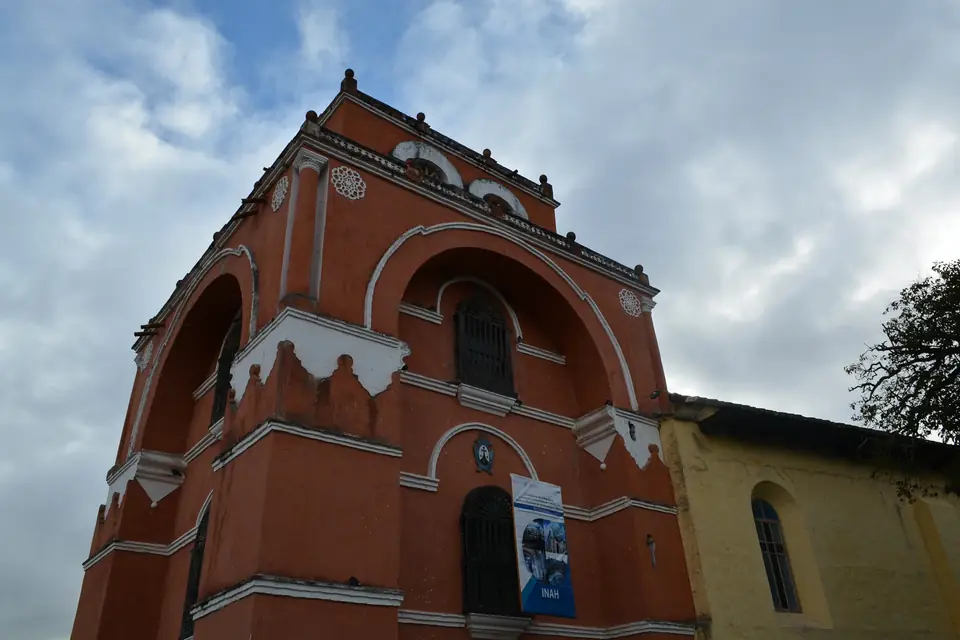
In 1677 the Conceptionist nuns of the Encarnación wanted to raise the bell tower at the foot of their church, but the tower closed off the street, and permission came with a condition: to build it "on arches so that there is a passage below". Thus arose a tower that is at once gateway and choir, with an open passage below, the nuns' choirs above and a domed bell tower at the top. The art historian Manuel Toussaint called it Mudéjar for its resemblance to Spanish Mudéjar architecture, and today it is the symbol of the city.
Of the convent that raised it, the only one of nuns between Oaxaca and Guatemala, almost nothing remains: the secularisation of 1867 turned it into a garrison and split it up, and the fire of 23 March 1993 consumed a good part of the church. What survived was precisely what is crossed every day without a thought: the tower-arch, the double-portalled church and its little square.
Highlights
- Bell tower of 1677 — passage, nuns' choirs and domed belfry, raised over the street by express licence
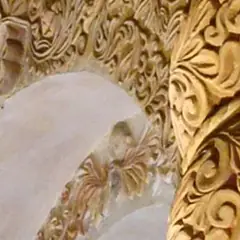
- Vault of the passage — octagonal timber with an eight-pointed star, a feature of the so-called Chiapas Mudéjar
- Cloistered choirs — windows onto the street from which the Conceptionists followed worship
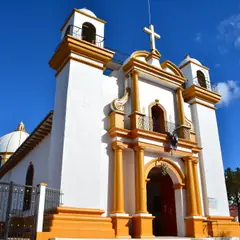
- Church of El Carmen — double portal and L-shaped plan from the brotherhood's chapel arm, of 1764
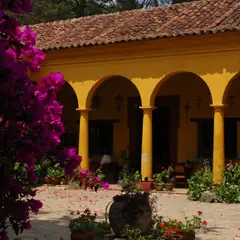
- Plazuela del Carmen — survivor of the convent complex after the fire of 1993
The story of the Arco del Carmen begins almost a century before the arch itself. On 30 November 1595, Philip II authorised by Royal Decree the monastery of Nuestra Señora de la Encarnación of Ciudad Real, the colonial name of San Cristóbal, requested for two hundred and thirty-six noble maidens, daughters of discoverers and settlers. It was the only convent of nuns between Oaxaca and Guatemala, and it was built on the grounds of the church of San Sebastián Mártir. The founders arrived in 1610; the bell tower, in 1677, at the request of the convent’s administrator, José Antonio de Torres.
That is the date given by historiography and the official tourism of Chiapas, although other sources speak of 1680 or, with no more precision, of the late 17th century. Nor is there agreement on its original function: popular guides present it as a triumphal arch or main gate of the city, even as a defensive boundary, while the documentation shows it as the bell tower and choir of a convent, whose lower passage was the condition for not cutting the road and which, incidentally, served as an access to Ciudad Real.
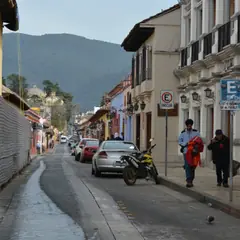
What to see at the Arco del Carmen fits into a short route along the Hidalgo pedestrian lane: the tower read from bottom to top, the vault covering the passage, the little square where it all began and the portal of the church that survived the fire. The audio guide covers it in 25 minutes, documented and checked against historical sources, to understand how a nuns’ choir perched over the street ended up as the postcard of the city.
About 400 metres to the north stands the San Cristóbal Cathedral, and the city’s first convent, that of La Merced, now houses the Amber Museum of Chiapas.
A tower licensed not to close the street
Bell tower of El Carmen
Summary of this stop
A few metres before the arch, on the Hidalgo pedestrian lane, the architecture of the Arco del Carmen can be read by sections. Below, the opening that spans the street; above, the levels of the choirs, with windows onto the street and mortar decoration; at the top, a smaller belfry, with the bells in view, crowned by a dome that was added in the 18th century. Not even the number of levels is settled: one analysis counts three (arch, ante-choir and belfry) and another four (passage, two choirs and domed belfry).
The tower exists because of a negotiation. In 1677 the nuns wanted to raise the bell tower at the foot of their church, but it closed the street, and permission was granted with a clause that can still be checked by walking: it had to be raised “on arches so that there is a passage below”.
Behind those windows lived a small cloistered city. The rules fixed the habit of the Conceptionists, white tunic and scapular and a sky-blue mantle with the image of the Virgin crowned with stars, without gold or stones. Inside, the hierarchy of Ciudad Real was reproduced, with nuns who could pay the dowry and Indigenous and Black women at their service; how the veils were shared out between criollas and mestizas is something the sources only allow us to suppose, and the narration tells it in front of the tower.
A wooden star above the pedestrian lane
Arco del Carmen
Summary of this stop
Under the arch, the passage is covered by an octagonal timber vault with an eight-pointed star, on a square plan and with mortar appliqués: the features of what has been called Chiapas Mudéjar, an echo of Mudéjar coffered ceilings. It is the inheritance Manuel Toussaint saw in the tower when he christened it so for its resemblance to Spanish Mudéjar architecture.
In viceregal times this opening linked convent and church and was one of the entrances to Ciudad Real, passable on foot or by carriage. The same place was, at once, a city gate and the floor of a nuns’ choir.
And there is something more that the neighbours tell. According to popular belief, the second level hides a passage that linked the church with the convent buildings, ordered built by the administrator so that the nuns could cross from one side of the street to the other unseen, keeping their enclosure. Below, carriages and walkers; above, perhaps, someone walking the other way. How much truth there is in it is part of what is heard under the vault.
Three nuns against the bishop’s will
Plazuela del Carmen
Summary of this stop
In the middle of the Plazuela del Carmen the origin of the complex is understood. The convent, called de la Encarnación from 1610 and known as El Carmen from 1930, was born of a tug-of-war. According to documented tradition, in 1609 the oidor Manuel de Ungría Girón, sent by the Audiencia of Guatemala, wanted to bring the founders as soon as possible, while Bishop fray Tomás de Blanes opposed it because the building, after twelve years of work, lacked the enclosure that Trent demanded.
Without the bishop’s blessing, a group of neighbours with the cantor Gabriel de Avendaño and the prebendary Cristóbal de Velasco set off for Guatemala to fetch them. The oidor dreamed of bringing them by river to Chiapa de Indios amid rejoicing and Indigenous conch shells; the bishop ordered that they pass through without stopping, on pain of excommunication.
On 1 March 1610, at midday, three Conceptionist nuns led by sor María de la Concepción were received in Ciudad Real in procession, with Dominicans, Franciscans and authorities, amid celebration and a Te Deum. The end of the day was less triumphant than its beginning promised, and the narration keeps it for the little square.
From the fire of 1993 to the feast of El Carmen
Church of El Carmen
Summary of this stop
In front of the church portal, what draws attention is what is missing. No cloister remains visible: with the Reform Laws, secularisation was decreed between 1861 and 1863 and carried out in 1867; the convent became a garrison and was later split up, and the last nuns survived in neighbouring houses making biscuits and sweets.
The church has a double portal, and its L-shaped plan is due to the chapel arm that the brotherhood of Nuestra Señora del Carmen built in 1764. That brotherhood, with a charter of 1704 confirmed in 1718, was the only one in the southeast that brought together devotees from Chiapas, Tabasco and Yucatán. On 23 March 1993 a fire consumed a good part of the church, with altarpieces, sculptures, paintings and the Guatemalan image of Saint Sebastian.
Even so, the place remains alive. The former complex houses the Centro Cultural El Carmen, with workshops and exhibition rooms, and every 16 July the church celebrates the feast of the Virgin of El Carmen, preceded by processions and neighbourhood fairs and with the solemn crowning of the image on the eve. The route ends here, before the paradox of a city whose symbol is what was left of a cloister.