House museum
Casa Na Bolom Audio Guide
A seminary that never opened ended up as the Jaguar House: the home where a Danish archaeologist and a Swiss photographer kept the memory of the Lacandon people and their jungle, and from where trees are still planted for Chiapas.
- 60 min of audio
- Maya ethnography
The central building of Na Bolom was raised in 1891, according to the association that runs it (other sources say 1898), as a Catholic seminary that never came into operation, and it is considered the first neoclassical civil building in San Cristóbal de las Casas. In 1950 it was bought, in poor condition, by the archaeologist Frans Blom and the photographer Gertrude Duby, who turned it into the Centre for Maya Area Studies, a home, museum, library and, from 1951, guesthouse.
The name is a play of ears: the Lacandon people turned the surname Blom into "Balum", jaguar, and in Tsotsil it became "Bolom". That is why a stone jaguar from an ancient Maya frieze watches over the door. And that is why the story of the house does not end in San Cristóbal, but deep in the jungle, where its owners came to rest eighteen years after Trudi's death.
Highlights
- Stone jaguar at the entrance — a relief from a Maya frieze that Frans Blom placed beside the door
- Neoclassical chapel — semicircular vault with two rows of nine fluted false columns and rosettes on the ceiling
- Gertrude Duby's archive — tens of thousands of black-and-white photographs of the Lacandon jungle
- Fray Bartolomé de las Casas Library — for 20 years the most complete in the state of Chiapas
- Long dining table and nursery garden — lamps made from the Bloms' hats and trees to reforest Chiapas
The story of Casa Na Bolom begins with a building that did not serve its intended purpose. The builder Manuel Penagos raised it as a Catholic seminary, but it never came to function as one; the house passed through several owners and, when Frans Blom and Gertrude Duby bought it in 1950, it was in poor condition. The date of construction is not unanimous: the Na Bolom association, citing Gertrude herself, gives 1891, and some sources speak of 1898. Nor do the biographies agree on the money for the purchase, which some attribute to an inheritance from Blom’s mother and others to one from his father.
The two had met in Chiapas. Gertrude Duby, Trudi, had arrived in 1943 invited by Governor Rafael Pascacio Gamboa to research the Lacandon people, and there she met the archaeologist Frans Blom. Together they founded the Centre for Maya Area Studies in the house in the Cerrillo quarter, and filled it with everything that gave it meaning: a museum with Maya, Zoque and Chiapaneca pieces, a library that came to be the most complete in the state, a photographic archive, a hotel with a communal table and a tree nursery.
What to see at Casa Na Bolom goes far beyond a museum of rooms: it is a house that still seems inhabited by its absent owners. The audio guide covers it in 60 minutes, documented and checked against historical sources, from the street gate on Calle Vicente Guerrero to the garden at the back, passing through the chapel, the photograph corridors and the dining room.
The textiles of the Maya world of the Highlands are kept in the former convent of the Santo Domingo Church, and to the southeast the Guadalupe Church looks out over the city from the top of its 79 steps.
A stone jaguar with a Danish surname
Casa Na Bolom
Summary of this stop
The route starts at the street gate on Calle Vicente Guerrero, where an ancient stone jaguar, from a Maya frieze, marks the main door. Frans Blom placed it there, and it is no ordinary ornament: it is the signature of the house’s name.
According to the Na Bolom association’s explanation, on their first visit the Lacandon people heard the surname Blom and turned it into “Balum”, which means jaguar; in Tsotsil, the Mayan language of the Highlands, the word became “Bolom”. Na Bolom means “the jaguar house”, and in the jungle its owner was called “Pancho Bolom”. Not all sources tell the origin the same way: some present it only as a Tsotsil word and others as a play on words sought by the Bloms themselves.
That feline at the entrance is not the only one in the house. Where the other stone feline appears is something the narration reserves for this first stop.
The chapel of a seminary that never opened
Neoclassical chapel of Na Bolom
Summary of this stop
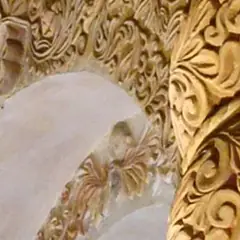
The architecture of Casa Na Bolom is best understood inside the chapel, the part that best preserves its original state. Under a semicircular vault run two rows of nine fluted composite false columns, with round arches and a ceiling decorated with floral rosettes. Today it holds sacred art made in Chiapas and a piano.
It is the clearest trace of the seminary that Manuel Penagos built and that never opened its doors, in what is considered the first neoclassical civil construction in San Cristóbal. Authorship is not entirely settled either: the association attributes the house to Penagos, while other sources hold that the chapel would be the work of the architect Carlos Zacarías Flores, from the early 20th century.
Around the original central courtyard, the Bloms rebuilt the house they had bought half in ruins in order to fulfil a dream: living in San Cristóbal. How an unused seminary is transformed into the home of two explorers is what is heard under this vault.
Photographs of a Chiapas that no longer exists
Gertrude Duby's photographs
Summary of this stop
Along the corridors hang black-and-white images from Gertrude Duby’s archive, among craft collections and wrought-iron crosses from the Cerrillo quarter. According to the museum, the collection holds some 50,000 photographs of a Chiapas that no longer exists and some 14,000 books on Maya archaeology, anthropology and history, although the figures vary by source. The Lacandon, Moxviquil and Gertrude Duby rooms complete the portrait: belongings of the Hach Winik, pieces from the archaeological site Frans Blom excavated in 1952 and 1953 in the same valley, and Trudi’s cameras, dresses and personal objects.
It is told that in 1943 Trudi persuaded a minister to let her join the first official expedition in search of the Lacandon people, which was to be made on horseback, although she had never ridden. She herself later attributed her place to her good looks and the camera hanging from her neck. She became an expert horsewoman, but photographic technique never interested her.
The story of Casa Na Bolom holds a paradox here: the archive that today documents a lost world was made by a woman who, it is said, often forgot to develop her own photos. What that reveals about her way of looking at the jungle is discovered before the walls.
Three languages and hats above the long table
Long dining table
Summary of this stop
The dining room is a living custom. Since 1951 Na Bolom has offered lodging: the Bloms admitted paying guests at their table to finance their expeditions, and Diego Rivera and Henry Kissinger passed through the house, while free rooms were reserved for the Lacandon people who came down to San Cristóbal for medical reasons. Frans Blom boasted that at his meals conversation was always in at least three languages, and the long table still brings together guests from half the world.
Above it hang lamps whose shades are old hats of the Bloms, surrounded by paintings, tapestries and carved wooden jaguars that guests have given over the years. At breakfast, eggs Frans Blom style, with red and green sauce, are still served.
The kitchen had its own protagonist. Bety Mijangos, born in Bochil in 1932, came to the house as a teenager over a sewing problem and stayed as the Bloms’ adopted daughter; Trudi took her to Najá and introduced her to Chan K’in as her daughter “of the heart”. How she ended up in charge of the stoves at Na Bolom is part of what is told beside this table.
Trudi’s nursery and the return to the jungle
Na Bolom nursery garden
Summary of this stop
At the back of the house, a small wood hides El Vivero, founded by Gertrude Duby in 1975. From here thousands of free trees have been handed out to reforest Chiapas, and today romerillo, alder, oak, holm oak and cypress are grown. As early as 1969 Trudi had denounced in the press the felling of the city’s old willows, and in 1971, after the fire that devastated the Cerrito de San Cristóbal, she reforested it with the house’s collaborators and trees from this nursery.
They say that anyone who came asking for little trees was subjected to an interrogation about what they wanted them for and where they would take them, because she did not give them to just anyone: they were, she said, her children.
Frans Blom died in 1963 and Gertrude Duby in 1993, and both were buried in the municipal cemetery of San Cristóbal. In 2011 their remains were exhumed and travelled to the Lacandon village of Najá, beside the grave of their old friend Chan K’in Viejo. The ceremony of that farewell, and what the Lacandon people said about the three friends, closes the route in this garden.