Lived-in hanok neighbourhood
Bukchon Hanok Village Audio Guide
A sloping neighbourhood between two Joseon palaces whose grey roofs are not six hundred years old but date from 1930: serial houses by a Korean developer who stood up to Japanese expansion and died without a house of his own. Today it closes to tourists at five in the afternoon so that its residents can go on living in it.
- 75 min of audio
- Hanok and resistance
Bukchon Hanok Village covers the hillside between Gyeongbokgung and Changdeokgung, the neighbourhood where the Joseon elite lived: the 1906 household register shows 10,241 inhabitants in 1,932 households, and 43.6% belonged to yangban families and senior officials. Even so, most of the hanok seen today are small houses from the 1930s, built by splitting large aristocratic estates into plots, with glass doors, sawn timber and galvanised sheet-metal eaves.
Behind that landscape stands Jeong Se-gwon, who founded Geonyangsa in 1920, the first modern Korean-owned real estate developer, which went on to build some 300 hanok in a single year. With the profits he funded the Korean Language Society, which cost him prison and torture under Japanese colonial rule. He died in 1965 without leaving a single house of his own.
Highlights
- Gahoe-dong 31 rooftop viewpoint — a sea of grey 1930s tiles with Namsan behind
- Baek In-je House — the 1913 mansion built by buying 12 neighbouring hanok, with a tatami room
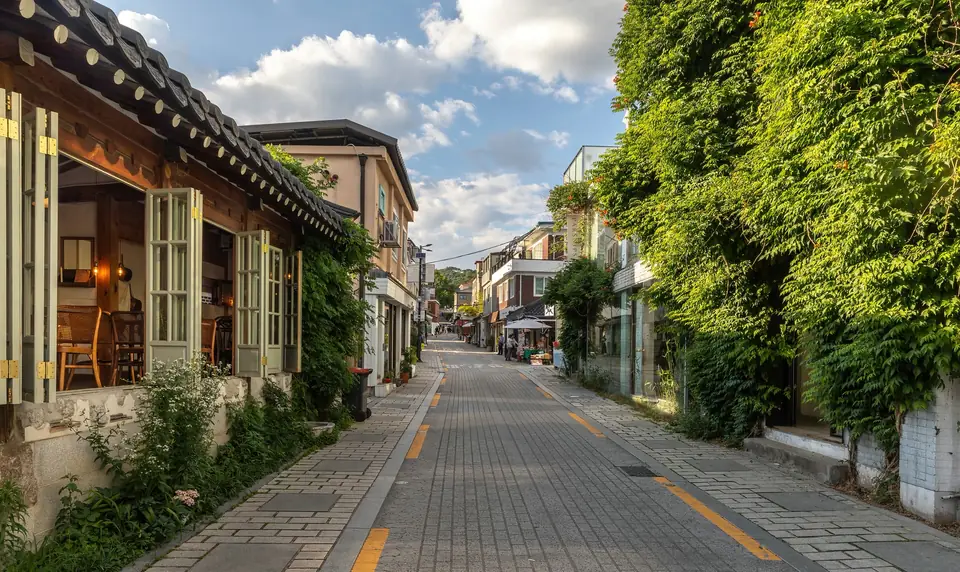
- Bukchon-ro 11-gil alley — the most photographed slope, closed to tourists from 5 pm to 10 am
- Myeongmundang building — a police lookout post that kept gaining floors from 1967
- Joongang School — the guardroom through which a draft independence declaration passed in 1919
Bukchon is often sold as a six-hundred-year-old village of nobles, and the figure has some truth in it: six hundred years is the age of its urban history and the layout of its streets. The houses tell another story. Most of the hanok still standing are small homes from the 1930s, built in series by developers, and that gap between the postcard and the chronology is the thread of the story of Bukchon Hanok Village.
In between, the neighbourhood has been many things. In 1976 it was declared a folk landscape zone and in 1983 a collective aesthetic district, which began the official conservation of the hanok; in 1991 and 1994 Seoul raised the height limits and houses were pulled down all over Bukchon to build apartment blocks. Between 2001 and 2006 the Bukchon Gakkugi programme invested some 84 billion won in recording, repairing and buying hanok. Its record is still disputed: the administration presents it as conservation agreed with residents, while the British journalist David Kilburn, a resident of Gahoe-dong 31 since 1988, and other locals accuse it of having funded reconstructions with concrete basements and of having driven out the original population.
Under the roofs there are also older stories. A documented tradition places in Gye-dong the house where Zhou Wenmo, the Chinese priest who had entered Korea clandestinely, stayed in 1795, and says that Choe In-gil disguised himself as a priest so that the police would arrest him instead. It is also said that the Seokjeong Boreum well, whose sealed rim is still on Gyedong-gil, ran clear for half a month and muddy for the other half.
What to see in Bukchon is spread from south to north, from Anguk-dong to Gye-dong. The audio guide covers it in five stops, with documented narration checked against historical sources, from a building that grew to keep watch to the guardroom of a school through which, according to tradition, a paper arrived from Tokyo in 1919.
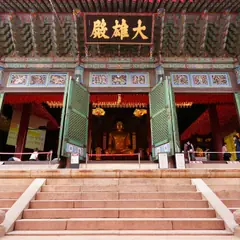
To the west, the neighbourhood borders Gyeongbokgung Palace, and less than a kilometre to the south Jogyesa Temple opened its main hall in those same 1930s.
A building that grew to spy
Yun Po-sun House
Summary of this stop
Opposite the west gate of the house of former president Yun Po-sun, in Anguk-dong, stands the building of the Myeongmundang publishing house, with an uneven silhouette of floors. In 1967 the Jongno police station set up a lookout post on its fourth floor over the house of Yun, then the opposition leader. The family planted tall trees to block the view, and the building kept gaining floors to go on looking over them.
A few steps further on, among the lanes, there are metal poles that pass for street lamps or electricity poles. They were put up after the raid by a North Korean commando in January 1968, to launch smoke bombs by day and flares by night in defence of Cheong Wa Dae, the presidential residence. Of the 68 identified, 12 in Bukchon are registered as Seoul Future Heritage.
In this first stretch the neighbourhood shows that power has always lived next door. How to recognise each pole among the cabling, and what the exact height of the lookout building reveals, is what the narration unveils in front of the gate.
The mansion that swallowed twelve houses
Baek In-je House
Summary of this stop
On a rise in Gahoe-dong, a raised gate with a flight of steps and red-brick walls announce the Baek In-je House. It was built in 1913 by Han Sang-ryong, maternal nephew of the collaborator Yi Wan-yong, and to build it he bought 12 neighbouring hanok. This is the Bukchon of the nobles and senior officials who in 1906 made up 43.6% of the neighbourhood, already settled into the colonial era.
The house mixes worlds. Its sarangchae, the men’s pavilion, has a two-storey section, something foreign to the traditional hanok, as well as Japanese-style corridors and a tatami room. It has been a museum since 18 November 2015.
The staircase lets you read, in stone and wood, the position of the elite that prospered under colonial rule. Which details of the house betray whom its owner wanted to resemble is explained at the foot of the gate.
A street with a closing time
Bukchon-ro 11-gil alley
Summary of this stop
The slope of Bukchon-ro 11-gil is the most photographed street in the neighbourhood, and also the most closely watched. Among its houses you can pick out the glass doors that close off the daecheong, the wooden-floored hall, and the eaves extended with galvanised iron sheet, often painted green, with gutters running down the facades: the new materials of the urban hanok of the 1930s.
The figures explain the signs. Bukchon received some 30,000 visitors in 2007 and 318,000 in 2010, after appearing on television programmes such as 2 Days & 1 Night; in 2024 it received 6.4 million in a neighbourhood of about 6,100 residents, who numbered 8,719 in 2012. In July 2024 the Jongno district declared it the country’s first special management zone, and since 1 November 2024 tourists cannot enter the red zone from 5 pm to 10 am, with fines of 100,000 won from March 2025. Since February 2026 coaches of more than 16 seats have been banned from a 2.3 km stretch.
The curfew divides the neighbourhood: residents and the district defend it for the noise reduction, and some of the shopkeepers hang banners demanding its withdrawal. On this slope the postcard turns into lived-in homes, and what is heard behind the doors when it rains is part of the story the narration tells.
A sea of 1930 rooftops
Gahoe-dong 31 rooftop viewpoint
Summary of this stop
From the top of Gahoe-dong 31, hundreds of grey-tiled roofs press eave against eave, with Namsan, the N Seoul Tower and the skyscrapers behind. It is the trace of an urban operation: in the 1930s the large aristocratic estates were divided into small plots, and that is how the cores of Gahoe-dong 11 and 31, Samcheong-dong 35 and Gye-dong 135 were born.
The author of a good part of that landscape was Jeong Se-gwon, born in Goseong and arrived in Gyeongseong, colonial Seoul, in 1919. In 1920 he founded Geonyangsa, the first modern Korean-owned real estate developer, which bought land, designed and built, and went on to build some 300 hanok in a single year. In 1935 he built and donated the headquarters of the Korean Language Society and paid its expenses; after that society’s incident in 1942 he was imprisoned, tortured and stripped of a good part of his property.
The man who filled Seoul with hanok died in 1965 without a house of his own. Which three objects made up all his material legacy, and why one of them is a dictionary, is the revelation the audio guide reserves for this viewpoint.
A rebellion in the guardroom
Joongang School
Summary of this stop
The route ends in Gye-dong, in front of the gate of Joongang School. There the teachers’ guardroom has been restored as Samil Kinyeomgwan, the March 1st memorial hall, and beside it a monument marks it as the place where the 1919 uprising began to be planned.
According to documented tradition, one day in January 1919 the student Song Gye-baek, arrived from Japan, visited Hyeon Sang-yun, a former pupil older than him and a teacher at the school, and handed him in that room the draft of the declaration of independence that Korean students in Japan would proclaim on 8 February. Opposite, another monument remembers the pupils who on 10 June 1926, as the funeral procession of Emperor Sunjong passed, shouted cheers for Korean independence and threw leaflets.
This neighbourhood of small houses was also a workshop of resistance. How a paper brought from Tokyo passed from hand to hand until it reached the streets is the scene with which the narration closes the visit.