Royal palace of Joseon
Gyeongbokgung Palace Audio Guide
The founding palace of the Joseon dynasty, raised in 1395 at the foot of Mount Bugaksan: burned, abandoned, rebuilt, dismantled and raised again. Almost nothing seen here is as old as it looks, and that is why this is the place to read how Korea lost and recovered its own centre.
- 120 min of audio
- Court of the Joseon dynasty
Gyeongbokgung finished its first phase in 1395, under King Taejo, and the minister Jeong Do-jeon named it after a line of the Classic of Poetry: Gyeongbok, “great blessing”. Here the Hunminjeongeum, the Korean alphabet promulgated in 1446 under King Sejong, was created and distributed, and here stands Geunjeongjeon, the largest main hall of the Joseon palaces, surrounded by gates, courtyards and pavilions lined up from south to north.
The palace has had several lives. It burned completely in 1592, during the Imjin War, and went unused for some 270 years; the regent Heungseon Daewongun rebuilt it from 1865 and by 1888 it counted some 500 buildings. From 1910 it was systematically dismantled, until 40 remained in 1945, while the Japanese Government-General building went up in front of the throne hall. It was demolished in 1995-1996, and the palace is still being pieced back together until 2045.
Highlights
- Gwanghwamun — a gate moved, rebuilt in concrete and returned in timber to its place in 2010
- Geunjeongjeon courtyard — roughly cut granite against glare and nine pairs of rank stones
- Gyeonghoeru — the banquet pavilion on 48 stone pillars in the middle of a pond
- Hyangwonjeong — beside the spot where Korea's first electric light was switched on in 1887
- Geoncheonggung — the private residence where Queen Min was murdered in 1895
The name Gyeongbokgung came from a poem. In the tenth month of 1395, with the first phase of the works just finished, the minister Jeong Do-jeon took the last two syllables of a line of the Classic of Poetry and called the palace Gyeongbok, “great blessing”. He also named the halls Geunjeongjeon, Sajeongjeon and Gangnyeongjeon with Neo-Confucian ideas: the new Joseon dynasty wanted its house to read as a programme of government. Half a century later, in this same compound, the Korean alphabet was created and distributed.
The history of Gyeongbokgung, however, is made of losses. The palace burned in 1592 and lay in ruins for some 270 years; it was reborn between 1865 and 1868 at a cost the people did not forget; it saw Korea’s first electric light switched on and a queen murdered; it was auctioned off in pieces and covered over by the barracks of the Japanese Government-General. Today it is being rebuilt building by building, with a horizon set at 2045, and the fidelity of some of those reconstructions, starting with that of 1867 in relation to the palace before 1592, remains debated.
What to see at Gyeongbokgung depends as much on what is there as on what is missing. The architecture of Gyeongbokgung is arranged on a south-to-north axis closed off by Mount Bugaksan, and the audio guide follows it in five stops, from the Gwanghwamun gate to the private residence of Geoncheonggung, with documented narration checked against historical sources that is heard on foot, in front of each scene.
Gojong’s story continues at Deoksugung Palace, where the court settled on leaving the Russian legation, and the slope between palaces is occupied by the houses of Bukchon Hanok Village, less than a kilometre to the east.
A gate that never stopped moving
Gwanghwamun
Summary of this stop
Facing Gwanghwamun, the south gate, three stone arches open under a timber pavilion, with the black plaque of golden hanja letters and, behind, the silhouette of Bugaksan. The central arch, taller, was the king’s. In front stretches the woldae, the ceremonial platform restored in 2023. Everything seems in its place, and almost nothing always has been.
In 1922 the Japanese critic Yanagi Muneyoshi published in the magazine Kaizō an essay against the demolition of the gate, and the Government-General ended up moving it beside the Geonchunmun gate between 1926 and 1927. Its timber part burned in the Korean War; in 1968 it was remade in concrete, with a hangul plaque written by Park Chung Hee, and between 2006 and 2010 it returned in timber to its original site, 14.5 metres further south and aligned with the palace axis. The 2010 plaque cracked after three months, and the debate over materials, fidelity and the script of the inscription remains open.
At the ends of the woldae two stone haechi keep watch, creatures with ears pressed to the head installed around 1870. The 1870 annals present them as a boundary marker of the palace, within which officials could not ride on horseback; popular belief, recorded since 1886, prefers to see them as guardians against the fire of Mount Gwanaksan. Removed in 1923 and moved three times since, they stand some 39.2 metres north of their original place. Where that exact point would be today is the detail with which the narration opens the tour.
The beasts that did not stop the Government-General
Yeongjegyo Bridge
Summary of this stop
Past Gwanghwamun opens the esplanade of the Heungnyemun gate, rebuilt between 1997 and 2001, where the changing of the guard is recreated, at 10:00 and 14:00, with drum and chwitadae band. On this ground, between 1916 and 1926, the Government-General of Chōsen building was raised, designed by Georg de Lalande and finished by Ichiro Nomura, planted in front of the throne hall on the very site of Heungnyemun. Its demolition began on 15 August 1995, Liberation Day, with the removal of the dome, and ended in November 1996. Some argued for keeping it as colonial memory and because the Republic of Korea was proclaimed there in 1948; today its absence is no longer noticed.
While that building grew, the palace was being sold off in pieces. In May 1910 some 4,000 kan of structures went up for auction, in 1915 many more were pulled down for the Joseon Industrial Exhibition and, of the some 500 buildings of 1888, 40 remained in 1945.
Yeongjegyo Bridge, about 13 metres long, crosses the Myeongdangsu stream, and on its banks four stone cheollok keep watch, beasts with a lion’s mane, a horn on the forehead and a scaly body, placed by custom to stop any evil that tried to slip in following the water. One of them sticks out its tongue, a wink attributed to the humour of the stonemason who carved it. Which one it is, and why these beasts could not stop what came afterwards, is told on the bridge.
A granite courtyard paid for with resentment
Geunjeongjeon
Summary of this stop
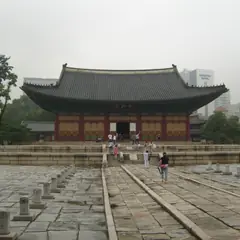
The courtyard of Geunjeongjeon is the ceremonial heart of Joseon: an esplanade of granite slabs deliberately cut rough to reduce the glare of the sun, a raised central path reserved for the king and, on both sides, nine pairs of pumgyeseok, the rank stones where civil and military officials stood. At the far end, the throne hall, with a double roof over two terraces, rebuilt in 1867; inside, the throne before the screen of the sun, the moon and the five peaks, and on the ceiling a pair of seven-clawed dragons.
That solemnity is a rebirth. In 1592 the palace burned completely along with the capital’s two other palaces; the Annals of Seonjo record rumours that blame ordinary Koreans, while other reconstructions stress that the palace was still standing when the Japanese entered. The court moved to Changdeokgung and Gyeongbokgung stood empty for some 270 years, until in 1865 the regent Sinjeong ordered it rebuilt. The regent Heungseon Daewongun directed works of more than seven years, financed in part with the dangbaekjeon coin, and the court returned in 1868. The construction diary, kept at Waseda University and made known in Korea in 2019, tells the other side: a stonecutter who pulled out nails in secret, a stretch of wall that collapsed in midwinter and blue tiles that no one knew how to make any more.
To pay for it, from 1865 the regent asked for a “voluntary” donation, the wonnapjeon, “money given willingly”. According to popular tradition, the people changed a single Chinese character, identical in pronunciation, and turned it into “money paid with resentment”; from those works, too, the Gyeongbokgung Taryeong, the song attributed to the labourers, is said to have been born. What its lyrics conceal is heard on this granite.
The pond of the seal and the alphabet
Gyeonghoeru
Summary of this stop
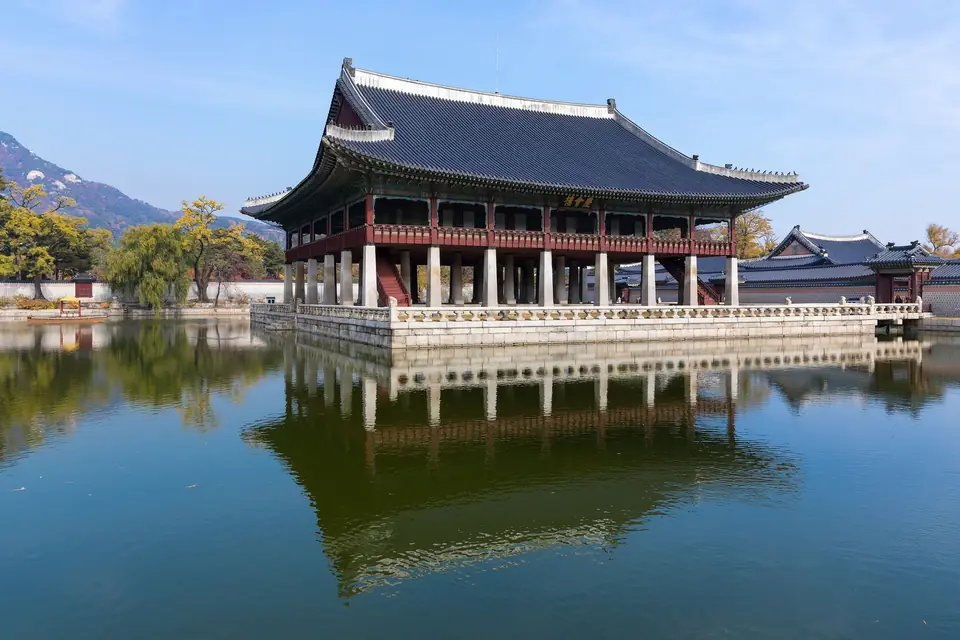
From the east shore, Gyeonghoeru floats over its reflection: a great banquet pavilion on an artificial island, resting on 48 stone pillars, square outside and round inside, joined to land by stone bridges. King Taejong enlarged the pond in 1412 to receive foreign envoys; the present pavilion dates from 1867 and the water measures some 113 metres from north to south and 128 from east to west. Two bronze dragons were placed in it as symbolic guardians against fire: in the 1997 dredging only one turned up, now in the National Palace Museum, and in 1998 two replicas were returned to the water.
South of the pond, on a high, wide platform, stands Sujeongjeon, rebuilt in 1867 on the site of the Jiphyeonjeon, the academy of scholars that worked on the Hunminjeongeum, the Korean alphabet promulgated in 1446 under King Sejong. Few places in Korea weigh so much in its identity as this quiet corner.
The same pond holds a dark episode recorded by documented tradition. In 1455, cornered by his uncle Suyang, the young King Danjong handed over the great seal of the kingdom beneath this pavilion, and the royal secretary Seong Sam-mun left from there humiliated. What was said that day on the shore, and where it led the former sages of the academy, is the scene the narration keeps for this point.
The electric light and the murdered queen
Geoncheonggung
Summary of this stop
At the northern end, the hexagonal pavilion of Hyangwonjeong rises on an island in its pond, joined by the timber bridge Chwihyanggyo, returned in 2021 to its original north side. Very close, a marker shows the site of Korea’s first power plant: between January and March 1887 the country’s first electric light was switched on here, with a plant ordered in 1884 from an Edison company. They called it “mulbul”, water light, and in 2015 an excavation found its remains south of the pond, with carbon arc lamps.
Behind it hides Geoncheonggung, the “palace within the palace”, built in 1873 in secret and with the private funds of King Gojong, like a scholar’s house without the dancheong paint of the rest of the compound. In its Okhoru pavilion Queen Min, Empress Myeongseong, was murdered around 6 in the morning of 8 October 1895. There is consensus that it was carried out by Japanese agents under the minister Miura Gorō, although the degree of involvement of the Japanese government is disputed; the Hiroshima court acquitted the accused. In February 1896 Gojong fled to the Russian legation and never resided here again.
Nearby are displayed the base stones of Jaseondang, the crown prince’s residence, sold in 1914 and reassembled in Tokyo at the house of the businessman Ōkura Kihachirō. The Great Kantō earthquake of 1923 destroyed it, the stones came back around 1996 and the building was rebuilt on its site in 2001, far from them. Why those remains are still set apart from the building they held up is the image with which the narration closes the tour.