Court of the Korean Empire
Deoksugung Palace Audio Guide
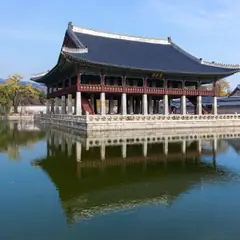
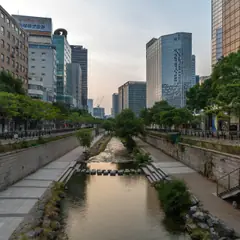
A palace born from a borrowed residence after a war that burned all the others, turned by Gojong into the court of the short-lived Korean Empire. Timber pavilions with imperial dragons and neoclassical granite halls now share a compound wedged between city hall and the skyscrapers of Seoul.
- 60 min of audio
- Korean timber and neoclassical granite
The history of Deoksugung begins in 1593, when the Imjin War had left the capital without a single palace standing and King Seonjo settled in the residence of Grand Prince Wolsan. In 1611 Gwanghaegun raised it to an official palace under the name Gyeongungung. Almost three centuries later, in 1897, Gojong left the Russian legation, settled here instead of returning to Gyeongbokgung and, after being crowned at the nearby Hwangudan, proclaimed the Korean Empire with this palace as its seat.
Few palaces have changed shape so much. The fire of 1904 destroyed most of the buildings and rebuilding them cost more than the empire's entire annual budget. After Gojong's death in 1919, the Government-General dismantled and sold parts of the compound, and in 1933 it opened it as a public park after removing ten buildings. Of the 18 original buildings that remained in 1930, 8 survive, and the present compound is roughly a third of the size it had at its height.
Highlights
- Daehanmun — the gate moved back some 33 metres in 1970 and the setting for the changing of the guard
- Junghwajeon — the ramp of the two imperial dragons and the screen of the Sun, the Moon and the Five Peaks
- Seogeodang — unpainted timber at the core of Seonjo's temporary palace
- Seokjojeon — neoclassical granite with Ionic columns, finished in 1910
- Jungmyeongjeon — the former imperial library where the Eulsa Treaty was signed in 1905
Deoksugung looks small beside Gyeongbokgung or Changdeokgung, and it is: today it covers roughly a third of what it once was. But in this compound, facing City Hall Plaza, Korea tried to become a modern empire and lost its independence. Here Gojong settled in 1897, a step from the foreign legations, after taking refuge in the Russian legation following the murder of Queen Min. Here he proclaimed the Korean Empire, built a throne hall to match the great palaces of Joseon and commissioned a European-style stone palace.
Even the name of the place carries that history. The palace was called Gyeongungung for centuries; Deoksugung, “palace of virtue and longevity”, is the title Sunjong gave his father after the forced abdication of 1907, although the National Archives place it in 1908. In 2011 it was proposed to restore the old name, since the current one was considered a vestige of Japanese interference, and after a public hearing the change was postponed.
The architecture of Deoksugung mixes two worlds openly: timber pavilions with yellow lattices beside neoclassical facades with Ionic columns and a brick pavilion of Romanesque air, Jeonggwanheon, which popular explanation presents as the place where Gojong drank coffee, although a 2018 study finds no records of it between 1900 and 1907. The audio guide covers the palace in five stops, with documented narration checked against historical sources, from the gate of the changing of the guard to the building where the Eulsa Treaty was signed, already outside the wall.
The other stage of Gojong is Gyeongbokgung Palace, which he left after the murder of Queen Min, and the harshest chapter of Korea’s 20th century is told at the War Memorial of Korea, some three kilometres to the south, in Yongsan.
Daehanmun, the gate that moved back 33 metres
Daehanmun
Summary of this stop
The roar of the avenue is cut off at the threshold of Daehanmun, a three-bay gate with a hipped roof. Over the central bay hangs the 1906 sign, written by the minister Nam Jeong-cheol when the old eastern gate Daeanmun, the “Great Peace” gate, was repaired, renamed and became the main entrance. The ceremonial text on the beam explains the character “han” as an enlarged Hanyang and as the sky and the Milky Way. The Annals of Gojong give no reason for the change, and around it circulate versions with no documentary backing, from a character considered ill-omened to a prophecy sold to the emperor.
The gate is not where it was built either. In 1914 it was moved inward into the palace for the opening of a roadway, and in 1970 the widening of Taepyeongno avenue set it back about 33 metres, to its present location. The staircase and the base of its platform were left under the asphalt: only the stone beasts peek out, at ground level.
In front, the royal gate changing of the guard ceremony is held, organised by the Seoul Metropolitan Government since 15 June 1996. It is not the literal copy of an ancient rite but a reconstruction set in the 18th century, with royal posts such as the guard commander, the scribe of the royal secretariat or the keeper of the keys, and it draws around 1.2 million spectators a year. What personal memory helped give it shape is the detail with which the narration opens the tour.
Imperial dragons on a throne without a second roof
Junghwajeon
Summary of this stop
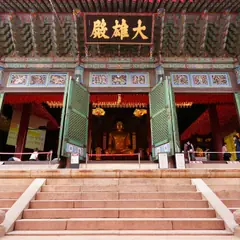
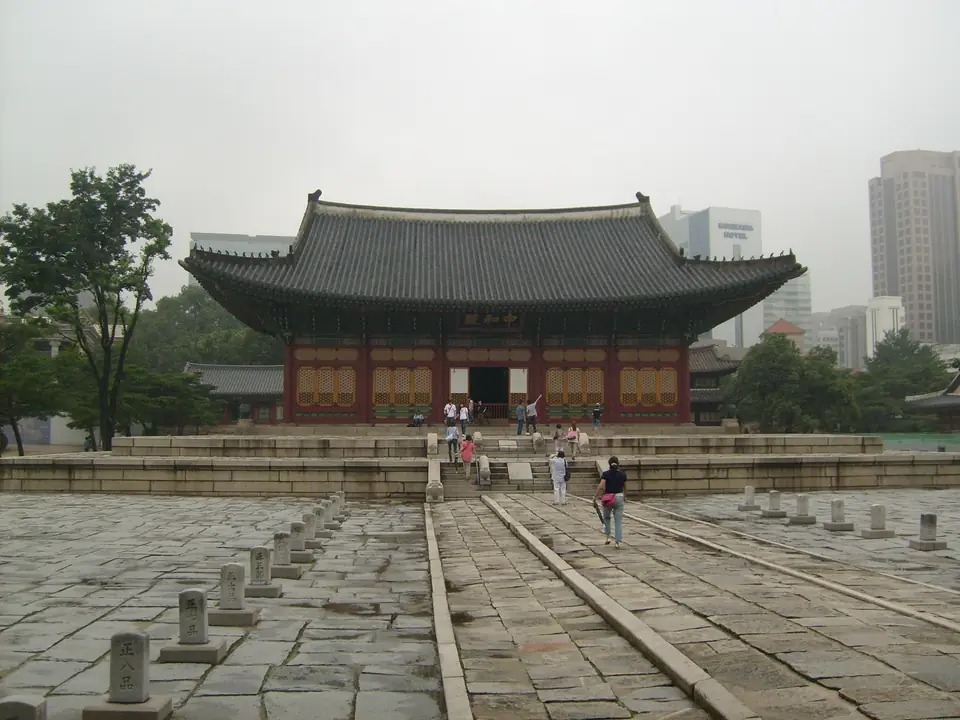
Past the Junghwamun gate, which today stands alone after losing its galleries in the colonial period, appears Junghwajeon, the throne hall, on a double stone platform. It was built in 1902 with two roofs and 5 by 4 bays, on a par with Geunjeongjeon at Gyeongbokgung and Injeongjeon at Changdeokgung. It burned in the fire of 1904 and was rebuilt with a single roof, the one seen today; sources disagree on whether the work was finished in 1905 or in 1906.
The details are a political statement. The central stone ramp carries two carved dragons, symbol of the emperor, while those of Gyeongbokgung and Changdeokgung carry phoenixes, emblem of a tributary kingdom. The lattices were painted imperial yellow, against the green of Geunjeongjeon. Inside, behind the throne, the screen of the Sun, the Moon and the Five Peaks measures 385 by 363 centimetres, and the conservator Jeon Na-na identifies it with the one installed in the rebuilding of 1906; on the ceiling, two golden dragons.
The fire that forced the rebuilding began on 14 April 1904 in Hamnyeongjeon, Gojong’s bedchamber, during work on its ondol underfloor heating. Gojong refused to return to Gyeongbokgung and the rebuilding began the next day. In that same Hamnyeongjeon he died in January 1919, a sudden death that unleashed a rumour of poisoning never cleared up, denied at the time by the Japanese authorities. What the dimensions of the screen say against the construction records is revealed before the throne.
Seogeodang, a king’s refuge and a queen’s prison
Seogeodang
Summary of this stop
The palace was born in this corner. Seogeodang, one of the few two-storey timber buildings in the compound, stands at the core of the old temporary palace where King Seonjo settled in 1593, with all the other palaces of the capital reduced to ashes by the Imjin War. Its timber does not carry the dancheong polychrome of the other pavilions, and it is said that later kings left it that way as a sign of mourning for Seonjo, who died here, and so as not to forget that war. In front grows the oldest apricot tree of the palace.
Beside Seogeodang, the Jeukjodang and Junmyeongdang pavilions are joined. The latter, where foreign envoys were received, served in 1916 as a kindergarten for Princess Deokhye, Gojong’s youngest daughter, and is remembered as the first of the imperial family.
The bare timber also holds the palace’s darkest episode. According to documented tradition, Gwanghaegun confined here from 1615 his stepmother, the dowager queen Inmok, after executing her father and causing the death of her only son. The Gyechuk Ilgi, written from the queen’s side, describes her ladies spending the winter without cotton. In 1623 that prison became the stage of her revenge, and how she did it, from this very courtyard, is what the narration tells in front of Seogeodang.
Seokjojeon, a stone palace out of time
Seokjojeon
Summary of this stop
In front of a geometric garden with a fountain, Seokjojeon dazzles with its granite, its Ionic colonnade and its pediment. The “stone hall” was proposed by the British adviser John McLeavy Brown and is attributed to the design of John Reginald Harding, although some sources also acknowledge a role for the engineer Ogawa Youkichi and the Korean architect Sim Ui-seok. Works began in 1900 and ended in 1910, and Korea was annexed by Japan two months later. Inside, the Daehan Empire History Museum recreates its rooms; next to it, the 1938 West Wing houses the National Museum of Modern and Contemporary Art.
The building saw the rest of the century go by. After the compound became a public park in 1933, the palace survived the Korean War thanks to one specific decision: on 25 September 1950, with hundreds of North Korean soldiers gathered in the compound, the American artillery second lieutenant James Hamilton Dill delayed the order to fire until they had left to the east. The palace was saved almost intact, although the interior of Seokjojeon burned during the war, and in 1996 the South Korean government presented him with a plaque of gratitude.
Before that, in 1946, the palace that the empire had built to look modern became the seat of the US-Soviet Joint Commission. What was discussed in that hall and why it ended without agreement is the scene the narration develops beside the fountain.
Jungmyeongjeon, the library where Eulsa was signed
Jungmyeongjeon
Summary of this stop
The last stop lies outside the wall. The way to it follows Deoksugung’s stone wall, the dating promenade par excellence of the 1960s and 1970s, with a curious local custom: in Seoul it is said that a couple who walk it together end up splitting up. Among the explanations in circulation there is a very prosaic one, because the wall was really cut by a gate of the British embassy from 1959 until its partial reopening in 2017.
At the end appears Jungmyeongjeon, a two-storey Western-style brick building in the Jeong-dong neighbourhood, now separated from the palace by the street. It was first called Suokheon and was an imperial library; after the fire of 1904 it housed Gojong. Here the Eulsa Treaty was signed on 17 November 1905, which deprived Korea of its foreign policy, and today an exhibition remembers it.
In this same building Gojong handed over in 1907 his letters to the secret envoys Yi Jun, Yi Sang-seol and Yi Wi-jong for the Hague Peace Conference, an episode that Japan used as a pretext to force his abdication that same year. What that attempt to ask the world for help left behind is the scene with which the tour closes.