Stream restored in 2005
Cheonggyecheon Stream Audio Guide
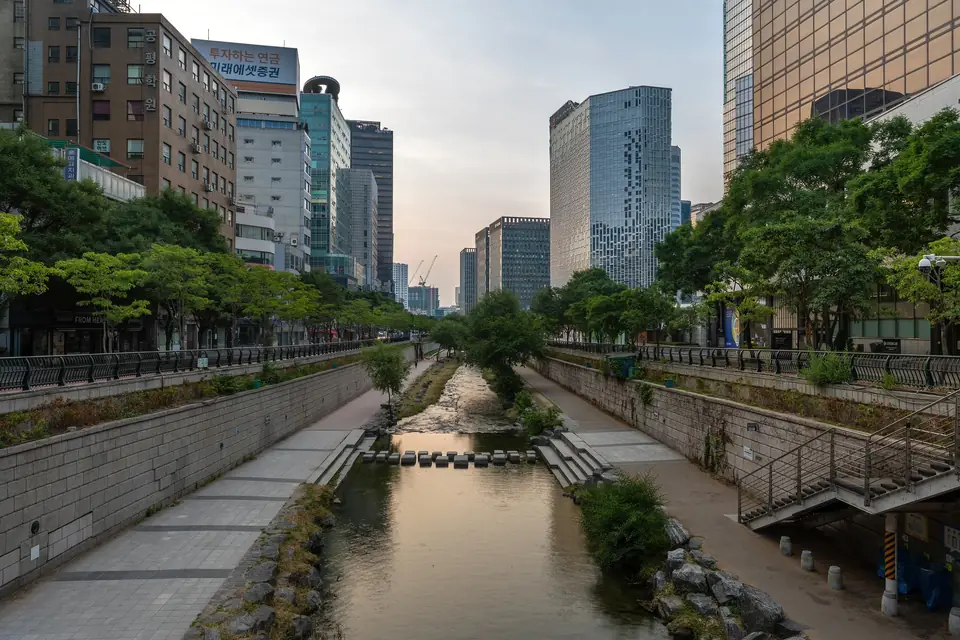
A channel that Joseon dug in 1412, that the postwar years buried under concrete and an elevated highway and that Seoul uncovered in 2005. Today it is a 5.84 km walk sunk below the city, and every bridge holds a decision about what to remember.
- 45 min of audio
- 5.84 km of waterside walk
The Cheonggyecheon began as a state project: in December 1411 King Taejong created an office to channel the natural stream, and in early 1412 some 52,800 workers from Chungcheong, Jeolla and Gyeongsang turned it into the Gaecheon, the “dug channel”, the name it kept throughout the Joseon era. It was the capital's drain, the setting for markets and full-moon games, and its stone bridges were used to measure the water and foresee floods.
What runs through the channel today is not the stream of old. That one was a dry bed that carried water only when it rained; the present one is fed with some 40,000 tonnes a day of water from the Han River, purified and pumped up to Cheonggye Plaza, while the city's wastewater flows underneath. Between the Biudanggyo and Muhakgyo bridges, three pillars of the demolished highway still stand in the middle of the water, with nothing left to hold up.
Highlights
- Gwangtonggyo — the 1410 bridge rebuilt with stones from Queen Sindeok's tomb
- Royal procession mural — 6,960 tiles, 1,779 figures and a horse without a king
- Beodeul Bridge — 800 copper plaques and the statue of Jeon Tae-il
- Three pillars of the elevated highway — preserved in the middle of the channel
- Yeongdogyo — the bridge of farewell between Danjong and Queen Jeongsun
In the ninth month of 1560, according to documented tradition, the bandit Im Kkeok-jeong and his band raided the capital’s prison at night, took out his imprisoned wife and fled along the channel of the Cheonggyecheon. When the guards seemed to have them within reach, they vanished through the Ogansumun, the five-arched sluice gate in the wall beside Dongdaemun, passing through its iron bars. Only two months later Seo Rim, his right-hand man, confessed to the raid, the same man who would end up pointing out his chief so that he could be captured. The sluice gate was destroyed in 1907; a recreation of its five arched openings stands today in the wall, beside Ogansugyo Bridge.
The history of Cheonggyecheon is that of a channel that Seoul used, covered and reinvented. Joseon dug it in 1412 and dredged it on a grand scale in 1760. In the early 20th century the stagnant water smelled foul and, after cholera and typhus epidemics, the Japanese Government-General blamed it and began covering it in sections from 1907; the name Cheonggyecheon became widespread from that time. Between 1958 and 1978 the covering was completed in stretches, and an elevated highway rose above it. On 1 July 2003 Mayor Lee Myung-bak, elected with the restoration as a promise, began to demolish it, and the stream opened to the public on 1 October 2005, after works costing 386.739 billion won that recovered 5.84 km of channel between Cheonggye Plaza and the Sindap railway bridge.
Restoration or creation: the debate remains open. Critics see an artificial concrete canal, a “great fishbowl” fed with pumped water over a channel that was dry most of the year, with ever more expensive maintenance and little heritage recovered; the city council and most visitors present it as an ecological and urban recovery. What to see at Cheonggyecheon, and how to read it, depends on that tension. The audio guide covers it in five stops, downstream from the headwater waterfall, with documented narration checked against historical sources.
A kilometre to the northwest, Jogyesa Temple is the Buddhist heart of the centre, and some two kilometres to the south, on the summit of Namsan, rises the N Seoul Tower, another symbol of 1970s Seoul.
A waterfall of water borrowed from the Han
Cheonggye Plaza
Summary of this stop
The walk starts at Cheonggye Plaza, where the water cascades into the sunken channel and steps go down to its level. The first impression is of a natural river, and it is not: the water is taken from the Han River, at the Jayang intake near Jamsil Bridge, purified and pumped at a rate of some 40,000 tonnes a day that are released here, plus some 20,000 tonnes of groundwater from the metro stations. The original Cheonggyecheon was a geoncheon, a dry channel with isolated pools that ran only when it rained.
At the headwaters stands Spring, a colourful spiral shell about 20 metres high, signed by Coosje van Bruggen and Claes Oldenburg and installed in 2006. It was donated by the company KT for 3.4 billion won, and in a 2005 poll by the Nate portal around 95% of 2,200 citizens opposed paying that sum for a foreign work. Part of the art world judged it foreign to the history of the stream and demanded a work by Paik Nam-june, who grew up near the channel; others defended it for its authors’ reputation. And although it is usually attributed to Oldenburg, the original idea was Van Bruggen’s.
A few steps away, beside Mojeongyo Bridge, the Palseokdam gathers stones representing the eight provinces of Joseon. Since October 2005 coins have been thrown into its centre to make a wish, and it is called “the Trevi Fountain of Seoul”. Between 2005 and May 2025 some 448 million won and some 390,000 foreign coins were collected. Where each of those coins ends up, and why a video filmed in this pond caused such a scandal in 2026, is told in the narration beside the water.
Gwangtonggyo, a bridge made from a tomb
Gwangtonggyo
Summary of this stop
Beneath Gwangtonggyo Bridge, the stream shows itself to be a Joseon work. This was the capital’s first bridge: made of earth in the time of King Taejo, it was washed away by a flood and in August 1410 it was rebuilt in stone. It was the busiest in Hanyang, on the axis that joined the Avenue of the Six Ministries, the Unjongga commercial street and the Sungnyemun gate, surrounded by shops of the official market. On the first full moon of the year it hosted the dapgyo, the popular game of “treading the bridges”.
The architecture of Cheonggyecheon keeps here its most unsettling detail. To rebuild the bridge, pieces from Jeongneung, the tomb of Queen Sindeok, Taejo’s second wife and Taejong’s stepmother, were used. Under the deck, the old, faded stones can be told apart from the new ones, and among them there are carved slabs laid upside down. The use of those stones is recorded; that Taejong placed them like that on purpose, so that all of Hanyang would trample his stepmother, some sources record as a handed-down tale and others as fact.
The bridge is not in its original place either. It was relocated in 2005 some 155 metres upstream, because rebuilding it at the original crossing would have cut four lanes of the avenue, against the principle of conservation on the original site defended by civic groups. What those upside-down slabs tell about a family quarrel at court is what the narration develops beneath the deck.
The mural of the invisible king and the missing bridge
King Jeongjo's royal procession mural
Summary of this stop
Between Jangtonggyo and Samilgyo bridges, a wall of 6,960 white porcelain tiles, 186 metres long and 2.4 high, reproduces the banchado of King Jeongjo’s 1795 procession to Hwaseong for his mother Lady Hyegyeong’s 60th birthday. It shows 1,779 people and 779 horses: the king’s mother, his two princess sisters, civil and military officials and the escort. Beside Jangtonggyo, storytellers in period dress still tell tales of King Sukjong and Jang Hui-bin, whose meeting one of the popular versions places beside a bridge on this stream.
The protagonist of the procession does not appear. Joseon rules prevented depicting the king’s body and face lightly, so the horse Jeongjo rode was painted and not the king himself. Finding that horse among almost eighteen hundred figures turns the wall into a search game.
A little further on, the channel is crossed by a Supyogyo that does not resemble the real one. In 1441 a water-level gauge was installed beside this bridge to foresee floods, and in 1760 King Yeongjo had a level mark engraved on its piers. When the stream was covered in 1959, the granite bridge, about 27 metres long, was dismantled and ended up in Jangchungdan Park; the stone gauge, in the King Sejong Memorial. Today’s is from 2003, because the original does not fit without narrowing the streets. The story of that absence is reserved for the audio guide.
Jeon Tae-il and the copper plaques
Jeon Tae-il Bridge
Summary of this stop
In the mid-1950s, the banks of the Cheonggyecheon were Seoul’s most representative shantytown, full of refugees from the Korean War who emptied their waste into the channel. The covering in stretches, between 1958 and 1978, razed those shacks, raised apartment blocks and shopping arcades and forcibly rehoused many residents in Bongcheon, Sillim, Sanggye and the large Gwangju complex, today Seongnam.
On top came the Cheonggye elevated highway, 5.6 kilometres long and 16 metres wide. The Seoul Archives dates its construction between 1967 and 1971, although other sources describe it as opened in stages between 1969 and 1976. For decades it was, together with the neighbouring Samil Building, a symbol of Korean modernisation, while beneath it the commercial district suffered traffic jams, noise and dust.
Opposite the Pyeonghwa Market, Beodeul Bridge recalls the other price of development. On 13 November 1970, the garment worker Jeon Tae-il, aged 22, set himself on fire there during a protest over conditions in the textile workshops. In 2005 the bridge was paved with 800 copper plaques paid for by citizens, at 100,000 won each, and in the centre stands his 210-centimetre statue. What that act forced the country to look at in the workshops next door is the heart of the narration on this bridge.
Yeongdogyo, the bridge of farewell
Yeongdogyo
Summary of this stop
Downstream, Yeongdogyo Bridge carries a name that sounds like an epitaph. According to tradition, in 1457 the young King Danjong, deposed by his uncle Sejo, left in exile for Yeongwol, and his wife, Queen Jeongsun, accompanied him to this stretch of the stream; there they held hands and wept before parting for ever. It is said that the bridge, formerly Yeongmigyo, came to be called Yeongdogyo, “the bridge crossed for ever”. Danjong was executed that same year; she lived 64 more years without seeing him again. In 2026, with the success of the film The King’s Warden, the bridge filled with visitors.
This stretch also holds a scene of joy. The great dredging ordered by Yeongjo began on 18 February 1760 downstream of Yeongdogyo; two days later the king came in person to the sluice gate, gave food to the labourers and they burst into cheers and dancing. According to the records of the works, once the channel was dredged anyone could pass on horseback under the bridges.
Since the highway came down, the water has regained life: between 2003 and the end of 2008 plant species rose from 62 to 308, fish from 4 to 25 and birds from 6 to 36. Beside the channel the temperature is between 3.3 and 5.9 °C lower than on a parallel street, and some 60,000 people walk it every day. What happened to the stone sign of the bridge during that 2026 frenzy is the scene with which the narration closes the walk.