1975 television tower
N Seoul Tower Audio Guide
A concrete television tower planted on the summit of Namsan, right where Joseon's warning fires ended. It spent five years closed to the public so that nobody could photograph the Blue House, and today every night it changes colour according to the air Seoul breathes.
- 90 min of audio
- Viewpoint in the centre of Seoul
Works began in December 1969, paid for by three private broadcasters, TBC, Dong-A Broadcasting and MBC, who wanted a single radio and television mast for the whole Seoul area. The architect Jang Jong-ryul designed it as a cylindrical reinforced-concrete shaft, built with the experience that the Korean cement industry had gained constructing silos. It was finished on 30 July 1975 as Korea's first general transmission tower: 236.7 metres, with the top at 479.7 metres above sea level, and the tallest in the country at the time.
Just after it was finished, a security inspection warned that its viewing decks allowed the Blue House, the presidential residence, to be photographed. Park Chung-hee then ordered that the tower serve only for broadcasting, and the decks, already built, stayed closed until 15 October 1980, a year after his assassination. The view people now pay to see was for five years a matter of state.
Highlights
- Namsan beacon — the end of Joseon's five fire routes, relit every noon
- Palgakjeong Pavilion — born with Syngman Rhee's pen name and demolished in 1960
- Padlock railings — a 2006 ritual with a sign and a bucket against thrown keys
- Jang Jong-ryul's shaft — 236.7 metres of concrete that at night signal the air quality
- North viewpoint — the view of the Blue House that was forbidden until 1980
Long before television, the summit of Namsan was already the place from which Seoul warned and watched over itself. Here the smoke and fire routes that crossed the kingdom of Joseon ended, here King Taejo had the spirit of the mountain honoured and here, in December 1961, a first 75-metre transmission tower was raised. The antennas that came afterwards occupied the site of the old beacons, and the present tower was designed to replace them all.
The history of N Seoul Tower is also that of its owners. The news channel YTN bought it in December 1999 from the post office employees’ mutual fund, and in 2005 CJ Foodville renovated it for about eight months at a cost of 15 billion won. On 9 December 2005 it reopened under the name N Seoul Tower, and today it still broadcasts the signals of KBS, MBC and SBS while thousands of visitors go up to look at the city.
What to see at N Seoul Tower goes far beyond the viewpoint: a reconstructed beacon, an octagonal pavilion with two names, the stone of a vanished shrine, railings covered in padlocks and a concrete shaft whose architecture owes more to silos than to skyscrapers. The audio guide covers the summit in five stops, with documented narration checked against historical sources, from the plaza to the north window.
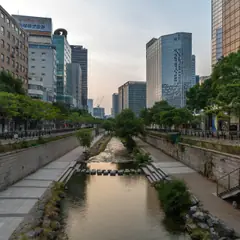
Some two kilometres to the north, at the foot of the mountain, Cheonggyecheon Stream tells the other side of that same Seoul, and at a similar distance to the southwest, in Yongsan, the War Memorial of Korea reviews the Korean War.
The beacon that waited for a single fire
Namsan Bongsudae
Summary of this stop
Beside Palgakjeong Plaza stands a stone platform with chimneys for fire and smoke: the Mongmyeoksan beacon, also called Gyeongbongsu, the capital’s beacon. It was the end of the kingdom’s five signal routes. The code was simple and fearsome: one fire meant peace; two, enemy in sight; three, enemy near the border; four, border crossed; five, fighting under way.
The signal had to reach Hanyang within 12 hours from any point of the kingdom, hopping between beacons about 4 or 4.5 kilometres apart. If rain prevented the smoke from being seen, soldiers carried the warning on horseback to the next one. The system worked until 1895, although the founding date of this beacon varies by source: 1394, 1406 or 1423. On the summit there came to be five platforms lined up from east to west; they disappeared, and in 1993 only one was rebuilt, positioned from the Cheonggudo map and other documents. Whether it occupies its original place is a matter of debate. The site has been Seoul Monument No. 14 since 20 September 1993.
Every day except Mondays, actors dressed as Joseon soldiers make rounds and stand guard beside the stone and at noon light the single fire that meant peace; in the afternoon, in the plaza, there is a spear and sword demonstration. What that lone smoke told a whole kingdom is discovered by listening to the narration in front of the beacon.
A pavilion in place of a shrine
Palgakjeong
Summary of this stop
At the edge of the plaza rises a traditional octagonal pavilion, and beside it a stone with the inscription “Guksadang site”. It is an absence you can see. From 1395, King Taejo had the spirit of the mountain honoured here as “Great King Mongmyeok”. In 1925, when building the Chosen Shrine on the slope, the Japanese authorities tore down the Guksadang so that it would not stand above their Shinto temple. It was rebuilt on Inwangsan with the original materials. Where exactly that Japanese shrine stood remains the subject of different versions depending on the source.
The pavilion has its own political history. On 13 November 1959 it was inaugurated on the old Guksadang site under the name Unamjeong, after the pen name of President Syngman Rhee, Unam. After the April Revolution of 1960 it was pulled down along with his statue, and in 1968 it was rebuilt with a deliberately neutral name: Palgakjeong, “octagonal pavilion”.
First the occupiers ruled and then a president’s vanity; the pavilion’s ownerless name is the scar of both, and the narration reads it stone by stone.
Thousands of padlocks and a bucket for the keys
Padlock railings and trees
Summary of this stop
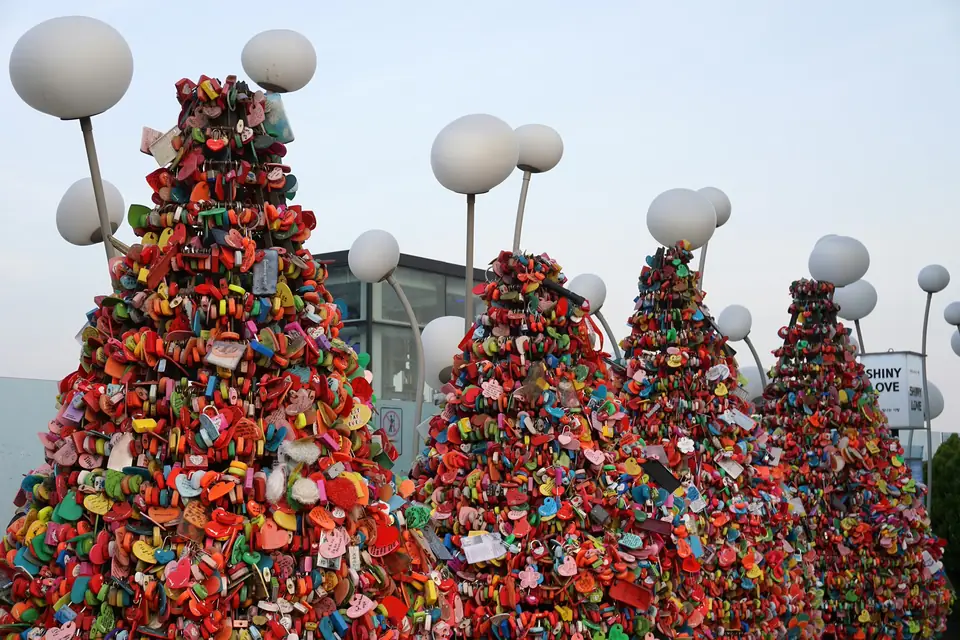
Railings, metal trees and stairs appear covered in coloured padlocks in the plaza and on the Roof Terrace. Namsan’s ritual of eternal love is barely twenty years old: the first padlocks appeared in 2006 and the following year they were officially promoted. In a 2011 survey, hanging a padlock was the favourite activity in Seoul of 16% of foreign visitors. Today they are only allowed in designated areas, and those hung elsewhere or that are too big are removed.
It is said that the idea was brought by Korean visitors who had seen it at Tokyo Tower. The big push came in 2008 with the MBC programme “We Got Married”, when the singer Alex and the model Shin-ae had their dates here, and padlock sales soared. Then came the drama “My Love from the Star”, and many of the padlocks are no longer couples’ but fans’ with the name of their idol. The custom called for throwing the key into the void, but the keys could fall on the people below: the tower put up a sign forbidding it and a bucket to collect them. The fences, moreover, were beginning to bend under the weight.
A tower employee told of a scene that sums up the less romantic side of the metal. What he saw come back to the same fence two months later is reserved for the audio guide.
A concrete silo for three broadcasters
N Seoul Tower
Summary of this stop
At the foot of the shaft you understand who the true owner of the summit is: the signal. Beside the white cylinder there still stands a metal lattice mast, a reminder that this is above all a broadcasting centre. The antennas that from the 1960s displaced the beacons opened the way to a bigger project, and in December 1969 three private broadcasters, TBC, Dong-A Broadcasting and MBC, began paying for a shared tower for the whole Seoul area.
The architecture of N Seoul Tower has an almost industrial simplicity. Jang Jong-ryul designed a cylindrical reinforced-concrete shaft of about 237 metres, built with the craft that the Korean cement industry had learned building silos. The shaft was finished on 3 December 1971, still without interior fittings; the official completion date of the whole, with viewing decks and facilities, is 30 July 1975, although one source places it in August.
From dusk until 23:00, or 22:00 in winter, the tower is lit in a colour that indicates the concentration of fine particles in Seoul: blue for good air, green for normal, yellow for bad and red for very bad. On special dates it changes, as in 2022, when it turned blue and yellow for Ukraine. How a television tower ended up as a thermometer visible from half the city is told by the narration at the foot of the concrete.
The forbidden view of the Blue House
North view from the observatory
Summary of this stop
From the north windows of the viewing deck opens the old Seoul enclosed by its mountains: Bugaksan, with the former Blue House compound at its feet, Inwangsan, Naksan and, in the distance, Bukhansan. It is exactly the panorama that Park Chung-hee’s order kept closed to the public between the tower’s completion in 1975 and 15 October 1980. One floor up, the floor of the revolving restaurant makes a full turn while you eat, and since the 2005 renovation the men’s restroom boasts urinals facing the window, the highest in Seoul.
The tower also stands at the exact centre of the city. In 2010, a GPS measurement by City Hall confirmed that Seoul’s geographic centre is on the summit of Namsan, and a marker, “Seoul Jungsimjeom”, was placed on the east plaza. The earlier reference, from 1896, is in Insa-dong, and the Gwanghwamun milestone is a Japanese stone of 1914 that only marked distances to other cities.
The policing of the views did not end with Park. Between 2022 and 2025, with the presidential residence moved from the Blue House to Hannam-dong, a photo zone of the tower from which the president’s house could be seen was closed. Why this summit has made power uncomfortable again and again is the scene with which the narration closes the tour.