Headquarters of Korean Buddhism
Jogyesa Temple Audio Guide
The head temple of Korean Buddhism was raised in a city that punished monks for entering it. Its great timber hall reuses the beams of another forbidden faith and stands on a base higher than the royal throne's.
- 30 min of audio
- 1938 timber hall
During the Joseon dynasty, a monk who entered the capital risked 100 strokes of the cane and slavery. The ban fell in 1895, and in October 1910 the Gakhwangsa, the first Buddhist temple within the four gates of Seoul and predecessor of Jogyesa, was founded in Susong-dong. The present hall, the Daeungjeon, was consecrated on 25 October 1938 with the columns and beams of a 1925 shrine brought from Jeongeup, and today it is the seat of the Jogye Order.
Wedged between offices in the heart of Jongno, the temple has been much more than a place of prayer. In 1980 martial law troops raided it, in 2015 its monks formed a human barricade before hundreds of police to protect a union leader sheltering in the compound, and every spring the street at its gate is the finish line of the lotus lantern parade, on UNESCO's Intangible Heritage list since 2020.
Highlights
- Daeungjeon — a 160 cm base, higher than the throne hall's at Gyeongbokgung
- Sibiljeon beams — the 1925 shrine of a religion liquidated by Japan
- Dogapsa wooden Buddha — a 15th-century figure, declared a Treasure in 2022
- Ten-storey octagonal pagoda — Buddha relics that arrived from Sri Lanka in 1913
- White pine — Natural Monument No. 9 with a single living branch
The history of Jogyesa begins with a prohibition. Under the Joseon dynasty, a monk who crossed the gates of the capital received 100 strokes of the cane and was made a slave. The ban was lifted in 1895, when Prime Minister Kim Hong-jip passed on to King Gojong the request of a Japanese monk of the Nichiren school, Sano Zenrei. Fifteen years later, in October 1910, the Gakhwangsa was founded in Susong-dong, the first Buddhist temple built within the four gates of Seoul. Its name presented the Buddha as the “emperor of awakening”.
That temple was Japanese in style, and in 1935 the abbots of the country’s 31 head temples agreed to build a headquarters for all of Korean Buddhism in the traditional style. They found it in someone else’s building: the Sibiljeon, the shrine of a Korean national religion that the Japanese authorities had just liquidated. With its columns and beams the main hall was consecrated in 1938, and in 1940 it was given the name Taegosa. When it came to be called Jogyesa is not clear: some sources give 1954, others link it to the unified order of 1962 and others put the formal change off until 1975. Nor is there full agreement on the foundation, which some sources place in 1395, as against the 1910 given by the temple itself, Seoul City Hall and the Encyclopedia of Korean Culture.
What to see at Jogyesa goes beyond architecture: the courtyard has been a refuge for the persecuted, a stage for protests and for harsh internal clashes within the order itself in 1994 and 1998, and every November it fills with families praying for the university entrance exam. The audio guide covers it in four stops, from the entrance gate to the altar, with documented narration checked against historical sources.
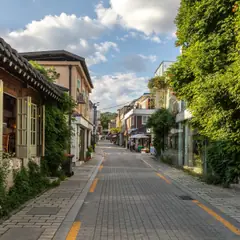
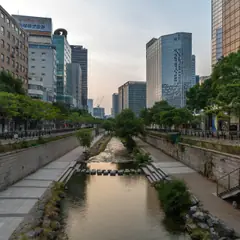
Very close are Bukchon Hanok Village, with its houses from the same 1930s, and, a kilometre to the southeast, Cheonggyecheon Stream, returned to the light in 2005 where an elevated highway once ran.
A gate in a capital that banned monks
Jogyesa Iljumun gate
Summary of this stop
The noise of Ujeongguk-ro avenue is cut off at the Iljumun, the one-pillar gate. Its plaque presents the compound as the head temple of Korean Buddhism, a title carried by no other temple gate in Korea. Beside it, the small Susong Park occupies the site of the vanished Gakhwangsa of 1910, torn down when the temple moved to the new hall: an absence that recalls that everything began a few steps from here.
That stretch of street has two seasons of its own. In the weeks around Buddha’s birthday, thousands of paper lanterns cover the courtyard and the street, which is the finish line of the Yeondeunghoe, the lantern parade inscribed by UNESCO on the Intangible Heritage list on 16 December 2020: it sets out from Heunginjimun, runs along Jongno and turns at Bosingak to the temple gate. In 2026 some 50,000 people marched with about 100,000 lanterns.
In autumn the scenery changes. From early October to early November, a chrysanthemum show fills the courtyard with floral sculptures; in the 2018 edition, a Buddha seated under the bodhi tree, made entirely of flowers, greeted visitors in front of this gate, and inside appeared a guardian dragon, elephants and even a cartoon child hero. Why the chosen flower is precisely the chrysanthemum is explained by the narration at the threshold.
A prayer courtyard turned into a barricade
Ten-storey octagonal pagoda
Summary of this stop
In the courtyard, in front of the hall, rises the ten-storey octagonal pagoda, from 2009, around which the faithful walk slowly. It holds the Buddha relics that the Sri Lankan monk Dharmapala gave to Korean Buddhism in 1913, previously kept in a stupa raised in front of the hall in 1929. Nearby, a pagoda tree more than 450 years old gathers every exam season students and families who pray before it.
The calm is deceptive. On 27 October 1980, Chun Doo-hwan’s martial law command raided the great temples, including Jogyesa, and detained more than 150 monks and Buddhist leaders, among them the order’s president, the Venerable Wolju; the exact figure varies by source, and a municipal plaque recalls those arrests. In November 2015, the union leader Han Sang-gyun took refuge here for weeks, and on 9 December the monks formed a human barricade before hundreds of police until the raid was postponed. The temple had already sheltered activists in 2008 and 2013.
The violence also came from within. According to accounts of the time, in June 1955, in the midst of President Syngman Rhee’s campaign against married monks, more than two hundred celibate monks and nuns shut themselves in the temple on a hunger strike, and one night before dawn some 200 married monks burst in with clubs. What happened that night to the sentry at the gate, and how that strike ended, is told beside the pagoda.
Beams of a forbidden faith, higher than the throne
Daeungjeon facade
Summary of this stop
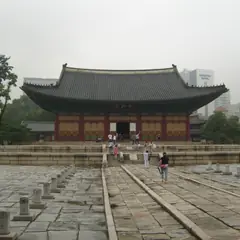
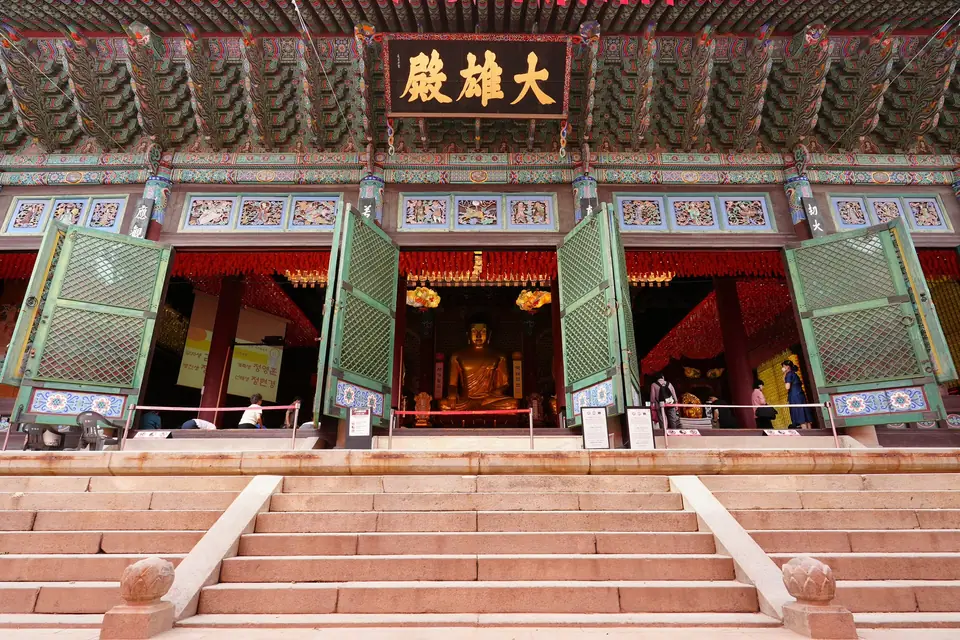
At the foot of the Daeungjeon, the main hall, the architecture of Jogyesa shows its defiance. The building rests on a 160 cm stone base, with stairs on all four sides and guardian animals such as haetae lined up at the front, a device proper to palaces. It is higher than that of any palace hall, including Gyeongbokgung’s Geunjeongjeon, and under the eaves crowd polychrome brackets with two more levels than those of the largest throne halls. The master carpenter Choi Won-sik had directed in the 1920s the reconstruction of the Daejojeon at Changdeokgung.
The facade has no wall: seven bays of doors and windows with flower lattices, with a plum blossom motif on the central doors that is uncommon in temples. That timber has another story. It was raised in 1925 in Jeongeup by Bocheongyo, a Korean national religion that came to have 2 million followers, as a Korean answer to the Chōsen Shrine that Japan had installed on Namsan.
After the death of its leader, Cha Gyeong-seok, the Japanese authorities liquidated the religion and sold off the building cheaply for 12,000 won, when a sack of rice cost 5.30. Buddhists bought it in March 1937, took it apart between 26 March and 5 May and moved its pieces to Seoul. How a persecuted shrine ended up as the seat of Korean Buddhism, and why it dared to outdo the throne, is the central scene of the narration.
Three giant Buddhas and a small displaced treasure
Daeungjeon altar
Summary of this stop
Inside, over the Gangwon red pine floor, the hall keeps the columns and beams of the Sibiljeon, whose form hardly changed. It was consecrated on 25 October 1938 before a great crowd, at a cost shared among the country’s 31 head temples. Above the altar three golden Buddhas of 5.3 m dominate: Sakyamuni in the centre, Bhaisajyaguru and Amitabha at the sides.
To the right, on an altar of its own, waits a much smaller figure: the seated wooden Buddha that arrived in June 1938 from Dogapsa Temple in Yeongam for the inauguration. Dated to the 15th century, in the Tibetan style adopted by Ming China and very rare in Korea, it was declared a Treasure in 2022, although its date and authorship are still debated. It was the main Buddha until the renovation begun in 2004, which replaced the ceiling with its paintings, the mother-of-pearl altar and the original tatami floor. The temple presented it as a return to the traditional style; the art historian Lee Kang-geun criticised it as a serious mistake.
Every November, on the eve of the suneung, the national university entrance exam, the hall fills with mothers, fathers and grandmothers who prostrate themselves before the Buddhas, up to 108 times, and outside yellow candles are lit with the student’s name and wish. What those families write, and what that ritual says about Seoul, is the scene with which the narration closes the tour.