Royal monument
King Ramkhamhaeng Monument Audio Guide
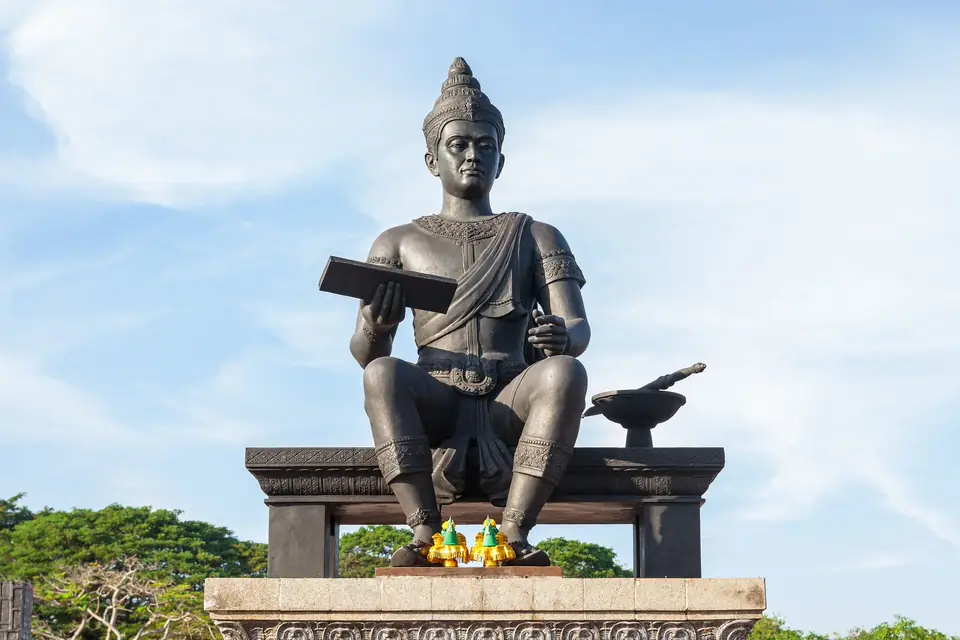
A bronze king seated on the exact copy of his stone throne of 1292, in the very heart of old Sukhothai, ringed by reliefs that tell of the bell of justice and facing the most venerated and most disputed stele in Thailand.
- 20 min of audio
- Bronze statue of 1976
The King Ramkhamhaeng Monument grew out of a request by the people of Sukhothai in 1964 and a long road: foundation stone in 1969, casting in Bangkok in 1970 under the presidency of King Bhumibol and Queen Sirikit, a year’s wait beside the mound of the old palace and enthronement on the pedestal on 13 April 1976. The square three-tier pedestal imitates the base of a chedi at Wat Mahathat, and on its front it bears a double-size copy of Inscription No. 1.
What makes this bronze more than a tribute is what surrounds it. According to a documented tradition, in the rite before its inauguration the spirit of the king was invited to leave the shrine of the province’s protective goddess and live in the statue; today it receives flowers, by popular custom also pigs’ heads, and every 17 January an official homage. All of this facing a stele whose authenticity historians have disputed since 1987.
Highlights
- Seated statue of the king — Bronze of about 3 tonnes and about 3 metres, twice life size
- Manangsilabat throne — Life-size replica, 4 by 2.88 metres, of the stone slab of 1292
- Double-size stele — Copy of Inscription No. 1, the most venerated and most disputed text in Thailand
- Pedestal reliefs — The white elephant Arujakhri, the duel against Khun Sam Chon and the bell of justice
- King Ramkhamhaeng Day — Official homage before the statue every 17 January, with offerings and a procession
In the heart of the old city of Sukhothai, between the mound of the ancient palace and the great temple of Wat Mahathat, a bronze king waits seated with his legs hanging down. The King Ramkhamhaeng Monument (พระบรมราชานุสาวรีย์พ่อขุนรามคำแหงมหาราช) is not a ruin of centuries but a work of the 20th century: the statue was cast in 1970 and has stood on its pedestal since 13 April 1976. Even so, nobody here treats it as a museum piece.
The history of the King Ramkhamhaeng Monument begins with a request from locals. On 25 January 1964, during the royal visit to open the Sukhothai National Museum, the inhabitants of the province asked for a statue of their king; the Government approved the project on 7 July of that year and commissioned the Fine Arts Department with its design, modelling and casting. On 26 November 1969 Field Marshal Thanom Kittikachorn, then prime minister, presided over the laying of the foundation stone of the pedestal. The sculptor was Sanan Silakorn, a master craftsman of the department and a pupil of Silpa Bhirasri, founder of Silpakorn University and a pillar of modern Thai art. His commission had a difficulty from the start: giving form to a monarch of whom no portrait survives and whose reign school chronology fixes between 1279 and 1298, although George Cœdès considered it more likely that he died shortly before 1318.
The architecture of the monument quotes that of the ancient city. The pedestal, square and of three tiers with lotus-petal mouldings, imitates the base of a round chedi at Wat Mahathat and is climbed by stairways on its four sides. On the front face stands a double-size copy of Inscription No. 1, the Ramkhamhaeng stele; around it, reliefs translate its passages into images; above, the king sits on the life-size replica of the Manangsilabat stone throne, which he himself had carved in 1292.
That text is at once the most venerated and the most disputed in Thailand: since 1987 a part of the specialists has doubted its authenticity, and in 2003 UNESCO inscribed it in its Memory of the World register. Devotion does not wait for the debate to close. According to popular custom, at the foot of the pedestal some leave pigs’ heads and trotters next to the flowers, and at Songkran, the Thai New Year in April, some splash water only on the statue’s feet for good luck.
To know what to see at the King Ramkhamhaeng Monument, the audio guide walks it in four stops and 20 minutes: from the front esplanade to the giant stele, from the pedestal reliefs to the top of the stairway, where the king is almost at eye level. The thread that joins them is a paradox: a bronze of 1976 that Sukhothai still visits like a neighbour, even though the stone that tells his story remains under suspicion.
About 350 metres to the south, Wat Mahathat, the great reliquary of the city, also enters the debate over where the stele was found. To the west, on top of a hill, Wat Saphan Hin may be the forest to which, according to that same inscription, the king rode on his elephant, and to the east Wat Traphang Thong keeps the Buddha footprint that Lithai consecrated in 1359.
A statue the locals asked for
King Ramkhamhaeng Monument
Summary of this stop
From the esplanade in front of the monument the whole figure is taken in: the stepped pedestal, the stairways and, above, the seated king. What cannot be seen from that distance is the long road that led here. After the locals’ request in 1964, the statue was cast on 7 December 1970 in the craft workshops of the Fine Arts Department, in Bangkok, in a metal-pouring ceremony presided over by King Bhumibol and Queen Sirikit. Then came the wait: the bronze reached Sukhothai on 13 April 1975 and spent a year in a temporary ceremonial pavilion beside Noen Prasat, the mound of the old palace, until on 13 April 1976 it rose onto its pedestal amid a great celebration. The sources do not always agree: one guide gives 1971 as the year of erection, and the official opening by the crown prince appears in some as 1985 and in others as 1983.
This same ground changes completely in January. Around 17 January, King Ramkhamhaeng Day, the State holds an official rite of homage before the statue. An envoy of the king arrives from Bangkok, who in 2022 was General Surayud Chulanont, president of the Privy Council, to lay the royal household’s floral arrangements and light incense and candles; the governor leads the placing of wreaths and public bodies, companies and locals parade in procession. There are offerings, recitation of sarabhanya psalms and folk-art shows, and at the Sukhothai Witthayakhom school battles with war elephants and martial arts are staged.
The edition of 17 to 19 January 2026 marked the 50th anniversary of the monument with the descendants of Sukhothai prostrating before the king, a contest of “grandchildren of Pho Khun”, games of chess with people as pieces and a light and sound show. During Loy Krathong and the Sukhothai candle festival, the esplanade also joins the festive route of the old city. Before the full figure, the audio guide explains why this monument is fully understood only on those days.
The most venerated and most disputed stele
Ramkhamhaeng stele at double size
Summary of this stop
On the front face of the pedestal, an enormous slab draws the eye before the king himself: it is a copy of Inscription No. 1, the Ramkhamhaeng stele, reproduced at double its real size. The original, about 114 centimetres high, has been in the National Museum in Bangkok since 1968. Enlarged like this, the stone reads as what tradition sees in it: a founding text.
Its modern story begins a few steps from here. In 1833 Prince Mongkut, then a monk and future King Rama IV, found it among the ruins of Noen Prasat, together with a carved slab that was taken for the throne of the king of Sukhothai, and took both to Bangkok. That find marks the province’s calendar today: in December 1988 the provincial council proposed a King Ramkhamhaeng Day every 17 November, the date on which Crown Prince Vajiralongkorn inaugurated the monument, and the celebration was later moved to 17 January, the day in 1833 when Mongkut found the stele.
That same stone has divided historians. In 1987 Michael Vickery compared it with the Piltdown man fraud and Michael Wright published his doubts; in 1988-1989 Piriya Krairiksh argued that Mongkut himself had fabricated it in the 19th century, and Prasert na Nagara attributed to the king only the first 17 lines. On the other side of the scale, a 1990 electron-microscope analysis dated it as contemporary with four other Sukhothai inscriptions, and most specialists consider it at least partly authentic. The debate did not stay in the journals: a 2004 article by Piriya and Wright provoked angry protests in Sukhothai and threats of legal action. Facing the stele, the audio guide sets out both sides of the argument without treating it as closed.
A bell of justice with a Tamil past
Pedestal reliefs
Summary of this stop
Around the pedestal, the stele turns into images. The reliefs show the king on the white elephant Arujakhri, on his way to the standing Buddha Phra Attharot of Wat Saphan Hin on a full-moon day; the free trade in cattle and horses; the duel on elephant back against Khun Sam Chon; the people of Sukhothai giving alms, and one more scene: the king receiving his subjects’ complaints.
That last one refers to the most famous passage of Inscription No. 1: a bell hung at the palace gate that any commoner with a grievance could strike; on hearing it, the king had him brought in, questioned him and settled the case in person. The bell is usually presented as a unique trait of Sukhothai’s good government, but the motif is far older. The king who hangs a bell so that anyone wronged may ask for justice already appears in the Purananuru, a Tamil poetry collection from between the 1st century BC and the 1st century AD, where the one who rings it is a cow whose calf had been run over by the prince’s chariot; the tale travelled through Sri Lanka and Bagan before reaching Southeast Asia. Between one version and the other there is a basic difference: in the Indian one, the king obeys a divine law to the point of executing his own son; in the Sukhothai one, it is the king who judges.
The scene also has a copy that circulates across the whole country. On 1 April 2013 the Bank of Thailand put into circulation a 20-baht banknote whose reverse reproduces this statue on its throne, together with the stele, the invention of the Thai script, the king attending his subjects’ complaints, the bell of justice and Sangkhalok ceramics. A new series arrived in 2018, but the Ramkhamhaeng note is still in circulation. Before the reliefs, the audio guide reads panel by panel what the stone tells.
A throne of 1292 that is not empty
Manangsilabat throne and statue of the king
Summary of this stop
At the top of the front stairway, the king is almost at eye level. The figure, of brass with blackened copper, weighs about 3 tonnes and stands about 3 metres, roughly twice life size. He sits with his legs hanging, holds a book or manuscript in his right hand and raises his left in a gesture of teaching his people. To his left, on the throne, a footed tray, the phan, holds the royal sword, symbol of the power of the State. With no portrait to rely on, Sanan Silakorn imagined the king’s face and bearing from the nobles of Sukhothai, and his face copies that of the Buddhas of the Sukhothai style.
Beneath him, the throne is a life-size replica, 4 metres by 2.88, of the Manangsilabat, the stone slab that Ramkhamhaeng had carved in 1292 and placed in the middle of a palm grove planted fourteen years earlier. On holy days a monk preached from it; the rest of the days, the king sat on top to dispatch affairs of State with officials and princes.
On that copied stone something more than an inauguration took place. According to a documented tradition, on 17 November 1985, before opening the monument, the crown prince presided over the rite of inviting the spirit of the king to leave the shrine of Phra Mae Ya and stay to live in the statue. Phra Mae Ya is the protective goddess of the province, a stone figure of about 130 centimetres that locals venerate as the spirit of Nang Sueang, the king’s mother, and that others identify with Phra Khaphung Phi, the spirit the stele calls the most powerful in the kingdom. At the top of the stairway, the audio guide closes the tour before a throne that, for Sukhothai, is not empty.