Khmer shrine
Wat Si Sawai Audio Guide
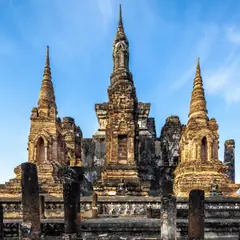
Before Sukhothai existed, these three towers were already here: a Khmer shrine raised for Hindu gods, turned to the south against custom and later made a Buddhist temple by sticking prayer halls onto its front.
- 30 min of audio
- Hindu Khmer shrine
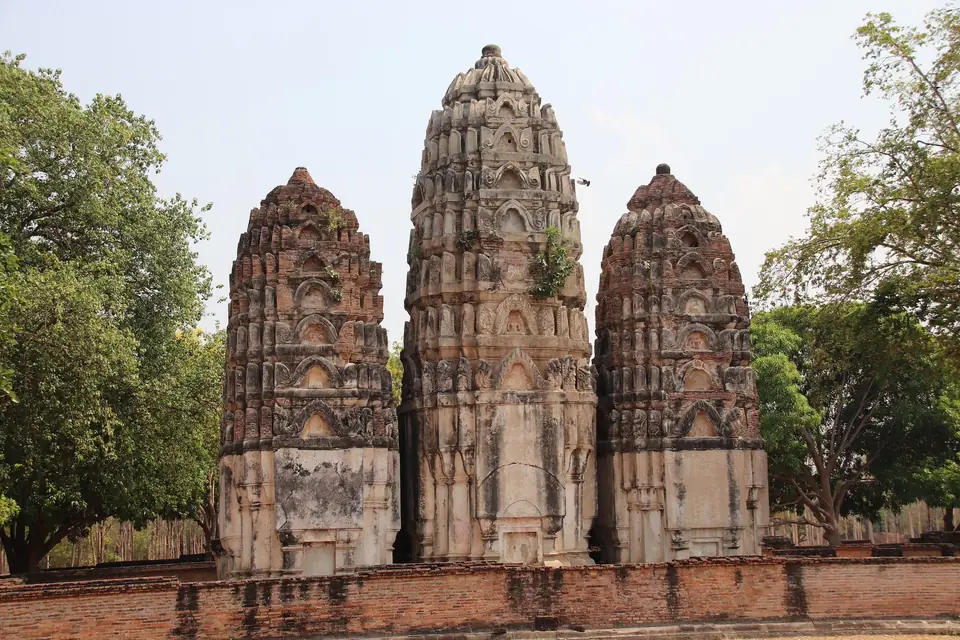
Wat Si Sawai is a Khmer shrine of three corncob-shaped prangs, founded at the end of the 12th century or the start of the 13th, during the reign of Jayavarman VII (1182-1219), a devoutly Buddhist king under whom it nevertheless functioned as a Hindu temple. By the 14th century it became a Buddhist monastery and received two prayer halls, or wihan, on its south side. Inside a double walled enclosure remain the towers, the attached central hall, the laterite pillars of the south hall and a Shiva yoni in the open air.
The towers do not hide their biography. Their lower halves are laterite and their upper ones brick: the Khmers left the work unfinished and other builders completed it, with stucco nagas, garudas and kalas among which motifs from Chinese Yuan-dynasty porcelain peep out. On top, the modern restoration left a smooth patch on the central prang that can be told apart at a glance. And the original name is lost: Prince Damrong proposed that Si Sawai is a corruption of Sri Siwaya, “glorious Shiva”.
Highlights
- Three Khmer prangs — Laterite and brick towers, the central one about 15 metres, facing south rather than east
- Shiva yoni — The ritual base of the lingam, exposed in the open air beside the eastern prang
- Stucco pediments — Nagas, garudas, makaras and kalas, with echoes of Chinese Yuan porcelain
- Attached wihan — Two 14th-century Buddhist prayer halls stuck onto a Hindu shrine
- Sa Loi Bap moat — The pond where, according to locals, sin is made to float away
In Sukhothai Historical Park, Wat Si Sawai (วัดศรีสวาย) holds a clue that contradicts the image of the city as the cradle of Thai Buddhism: three corncob-shaped Khmer towers, the prangs, raised for Hindu gods before the kingdom existed. Sukhothai did not tear them down. It inherited them, ringed them with Buddhist prayer halls and moved on, leaving the seam between one faith and the other in plain view.
The history of Wat Si Sawai begins at the end of the 12th century or the start of the 13th, during the reign of Jayavarman VII (1182-1219), a devoutly Buddhist Khmer king under whom, paradoxically, the shrine functioned as a Hindu temple. The pieces found in the compound give it away: a lintel with Narayana, that is, Vishnu, reclining on the cosmic ocean, fragments of divine images and a lingam of Shiva. Which god it was dedicated to remains in dispute: one version ties it to Vishnu and his rite, and others consider it a shrine of Shiva, because of the lingam, the yoni and the image of the god found here. The original Khmer name is lost. Prince Damrong Rajanubhab proposed that Si Sawai is a corruption of Sri Siwaya, “glorious Shiva” in Pali, although the popular translation “Temple of the Mangoes” also circulates. And the tangle does not end there: the map that the Historical Park hands to visitors spells it “Wat Si Sawat”, a typo copied on many websites; another common transcription is Wat Sri Savaya.
The architecture of Wat Si Sawai has an oddity from the start: the three towers face south, whereas most Khmer temples, including the other two in Sukhothai, Wat Phra Phai Luang and San Ta Pha Daeng, are oriented to the east. The central prang measures about 15 metres and the side ones, equally wide, are a few metres lower. They are laterite below and brick above, because the Khmers left the work unfinished; when it was completed is also disputed, since some sources attribute the brick crown and the stucco to Sukhothai, around the 14th century, and others take it to the 15th, already in the Ayutthaya period and in the Lopburi style. An inner brick enclosure of about 30 by 36 metres surrounds the towers and the central hall, and an outer laterite wall of about 100 by 110 metres closes the complex; between them stands a small laterite building of unknown function and, in the southeast corner, a large bodhi tree with its roots raised above the ground. One absence completes the visit: the Vishnu lintel is no longer here, but in the Ramkhamhaeng National Museum.
To know what to see at Wat Si Sawai, the audio guide walks the shrine in five stops and 30 minutes: the pillars of the south hall, the wihan attached to the towers, the facade of the three prangs, the yoni of the eastern prang and the moat behind. The thread that joins them is a thesis easy to state and hard to forget: Sukhothai was not born Buddhist, and the proof is written in a tower, in a stone of Shiva and in the name of a pond.
To the north, Wat Mahathat was the great reliquary at the centre of the city, with its 29-metre lotus-bud chedi, and a little further on Wat Sa Si rises on an island in the largest pond inside the walls.
Laterite pillars framing three towers
Wat Si Sawai
Summary of this stop
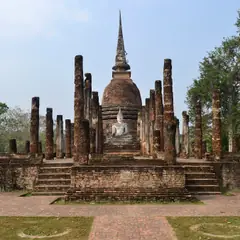
The visit begins where almost everyone takes out a camera. Of the prayer hall to the south, a wihan about 20 metres long, only thick laterite pillars remain; lined up with the three towers at the back, they make the classic photo of Wat Si Sawai. From here the proportions read well: a central prang of about 15 metres flanked by two equally wide, slightly lower towers, on a common base.
What the frame does not tell is that these towers, which look like the heart of Sukhothai, are older than the kingdom itself. They were founded at the end of the 12th century or the start of the 13th as a Khmer shrine, when this land looked toward Angkor. And they are turned: against the Khmer custom of orienting temples to the east, as the other two Khmer shrines of Sukhothai do, these three face south. At this first stop, the audio guide poses the question that the rest of the tour goes on answering: what was a temple like this doing here before the city arrived.
A Buddhist hall stuck onto a Hindu temple
Central wihan
Summary of this stop
Stuck onto the south front of the prangs is the central wihan, another prayer hall of about 20 metres, with massive brick walls and narrow slits for light. Around the 14th century, when the shrine became a Buddhist monastery, these halls were added in front of it, and the join with the Khmer towers is visibly clumsy: two architectures and two faiths forced together.
That hall was also the scene of a find with something of a novel about it. In 1907, Crown Prince Vajiravudh, the future Rama VI, visited the temple and found an image of Shiva, which according to the account was not in any Khmer tower but inside the Buddhist wihan. In Thai it is called Phra Sayom or Sayomphu, one of the names of the god. The prince also came across two old wooden trunks and supposed that the Brahmanic rite of the Triyampawai, that of the giant swing of Bangkok, was held here, a hypothesis more conjecture than proof. Some popular page attributes these finds to Rama V, but most versions assign them to Vajiravudh. Inside the hall, the audio guide reconstructs the moment when a Hindu god appeared under a Buddhist roof.
Laterite, brick and a smooth patch
Three Khmer prangs
Summary of this stop
In front of the three prangs, the facade reads as a palimpsest. Below, the laterite of the Khmer work, which was left unfinished; above, the brick of the builders who completed it later. The seam between the two materials can be seen at a glance and sums up the history of the place: a Khmer project finished by other hands, on a date the sources place in the 14th century or the 15th.
Those builders also changed the decorative language. The Khmer pediment called bantalaeng was transformed here into klip khanun petals, covered in stucco with garudas holding nagas and figures of devatas. On the pediments of the eastern and central prangs peep out multi-headed nagas, makaras spitting garlands and kala faces without a lower jaw, and part of those reliefs reproduces motifs similar to those of Chinese Yuan-dynasty porcelain. Many niches have lost the images of the Buddha they contained.
The last layer is modern. The upper half of the central prang carries a smooth stucco, without reliefs, added by Thailand’s Fine Arts Department in its restoration, which contrasts at a glance with the old stucco. In front of the facade, the audio guide teaches you to tell apart the three hands that worked on the same tower.
The stone of Shiva under a Buddhist king
Yoni of the eastern prang
Summary of this stop
Beside the eastern prang, in the open air, rests a yoni: the ritual stone base on which the lingam of Shiva sat. It is the most tangible Hindu trace left on the site. The cells of the towers, entered by going down a little, are empty, without images or reliefs; in the central one remain the wooden remains of a Sukhothai-era roof, and from time to time incense sticks and candles appear inside, although the temple no longer has an abbot or a community and is run by the Historical Park.
Here the central paradox closes. The shrine was raised under Jayavarman VII, a devoutly Buddhist king, and still functioned as a Hindu temple. But for which god: the lingam, the yoni, the image found in 1907 and the etymology of Sri Siwaya point to Shiva, whereas the lintel found in the compound, today in the Ramkhamhaeng National Museum, depicts Vishnu reclining on the cosmic ocean.
A popular reading also says that the three towers would be the Hindu trinity: one for Brahma, another for Vishnu and another for Shiva. Nobody knows which tower would correspond to each god, and the only Brahma who left a trace here is a small figure seated on a lotus that sprouts from Vishnu’s navel, on that same lintel. Beside the yoni, the audio guide puts to the test a count that comes out so round it is hard not to believe it.
The pond where sin used to float
Sa Loi Bap moat
Summary of this stop
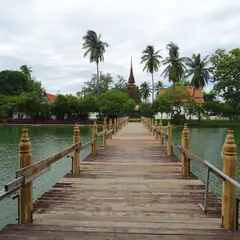
Behind the shrine survives a stretch of moat that locals call Sa Loi Bap (สระลอยบาป), “the pond where sin is made to float”. From the opposite bank you get the full view of the three towers from behind, reflected on still water: the face of the temple that does not appear in the classic photo.
The name links the water with the Hindu idea of ritual cleansing, that of releasing or washing away guilt in the pond, from when the compound was a Hindu shrine. According to popular belief, here one was freed of sin; of that ceremony nothing remains but the word. On the edge of the moat, the audio guide closes the tour with the last echo of the faith that raised these towers, kept not in the stone but in a name.