Temple of the Great Relic
Wat Mahathat Audio Guide
In the exact centre of ancient Sukhothai, a 29-metre lotus-bud chedi rises among 200 smaller chedis and a procession of stucco disciples that never ends; the great bronze Buddha that presided over the temple floated down to Bangkok on a raft in 1808 and never came back.
- 60 min of audio
- Royal temple in ruins
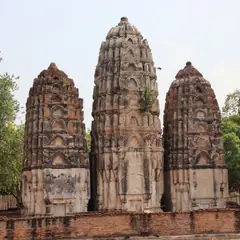
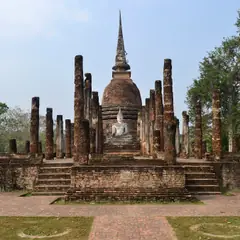
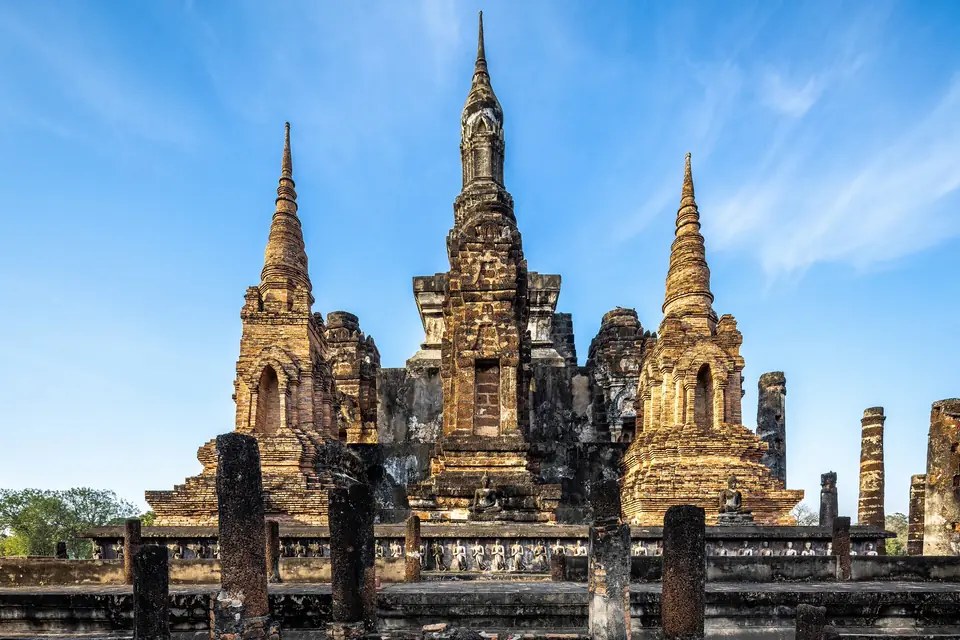
Wat Mahathat, the temple of the Great Relic, is the largest of the intramural temples of Sukhothai Historical Park, a UNESCO World Heritage Site since 1991. Its main chedi was raised in 1345 to house relics of the Buddha and sits at the centre of a mandala plan: on the same platform, four Khmer-profile prangs mark the cardinal points and four stepped chedis the corners, and around them spread 200 smaller chedis, ponds and a brick wall closing the compound on all four sides.
What weighs most here is what is missing. In the great eastern vihara, today roofless laterite columns, King Lithai consecrated in 1361 a bronze Buddha with a lap width of 6.25 metres. In 1808, on the orders of Rama I, the image went down to Bangkok on a raft and, since it would not fit through the city gate, the gate was torn down. Today it is the Phra Si Sakyamuni of Wat Suthat, and its empty platform in Sukhothai still marks the place it occupied.
Highlights
- Lotus-bud chedi — 29 metres high on a base 27 metres on each side
- Procession of disciples — More than a hundred stucco figures circling the base with hands joined
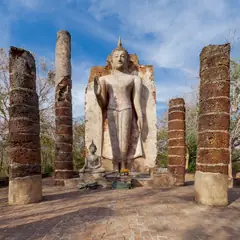
- Phra Attharot Buddhas — Two standing Buddhas of between 9 and 12 metres, the height the scriptures give the Buddha
- Great eastern vihara — Laterite columns where the bronze Buddha that now presides over Wat Suthat once stood
- Mandala of 200 chedis — Khmer prangs, ponds and a brick wall around the reliquary
In the heart of the ancient walled enclosure of Sukhothai, Wat Mahathat (วัดมหาธาตุ) was the royal temple of the Great Relic and the measured, ordered centre of a kingdom. As early as 1292, the inscription of Ramkhamhaeng described, in the middle of the city, a vihara with beautiful images of the Buddha, which is identified with the great vihara east of the main chedi. Today it is the largest of the intramural temples of Sukhothai Historical Park, officially opened in July 1988 and inscribed on the UNESCO World Heritage List on 12 December 1991.
The history of Wat Mahathat has no fixed birth date. Its foundation is attributed to Si Inthrathit, first king of Sukhothai in the 13th century, but other readings place it between 1292 and 1347, and the main chedi is dated after 1292 because the inscription of that year does not mention it. What is documented is its reason for being: the great chedi was raised in 1345 to house relics of the Buddha, and around that decade relics brought from Sri Lanka, a hair and a neck bone of the Buddha, arrived at the temple in the time of the monk Si Satha, author of Inscription No. 2.
The architecture of Wat Mahathat is laid out like a mandala. On the axis, the lotus-bud chedi rises to 29 metres on a base 27 metres on each side, and on its same platform it is accompanied by four Khmer-profile prangs at the cardinal points and four corner chedis with niches. Around the base marches a frieze of more than a hundred stucco disciples; to the north and south, in open mondops, two standing Buddhas, the Phra Attharot, reach between 9 and 12 metres depending on the measurement. The rest of the compound is filled by 200 smaller chedis, an ubosot to the north, a five-tier stupa that lost its spires, a base with stucco elephants, lions and demons, and the ponds of the north and west.
To know what to see at Wat Mahathat, the audio guide walks the roofless ruins in five stops and 60 minutes, from east to north, in the same direction in which one circles the reliquary. The thread that joins them is an unsettling idea: in this field of brick, the absences, from the great bronze Buddha to the rock of a petrified spy, tell as much as what is still standing.
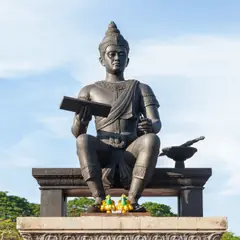
About 350 metres to the north, the King Ramkhamhaeng Monument reproduces at double size the most disputed stele in Thailand, and south of the compound Wat Si Sawai preserves three Khmer towers older than the city itself. Outside the walls, on top of a hill, Wat Saphan Hin holds another standing Buddha of eighteen cubits.
The platform of the Buddha that left
Wat Mahathat
Summary of this stop
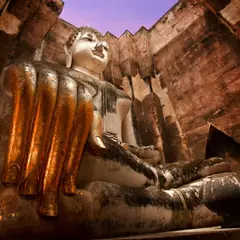
East of the main chedi extends the great eastern vihara, the vihara luang: a raised brick platform with rows of laterite pillars that no longer hold up any roof. At its western end sits a white stucco Buddha in the pose of subduing Mara, which still receives offerings. It is, in all likelihood, the same vihara of beautiful images that the 1292 inscription places at the centre of Sukhothai.
The most solemn space of the temple is today a void, and that void has a known destination. King Lithai (Phra Maha Thammaracha Lithai) had a bronze Buddha in the Sukhothai style cast here, with a lap width of 6.25 metres, and consecrated it in Buddhist year 1904, 1361 of our era, although some sources give 1362. In 1808, on the orders of Rama I, the image went down to Bangkok on a raft. At the Tha Chang pier it would not fit through the city gate, so the gate was torn down, and the new one was named Pratu Tha Phra. Once in the capital, Rama II had the head and face dismantled and recast to make them larger, and the fingers lengthened to match.
Today it is the Phra Si Sakyamuni of Wat Suthat, and its weight in Bangkok was such that, according to tradition, people named the temple after it: Wat Phra To or Wat Phra Yai, the temple of the Big Buddha. Its story did not end with the journey. Before this empty platform, the audio guide follows the trail of the Buddha to a fate that nobody in the Sukhothai of Lithai could have foreseen, tied to a king of the 20th century.
Stucco monks in an eternal procession
Procession of disciples around the main chedi
Summary of this stop
From the east base the tower is understood for what it is: the centre of a mandala. The main chedi, raised in 1345 to house relics of the Buddha, has smaller chedis in the eight directions, and on its same platform stand the four prangs of the cardinal points and the four corner chedis. The base measures 27 metres on each side and the whole culminates at 29 metres in a lotus-bud finial, the most recognisable form of Sukhothai. Inside, according to the sources, the relics that arrived from Sri Lanka were installed around the 1340s: a hair and a neck bone of the Buddha.
What holds the eye is lower down. Around the base march more than a hundred stucco disciples who walk in line with their hands joined in greeting, and the frieze reads best when followed in the direction of the march. It is not a wholly still procession. On the night of Asanha Bucha, the full moon of the eighth lunar month that remembers the Buddha’s first sermon, the temple fills with little lamps for the wian thian takhan: the faithful circle the reliquary clockwise with a candle in a takhan, a clay bowl, behind the disciples of the frieze.
The rite has its logic. That first sermon gave the world its first monk, Annakondanna, and whoever walks follows the first disciples. The Sukhothai office of the Tourism Authority of Thailand and the historical park celebrated it on 1 August 2023 and 20 July 2024, from 7 to 9 pm, with 999 lamps given away; it is one of the three yearly evenings of this rite in the ancient temples of the city. Beside the base, the audio guide sets the walk to the pace of that stucco procession.
Eighteen cubits: the life-size Buddha
Standing Phra Attharot of the south mondop
Summary of this stop
South of the main chedi, inside an open mondop, stands one of the two Phra Attharot, the great standing Buddhas that flank the reliquary to the north and south. Its height varies by source, between 9 and 12 metres, and from below the figure seems designed to dominate the whole compound.
The name, however, changes the scale of everything. Phra Attharot (พระอัฏฐารส) is not a proper name but a measurement: it means “the one of eighteen”, for the eighteen cubits (sok) of height. The figure comes from the texts, because the Madhuratthavilasini and the Buddhavamsa of the Pali Canon attribute that stature to the Buddha. According to the tradition that gives them their name, in Sukhothai these images were raised to reproduce the size of the living Buddha’s body; hence the name is usually translated as “the one of about nine metres”.
The idea is old. Inscription 1, the one of 1292, already lists in the centre of Sukhothai, next to the vihara and the golden Buddhas, a “phra attharot”. Beneath the south mondop, the audio guide explains why, according to that reading, these figures are not giant Buddhas but life-size Buddhas.
Lost spires and a stone spy
Five-tier stupa without its spires
Summary of this stop
In the southern sector, the temple teaches you to read absences. A five-tier stupa whose tiers narrow like stacked boxes ends in an empty top, where its spires once rose. Very close by, the lower platform of a great stepped chedi keeps stucco figures of demons, elephants and lions, the guard of a building that no longer exists.
In front of the south mondop something else is missing. Before the temple’s southern image there appeared a sculpture called Khom Dam Din, “the Khmer who travelled underground”, which is kept today in the Phra Mae Ya shrine, next to the Sukhothai town hall. Behind the name there is a legend, first written down in the Northern Chronicle of Phra Wichianpricha (Noi) in 1807. According to it, the Khmer king wanted Phra Ruang dead, the leader with the magic word who had taken refuge as a monk in Sukhothai, and sent after him a spy who advanced by diving beneath the earth.
The spy emerged before Phra Ruang himself without knowing his face and asked him about him. The answer was a single sentence, and it was enough to leave him turned to stone. Tradition pointed to a rock in front of the south mondop as that petrified Khmer; the rock is no longer there. And across the border, in the Cambodian royal chronicles, the same character bears another name and another reputation. In front of the stupa without spires, the audio guide tells the two faces of this spy.
The disputed stele of the neighbouring palace
Northern ubosot
Summary of this stop
North of the compound, the ubosot keeps a brick terrace of about 14 by 25 metres with round columns and, at its western end, a great seated stucco Buddha. Beyond lie the ponds of the north and west, the field of bases of smaller chedis and the wall that closes the temple on all four sides.
Very close to here came to light the most famous text of the kingdom. In Buddhist year 2376, between 1833 and 1834, Prince Mongkut, then a monk, found the stele of Ramkhamhaeng and took it to Bangkok. Not even the place of the find is certain: some sources put it at Noen Prasat, the mound of the neighbouring royal palace, and others inside Wat Mahathat itself. The piece itself is in dispute. In 1987 and 1988, Michael Vickery and Piriya Krairiksh branded it a forgery, and the second thesis went so far as to attribute it to Mongkut himself; a 1990 analysis with a scanning electron microscope dated it the same as other Sukhothai inscriptions. The debate remains open, and in 2004 it provoked protests in the city.
The complex that was the centre of Sukhothai also has a lit-up present. During the Loy Krathong festival, Wat Mahathat becomes the stage of a 45-minute light and sound show, with lasers, music and fireworks, which narrates the festival and the founding of the city. Beside the northern ubosot, the audio guide closes the tour with that unsolved mystery.