Forest monastery
Wat Saphan Hin Audio Guide
On top of a hill west of Sukhothai, a path of slate slabs climbs to a standing Buddha 12.50 metres high who gazes at the old city with his hand raised. It may be the sacred forest to which, according to Thailand’s most famous inscription, a king rode on his white elephant.
- 45 min of audio
- Standing Buddha on the hill
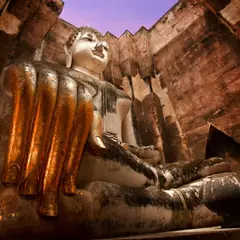
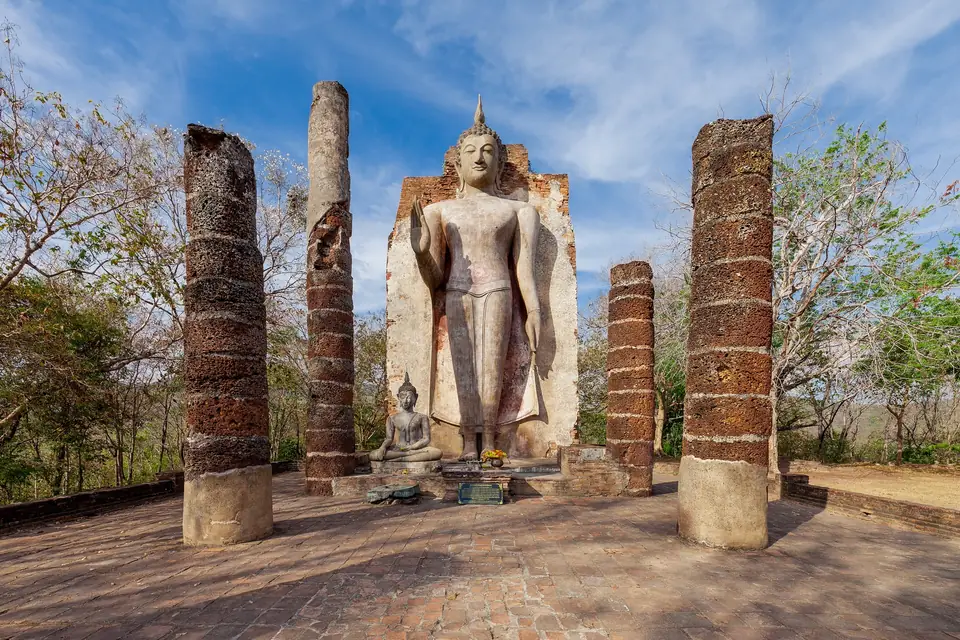
Wat Saphan Hin, the “stone bridge”, takes its name from the path of slate slabs that climbs the slope, about 3 kilometres west of the old wall. It was the main temple of the aranyawasi, the forest monks who lived outside the city and put meditation before the study of the scriptures. On the summit remain two rows of laterite columns of a roofless vihara and, at the back, the Phra Attharot, a standing stucco Buddha in the abhaya gesture that can be made out from the foot of the hill.
The giant came close to collapsing. From the end of 2016, water seeping between the layers of stucco rotted the figure between the waist and the knees, and the pieces piled up at his feet. In 2017 the Fine Arts Department propped him up and commissioned master craftsman Phasom Narata for a repair of about four months: a stainless steel frame and stucco redone from the bottom up with pun mak, the fermented lime of the ancient technique.
Highlights
- Slate-slab path — About 300 metres of climb that give the temple its name, the “stone bridge”
- Phra Attharot — Standing stucco Buddha 12.50 metres high with a raised hand in the abhaya gesture
- Vihara columns — Two rows of laterite pillars in a hall that is now open to the sky
- Lotus-bud chedi — The typical Sukhothai finial on five tiers, halfway up
- View of the plain — The ruins of the historical park to the southeast and one of its best sunrises
Outside the wall of Sukhothai, in the western strip where the forest monasteries were scattered, Wat Saphan Hin (วัดสะพานหิน) crowns a hill about 3 kilometres from the old enclosure. Its name means “stone bridge” and does not refer to any building but to the ground: a path of large slate slabs that climbs the slope to a roofless vihara and a standing Buddha 12.50 metres high who, with his hand raised, gazes toward the old city.
The history of Wat Saphan Hin is usually read in the light of Ramkhamhaeng’s Inscription No. 1, dated 1292. The text places west of Sukhothai an Aranyik, a “forest”, where the king gave alms to the Mahathera Sangharaja, a sage from Nakhon Si Thammarat who had studied the whole Tripitaka; in the middle of the Aranyik stood a great vihara, tall and beautiful, with a standing Phra Attharot. The stone, however, does not name Wat Saphan Hin. That this forest is this hill is a presumed identification, and the ruins now called Wat Aranyik, about 500 metres away, complicate the picture: everything suggests that both places originally formed a single forest monastery, although some separate them. On top of that comes a larger debate, open since 1987: Michael Vickery and Piriya Krairiksh argued that the inscription itself was a 19th-century forgery attributable to Mongkut; a 1990 analysis with electron microscopy dated it as contemporary with other Sukhothai inscriptions, and UNESCO included it in 2003 in the Memory of the World register, without the discussion being fully closed.
The architecture of Wat Saphan Hin is sober and eloquent. On the summit, two rows of laterite pillars on a brick terrace mark a five-bay vihara facing east, and at the back stands the Phra Attharot, a standing stucco Buddha in the abhaya gesture, “fear not”. Its model is the great standing Buddhas of Lanka, for which from the end of the Anuradhapura period and in the Polonnaruwa one dedicated viharas were built; the reference example is the Attharot of the Lankatilaka vihara. Six Phra Attharot survive today: in Sukhothai, two at Wat Mahathat and the one at Wat Saphan Hin; two in Phitsanulok and one at Wat Chedi Luang in Chiang Mai. The hill also held a surprise older than the city: in the mid-20th century another great image of the Buddha with features of the Dvaravati style turned up here, probably made in the 8th century in the kingdom of Srivijaya.
To know what to see at Wat Saphan Hin, the audio guide accompanies the climb in four stops and 45 minutes: the foot of the slate-slab path, the lotus-bud chedi halfway up the slope, the great standing Buddha and the edge of the terrace over the plain. The thread that joins them is a walk with a double bottom: the path you tread today may have been that of a king on his white elephant, and the giant waiting at the top is still standing because someone made him again with lime and patience.
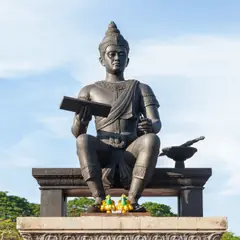
Back on the plain, the other great Phra Attharot of Sukhothai is at Wat Mahathat, in the centre of the old city, and the King Ramkhamhaeng Monument reproduces the inscription that mentions the sacred forest. About 2 km to the northeast, Wat Si Chum encloses a 15-metre seated Buddha between walls.
A stone bridge that climbs the hill
Wat Saphan Hin
Summary of this stop
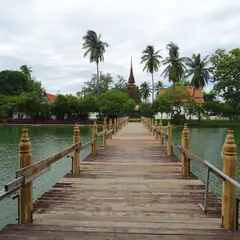
At the foot of the hill begins the stairway that gives the temple its name: a path of slate slabs, hin chanuan, of about 300 metres according to most descriptions, although others speak of about 200. The stones are polished and slippery in places from the constant passage of visitors. From below you can already make out, outlined at the top, the 12.50-metre Phra Attharot, facing the old city.
This slope was the refuge of the aranyawasi, the forest monks. Unlike the kamawasi of the urban monasteries, devoted to the study of the scriptures, they lived outside the city and gave priority to meditation, and Wat Saphan Hin was their main temple.
The stairway also has a symbolic reading. According to Buddhist tradition, at the end of the rains retreat the Buddha came down from the Tavatimsa heaven by a stairway of gold, crystal and silver that the god Indra laid to the city of Sankassa, and in that descent he “opened the three worlds”: gods, humans and the damned could see one another. It is the scene of the Tak Bat Thewo, the great alms offering of Ok Phansa, and in Sukhothai this temple, also called Wat Taphan Hin, is held to be a place for giving precepts and alms on that date. On the first step, the narration reveals why this stone climb passes for the point where heaven, earth and hell touch.
The lotus chedi of the forest monastery
Lotus-bud chedi
Summary of this stop
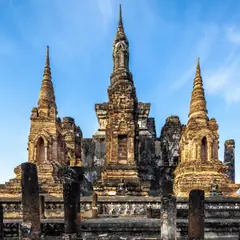
A little past the middle of the path, on a stone platform, appears a small chedi with a lotus-bud finial, the characteristic type of Sukhothai, set on five diminishing tiers and with niches beneath the finial where there were images of the Buddha. Along the climb the foundations of a few more chedis peep out: together with the vihara at the top, it is what remains of the monastery’s buildings.
That scattered trace helps to understand the scale of the complex. Wat Saphan Hin and the ruins of Wat Aranyik, about 500 metres away, were probably a single monastery spread among trees, the Aranyik of the west described by Inscription No. 1. There, according to the stone, Ramkhamhaeng gave alms to the Mahathera Sangharaja, the monk from Nakhon Si Thammarat who knew the whole Tripitaka.
The relationship between king and monk has often been told more emphatically: it is claimed that Ramkhamhaeng built Wat Saphan Hin to house the Sangharaja, when the inscription says only that he gave him alms there. Beside the chedi, the audio guide separates what the stone says from what has been added to it.
A stucco giant rebuilt with lime
Phra Attharot
Summary of this stop
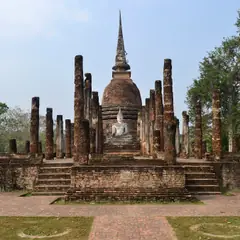
At the summit, two rows of laterite pillars flank the Phra Attharot on a brick terrace. The roof is missing, so the vihara hall is today an open-air space, and among its ruins, at the giant’s feet, remains a much smaller seated image in the gesture of calling the earth to witness.
The name of the great Buddha admits two readings. Attharot means “the one of eighteen cubits”, according to the Lanka tradition that attributed that stature to the Buddha; hence it designates a type of giant standing Buddha with the hand raised and the palm outward. Another interpretation reads it as “the one who possesses the eighteen Buddhadhammas”, the eighteen qualities of the Buddha named in the Atanatiya paritta. Nor do the measurements fit without dispute: the English translation of the inscription speaks of nine metres, the present image measures 12.50, and by some counts only the two Attharot of Wat Mahathat truly reach eighteen cubits. Its age is also disputed: it is credited with over 700 years, but some propose it was made about 60 or 70 years after Ramkhamhaeng, which would cast doubt on whether it is the same image as in 1292.
The figure seen today owes much to its restorers. After a first major intervention in 1956, from the end of 2016 the stucco between the waist and the knees rotted from seeping water and began to fall in pieces, with the risk of the whole Buddha collapsing. On 9 May 2017 the Fine Arts Department approved 600,000 baht and master craftsman Phasom Narata redid it in about four months, with a stainless steel frame and stucco of pun mak, fermented lime, applied from the bottom up. Before the giant, the narration asks what his name really measures.
The raised hand over the plain of Sukhothai
View of the Sukhothai plain
Summary of this stop
From the east edge of the terrace you command the plain of the historical park, with the ruins of the central zone to the southeast and hills to the north and south; it is one of the best sunrise spots in Sukhothai. Over that landscape takes shape the most famous scene of Inscription No. 1: on new-moon and full-moon days, Ramkhamhaeng mounted the white elephant Rujakri, adorned with a howdah, a tasselled headdress and gold on both tusks, rode up to the Aranyik of the west to pay homage to the Mahathera Sangharaja and returned to the city. The text is vague: other versions reduce the climb to every full moon or every Buddhist holy day, make the Buddha the recipient of the homage and call the elephant Rujakhiri or Ruchakhari.
The same inscription describes the end of the Kathin, the month-long ceremonies that closed the rainy season and culminated in this western forest: to return, the whole city walked in a single line from Wat Saphan Hin to the parade ground, amid instruments, songs and repeated homages.
Around the Buddha there are also legends the stone does not record. It is told that the king came up here also to survey the terrain and look for water for the city, and that the giant’s outstretched hand silently protects it, in line with the old royal custom of raising a great standing Buddha as the image of the capital, so that the country would remain at peace and firm like the statue. Today it is still an image of worship: people come to ask it for blessings and good fortune, and visitors take off their shoes before stepping on the platform around it. At the last point of the terrace, the audio guide follows the direction of that hand over the plain.