Temple of the golden pond
Wat Traphang Thong Audio Guide
The only temple in Sukhothai Historical Park where monks still live sits on an islet in the “golden pond”, joined to land by wooden bridges; in it rests the Buddha footprint that Lithai carried up a hill in 1359 and that locals brought down by hand centuries later.
- 25 min of audio
- Temple with resident monks
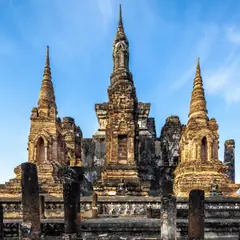
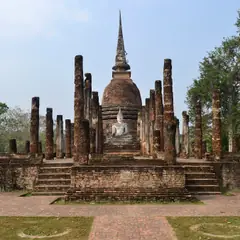
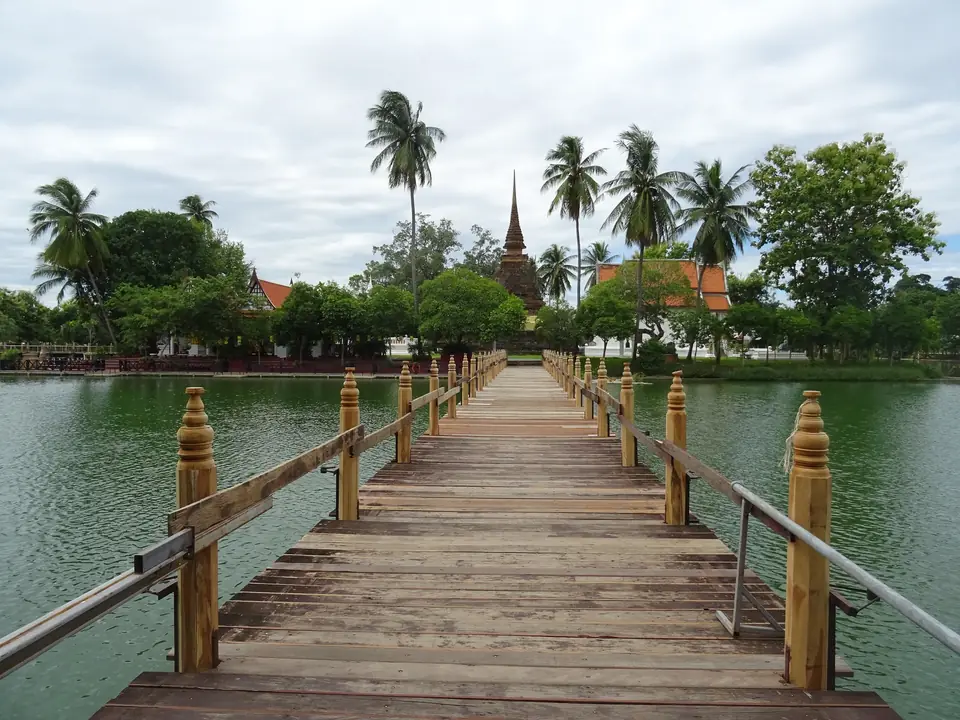
Wat Traphang Thong takes its name from the pond that surrounds it, the Traphang Thong or “golden pond”, one of the reservoirs of the water network that supplied the city and the palace. Its foundation is dated to around 1283, in the time of Ramkhamhaeng, although another reading takes it to the 14th century, when King Lithai restored it. On the islet stand a bell-shaped chedi in Sinhalese style ringed by eight smaller stupas, an ubosot of 2007 built on the foundations of the old one and the pavilion of a great Buddha footprint.
It is the only temple in the park with a resident monastic community, and it shows it every day before dawn, when the monks cross the wooden Saphan Boon bridge barefoot for the alms round. Its most valuable piece came from afar: the footprint that Lithai installed in 1359 on the summit of a hill named after Sri Lanka’s Adam’s Peak, today’s Khao Phra Bat Yai, and which in the 20th century villagers, monks and novices brought down with wooden rollers and leather ropes.
Highlights
- Buddha footprint of 1359 — Right foot carved in a grey stone slab of about 1.47 by 2.03 metres, brought down by hand from Khao Phra Bat Yai
- Bell-shaped chedi — Sinhalese bell of laterite and brick 12 wa high, ringed by eight smaller stupas
- Saphan Boon bridge — Wooden walkway over the pond and the stage of the monks’ dawn alms round
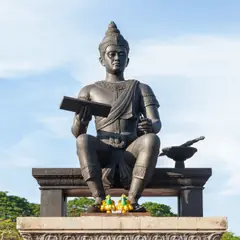
- Khom Dam Din statue — Bronze of the Khmer spy who, according to legend, was turned to stone before Phra Ruang
- A lived-in temple — Resident monks and teaching of the Buddhist scriptures since 1932
In the middle of the old city of Sukhothai, beside the wall and the eastern gate Kamphaeng Hak, Wat Traphang Thong (วัดตระพังทอง) occupies an islet reached only by wooden bridges. It is the only temple in the historical park with a resident monastic community: among ruins of brick and laterite, here there are monks who live, study and go out each morning to receive alms. The name comes from the water around it, the Traphang Thong, the “golden pond”.
The history of Wat Traphang Thong begins with a disputed date. The temple register places its foundation around 1283, year 1826 of the Buddhist era, in the time of Ramkhamhaeng, and the grant of its ordination ground in 1287; another reading takes it to the 14th century, more in line with the restoration undertaken by King Lithai and with the Sinhalese form of its chedi. The reconstructions came later: around 1907 Phraya Ronnachai Chanyut (Khrut) led the population in restoring the ubosot, although another source speaks of an ordination hall founded in 1917 by a governor of Sukhothai, and in 2007 the present hall was raised on the foundations of the old one.
Its most venerated piece came from outside. In 1359 Lithai installed a Buddha footprint on the summit of Khao Sumanakut, today’s Khao Phra Bat Yai, southwest of the city, and Sukhothai Inscription No. 8 recorded the procession with which it was carried up the hill. In 1908 Crown Prince Vajiravudh, the future Rama VI, removed from the hill the stele of that inscription, already broken into small fragments, and had it pieced together into one; the footprint stayed up there until its descent in the 20th century. The sources do not date that move alike: 1927, with the descent organised by Chao Khun Boran Watthachan, or around 1930, when Phra Ratchaprasitthikhun, head of the province’s clergy, installed it in the temple and instituted an annual festival of veneration. Perhaps they are two phases of the same journey, perhaps a discrepancy of chronology.
The islet also keeps a legend that reached the theatre through a king. That of Khom Dam Din, the Khmer spy who travelled underground, was heard told by Vajiravudh in Sukhothai and Uttaradit, and with it he wrote a play dated 1907; in 1912 it was adapted as a dance-drama and later became the verse play “Phra Ruang”, in which the king himself played the part of Man Puenyao and which was staged as a musical drama in 1924. Rama VI explained the hero’s powers as intelligence and wit, not magic. Around 1930 his brother Rama VII touched up the dance text to fit music in the Khmer style, and Prince Narisara Nuwattiwong, in some verses for singing, was the first to give the spy a name: Phaya Decho.
To know what to see at Wat Traphang Thong, the audio guide walks the islet in four stops and 25 minutes: the wooden access bridge, the bell-shaped chedi with its eight smaller stupas, the pavilion of the Buddha footprint and the bronze statue to the south. The thread that joins them is an exception: the only corner of the old city that is not a ruin, where the water of the kingdom, a stone of 1359 and today’s villagers are still joined.
It is not the only island temple in the city: to the west, Wat Sa Si rises on another pond, with a bell chedi in the manner of Sri Lanka. And the legend of the Khmer spy reappears at Wat Mahathat, the great reliquary at the centre, a short distance from the Khmer towers of Wat Si Sawai.
A wooden bridge over the golden pond
Wat Traphang Thong
Summary of this stop
From the road, wooden walkways cross the Traphang Thong pond to the islet. Beneath them lies water with a history: the pond is part of Sukhothai’s water network. The Saritphong dam, also called Thamnop Phra Ruang, located between Khao Phra Bat Yai and Khao Kio Ai Ma, sent water through canals to the city gates to store it in the Traphang Ngoen and Traphang Thong ponds, which supplied the city and the palace.
The access bridge is the Saphan Boon, the “bridge of merit”, and every day, before dawn, it becomes the stage of the tak bat, the alms round. The monks cross it barefoot and in line; on the road, stalls sell offering sets in paper bags with rice, fruit, snacks and garlands of flowers, and the faithful wait seated on mats along the bridge to place the food in the metal bowls. On Saturdays more Thais come: a presenter with a microphone talks about the temple, a monk leads the chant that everyone echoes and the bags that do not fit in the bowls end up in a cart heading back to the monastery, with the neighbourhood dogs in the front row. In December 2023 the Department of Religious Affairs included this alms round among ten highlights across the whole country.
The scene has a simple explanation: people live here. In the late 1980s, 20 monks and 34 novices spent the rains retreat in the temple, and since 1932 the pariyatti, the study of the Buddhist scriptures, has been taught in it. On the bridge, the audio guide marks the passage from a city of ruins to an inhabited temple, the only setting in the park that exists only in the early morning.
A Sinhalese bell with eight guardians
Bell-shaped chedi and eight smaller stupas
Summary of this stop
In the centre of the islet rises the main chedi, of Sinhalese bell-shaped type: laterite base, brick body, 8 wa at the base and 12 wa high, bearing in mind that the wa, the Thai fathom, is equal to about two metres. Around it are spread eight smaller stupas, like a retinue around the bell. It is the most visible ancient element of the temple and the clearest clue to its lineage: the form comes from Sri Lanka.
That link with the island is not an isolated detail. The same Lithai who restored the temple in the 14th century looked to Sri Lanka when he chose the hill for his Buddha footprint: he called it Sumanakut, a copy of the name of Samanakuta, the Sinhalese sacred mountain with a Buddha footprint known in English as Adam’s Peak. Up there, in 1359, the slab was installed, also carved on a Sinhalese model.
The architecture of Wat Traphang Thong thus reads as a conversation with Sri Lanka, from the brick bell to the name of a hill. Beside the chedi, the audio guide draws the thread between the two and leaves open the question of how a stone from the top of the hill ended up at water level.
A stone foot brought down on rollers
Buddha footprint slab
Summary of this stop
East of the ubosot and beside the chedi, a small modern pavilion, the mandapa, houses the Buddha footprint brought from Khao Phra Bat Yai. It is a right foot carved in a slab of dark grey stone 4 feet 10 inches wide by 6 feet 8 inches long, about 1.47 by 2.03 metres. A border of flowers runs along the edge and the interior is covered in engraved motifs, whose number and reading differ among the sources: some speak of 54 flowers and jataka scenes, others of 108 motifs on the border or of 108 auspicious marks inside.
Bringing it here took effort. In 1927, with the slab at risk of damage on the summit, Chao Khun Boran Watthachan organised villagers, monks and novices of Ban Thani and Ban Mueang Kao to bring it down from the hill. It was done by hand: wooden rollers, support planks and animal-hide ropes controlled the movement of the stone downhill, and then a cart took it to the temple. Other sources place the move around 1930 or, more vaguely, the mid-20th century.
A custom went with the stone. Every year, on the full moon of the third lunar month, the day of Makha Bucha, the villagers of the Si Khiri Mat subdistrict and the surrounding villages climbed Khao Phra Bat, a hill of about 40 metres, to pay homage to the footprint beside the rock shelter on the west side of the summit, with ceremonies, shows and a gathering of neighbours at the foot. Today that pilgrimage survives mostly in the memory of the district. Facing the slab, the audio guide reconstructs the descent metre by metre.
The Khmer spy who is still waiting
Statue of Khom Dam Din and Phra Ruang
Summary of this stop
In the southern part of the islet, a bronze group depicts King Phra Ruang and Khom Dam Din, “the Khmer who dives into the earth”, a name already recorded in the Northern Chronicle of 1807. The sculpture freezes the end of a legend: when the Tai had to carry water to Angkor as tribute in heavy clay jars, Phra Ruang, the leader with the magic word, made some bamboo baskets waterproof. The Khmer king wanted him dead, Phra Ruang fled and became a monk in Sukhothai, and after him set out a spy who travelled by diving underground. The outcome, which fits in a single sentence, is left for the audio guide.
Very close by, the ubosot of 2007, 8.30 by 15 metres, rises on the foundations of the old one. Its chofa, the roof finials, are naga heads of sangkhalok ceramic, the glazed ware of Sukhothai, and inside it keeps the main Buddha, Luang Pho Khao. A new hall on old foundations: proof that the temple is still in use.
The islet is also the local heart of Loy Krathong. The provincial festival “Loy Krathong, Phao Thian Len Fai” has been held in the historical park for over forty years, and in 2023 it lasted ten days, from 18 to 27 November, but the villagers’ celebration centres here. Popular belief places the origin of the krathong at the Sukhothai court, with the lady Nang Nopphamat, although that tale comes from a poem of the early Bangkok period, in the 19th century; there is no proof of the festival in ancient Sukhothai and its origin remains in debate, even if the kingdom’s inscriptions do mention festivals of candles and fire. Beside the statue, the audio guide closes the tour separating the myth of the festival from what the stones tell.