Temple of the great seated Buddha
Wat Si Chum Audio Guide
Instead of a chedi, Wat Si Chum raises an open-air box of 15-metre walls that holds, almost under pressure, a seated Buddha of the same height: his face peeps out through a slit, and inside the walls a staircase climbs that, according to tradition, lent him his voice.
- 40 min of audio
- Giant Buddha in a mandapa
Wat Si Chum is the temple of Sukhothai that swaps the main chedi for a mandapa: a square building 32 metres on each side and 15 high, with walls 3 metres thick, filled entirely by the Phra Achana, a seated Buddha in the gesture of victory over Mara that measures 11.30 metres from knee to knee. Its name, “the one who does not tremble”, already appears in Ramkhamhaeng’s Inscription No. 1, although the date of the mandapa and the king who promoted it remain in dispute.
The walls hold more than they show. Between the original wall and a second one raised in the time of King Lithai climbs a staircase-tunnel whose ceiling was lined with slabs engraved with jatakas, the oldest surviving set of line drawing in Thai art; in that passage Inscription No. 2 turned up in 1887. According to tradition, up that same staircase climbed a soldier of Naresuan in 1584 to speak from behind the Buddha.
Highlights
- Phra Achana — Seated Buddha 15 metres high and 11.30 from knee to knee that fills its mandapa completely
- Front slit — Vertical opening in the east wall that frames the Buddha’s face from afar
- Open-air mandapa — Box 32 metres on each side with walls 3 metres thick and no roof
- Staircase inside the wall — Passage whose ceiling was lined with jataka slabs, the oldest line drawing in Thai art
- Heritage mango — A tree over 200 years old and more than 20 metres tall beside the north wall
In Sukhothai, the great temples are arranged around a main chedi. Wat Si Chum (วัดศรีชุม) does without one. In its place rises a mandapa, a square building 32 metres on each side and 15 high with walls 3 metres thick, and inside, almost under pressure, the Phra Achana: a 15-metre seated Buddha that fills the whole interior. From outside you barely see his face, peeping through a vertical slit in the east wall, as if the building had been built around him to hide him.
The history of Wat Si Chum starts with a mention. Ramkhamhaeng’s Inscription No. 1 cites, north of the city of Sukhothai, a “Phra Achana” with its “prasat”, and from that comes the name of the great Buddha, which means “the one who does not tremble” or “the one who has no fear”. From that line, one interpretation ties the temple to the age of Ramkhamhaeng, at the end of the 13th century; another places the building of the mandapa at the end of the 14th century, under Maha Thammaracha II, and King Lithai is credited with a major reform: a second wall raised 1.50 metres from the original, which turned the gap between them into a hidden staircase. Abandoned towards the end of the Ayutthaya period, the complex was restored between 1953 and 1956.
Inside that double wall turned up, in 1887, Inscription No. 2, a slate slab in the shape of a sema, 275 centimetres high, dated to around 1341-1367, which narrates the founding of Sukhothai and the life of the monk Phra Maha Thera Sri Sattha. Its text contains an Old Mon prefix that appears in no other Sukhothai inscription, a clue that the first language of its writer may have been Mon and not Thai. According to a documented tradition, the stone did not travel to Bangkok at once: in 1891 it was still at the temple when the French archaeologist Lucien Fournereau photographed it, and his image was published in 1908 in the second part of Le Siam Ancien, when nobody had yet managed to read it in full. That same year it was sent to the National Museum in Bangkok, where it is kept today.
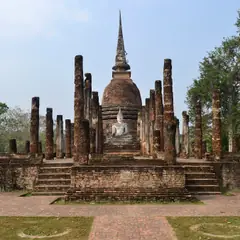
The architecture of Wat Si Chum reads from east to west. In front of the mandapa remain the rows of truncated laterite pillars and the bases of three Buddha pedestals of the vihara, the six-bay assembly hall that preceded it. To the north are the ruins of a smaller vihara and of a small mandapa with its own image, and a moat of water surrounds the whole compound; a small bridge joins it to the modern temple next door. A Fine Arts Department panel draws what the complex was like in the Sukhothai period, although the big question, what covered those 15-metre walls, remains open.
To know what to see at Wat Si Chum, the audio guide walks the compound in four stops and 40 minutes: the vihara pillars facing the slit, the feet of the Phra Achana, the grille of the wall staircase and the great mango on the north side. The thread that joins them is that this Buddha, which looks like just a serene mass, has been a hiding place, an army’s loudspeaker and a strongbox of drawings, and that to this day it is still argued who owns him.
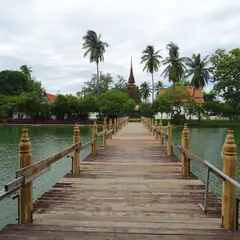
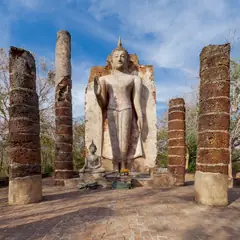
To the west, on the hill of Wat Saphan Hin, another giant Buddha, this one standing, gazes toward the old city with his hand raised; inside the walls, Wat Sa Si raises its bell-shaped chedi on an island in the great pond.
A face peeping through a slit
Wat Si Chum
Summary of this stop
Among the truncated pillars of the vihara, the mandapa appears as a blind brick box, with no tower or crown. Only a vertical opening in the east wall, narrowing toward the top, breaks the wall: through it, as in a stone frame, the serene face of the Buddha peeps out from afar, with his faint Sukhothai-style smile. It is the image that defines the temple, and it works precisely because almost everything else stays hidden.
What is out of sight also counts. The 15-metre walls end open to the sky, and that absence allows two readings: one describes a building whose brick cover, perhaps a dome, collapsed; the other, which research considers very likely, sees in them the unfinished phase of a much taller building that may have culminated in a shrine tower of the prang type.
The face is not exactly the original either. During the 1953-1956 restoration, carried out with traditional techniques and materials, Silpa Bhirasri and Khien Yimsiri remade the Phra Achana taking the bronze Buddhas of the Sukhothai style as their model. Facing the slit, the audio guide separates what dates from the Sukhothai period and what from the 20th century in that face everyone photographs.
The golden knees of the one who does not tremble
Golden right hand of the Phra Achana
Summary of this stop
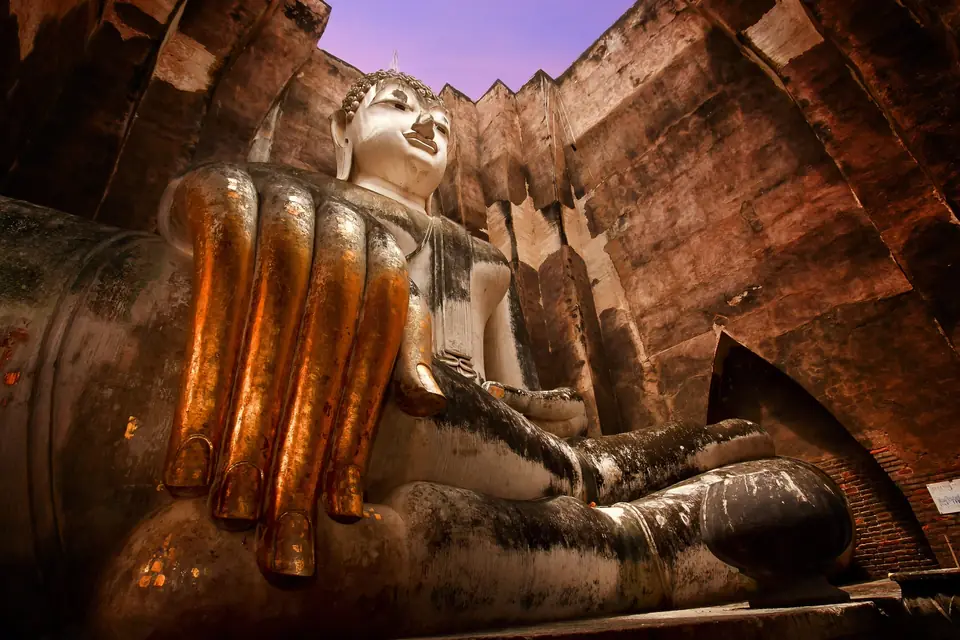
On crossing the opening, the scale changes suddenly. The Phra Achana sits in the gesture of victory over Mara, the maravijaya, with a core of brick and laterite covered in stucco: 11.30 metres from knee to knee and 15 high, so that between the image and the walls there is barely any space. The gaze climbs from the knees to a face that, from inside, sits far above whoever looks at it.
At floor level, the right hand, the one touching the earth, with long, slender fingers, gleams with the gold leaf that devotees still stick on when venerating the image, and offerings pile up at its foot. It is not a dead relic: the monks of the neighbouring temple come to the mandapa to pray on full-moon nights.
Tradition gave this “fearless” giant a nickname: Phra Phut Dai, the Buddha who speaks. It is told that, in the campaign of Naresuan against Chaliang after proclaiming independence from Burma in 1584, with the troops gathered at Wat Si Chum, a soldier climbed the wall staircase and spoke from behind the Buddha to raise morale; to that ruse was added, according to a documented tradition, an oath of loyalty with consecrated water. The legend also circulates in other versions, with a Burmese army that flees in terror at the sight of the image or with the king himself speaking through the gap beside the head. At the Buddha’s feet, the audio guide sets those opposing stories face to face.
The secret staircase inside the wall
Entrance to the wall staircase
Summary of this stop
In the thick side wall of the mandapa, a grille now closes off access to a narrow passage. It is the trace of the reform of the Lithai period: a second wall raised 1.50 metres from the original, whose gap became a staircase-tunnel that climbs inside up to the height of the Buddha’s back and head. It is the setting of the tradition of the speaking Buddha and the place where in 1887 Luang Samosorn Pollakarn found Inscription No. 2.
The ceiling of that dark staircase was lined with stone slabs engraved with jatakas, the previous lives of the Buddha, accompanied by brief captions in Old Thai: the oldest surviving set of line drawing in Thai art. Their number varies by source, between about 50 and 86, and their origin is disputed: one thesis holds that they were dismantled from the nine-spire chedi of Wat Mahathat; another, that they were conceived from the start for this inaccessible corridor, probably hidden on purpose so as not to be lost when the year 2000 of the Buddhist era arrived, 1457. Nor is there agreement on whether they are still in the passage or were removed for conservation to the Ramkhamhaeng National Museum.
The mandapa also has a second tunnel, in the right wall, with its descent walled up with cement. Legend has it that it does not end in the temple but continues underground to old Si Satchanalai, and even to Wat Thung Yang, in Laplae, where the elders speak of a herd of cows and buffaloes that entered a cave and later appeared here. Beside the grille, the audio guide follows that underground trail and what, as the story goes, whoever dared to go down found.
A heritage mango and a lawsuit over the Buddha
Great mango on the north side
Summary of this stop
Beside the north side of the mandapa grows a wild mango tree more than 200 years old and over 20 metres tall, registered by the Ministry of Culture as a national heritage tree. In its shade, the tour returns to the name of the place: “Si Chum” comes from an old local word for the bodhi tree and means “grove of bodhis”, but the royal chronicles of Ayutthaya, which no longer understood the term, turned it into “Rue-si Chum”, “gathering of hermits”.
The temple is still alive in the calendar. At Songkran, the Thai New Year, Wat Si Chum holds its own festival from 13 to 16 April with the ceremony of bathing the Phra Achana: a small replica of the image goes out in procession for people to sprinkle it with water, while other worshippers stick gold leaf on the mandapa. There is a duel of long drums, the klong yao, and the custom of making the year’s wishes on silver and gold bodhi leaves.
That Buddha is also at the centre of a lawsuit. In March 2018, the abbot of the present Wat Si Chum, the neighbouring temple recognised in 1993, sued the Fine Arts Department for 50 million baht over the land of the mandapa and over charging Thai worshippers 20 baht to enter and venerate the Phra Achana. The modern temple claims to have had a royal sima since 1357, the year 1900 of the Buddhist era; the Fine Arts Department maintains that it is a new temple, distinct from the ancient one. Under the mango, the audio guide’s last stop explains why a Buddha centuries old is still fought over in the courts.