Orthodox cathedral
Alexander Nevsky Cathedral Audio Guide (Aleksander Nevski katedraal)
Five onion domes planted on purpose opposite Toompea Castle: the Russian Empire wanted its cross to dominate Lutheran Tallinn, the Estonian republic tried to pull it down and the Soviets thought of turning it into a planetarium.
- 30 min audio
- Russian Orthodox architecture
Alexander Nevsky Cathedral was built between 1894 and 1900 on the initiative of the governor of Estonia, Prince Sergei Šahhovskoi, right across from the castle that was then his residence and is now the Estonian parliament. It was designed by Mikhail Preobrazhensky, of the St Petersburg Academy of Fine Arts, in the Muscovite-Yaroslavl style of the 17th century: three altars, five domes, 58 metres high and room for 1,500 worshippers. It was paid for by a collection spread across the whole Russian Empire and, for the rest, by the state treasury.
In 1936 the authorities ordered the gold stripped from its domes, seven layers of gilding applied in 1898, and hung a Foucault pendulum inside the church. Earlier, in 1928, a bill to pull it down on 1 May 1929 had reached the Riigikogu. Today the building belongs to the city, which since 2001 has leased it free of charge to the Orthodox church linked to the Moscow Patriarchate, and in 2026 its future was again openly debated.
Highlights
- Five onion domes 58 metres high, facing Toompea Castle, now the Estonian parliament
- Eleven bells cast in St Petersburg; the largest, of about 15 tonnes, is the biggest in Tallinn
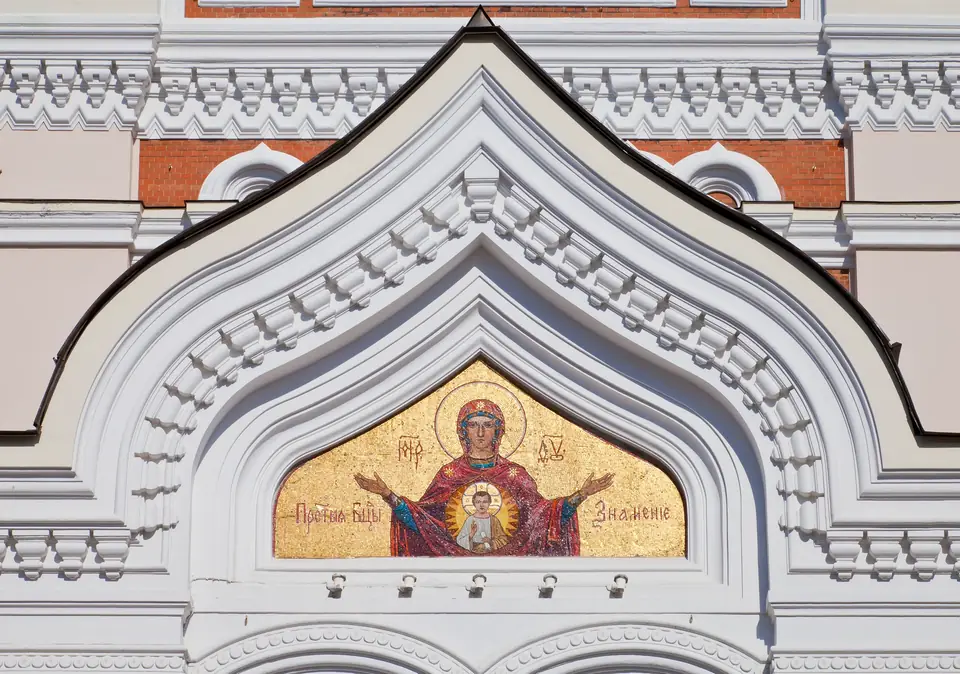
- Mosaics of Alexander Nevsky, the Holy Face and the Virgin of the Sign over the porches of the three flights of steps
- Three gilded wooden iconostases with icons painted in St Petersburg on copper and zinc plates
- A church the Estonian republic wanted to pull down in 1929 and the Soviet regime to turn into a planetarium
The history of Alexander Nevsky Cathedral begins with a complaint. In 1888 the appeal for the collection, sent with some 55,600 subscription lists to every corner of the Russian Empire, lamented that anyone arriving in Reval, today’s Tallinn, by sea or by land did not recognise a Russian city: only Lutheran church spires showed. Governor Sergei Šahhovskoi wanted a new cross to shine over the city from the sea and from the land. Between 1894 and 1900 he got it, on the very top of Toompea, and the building has been argued over ever since.
The architecture of Alexander Nevsky Cathedral speaks the language of Moscow: Muscovite-Yaroslavl style of the 17th century, five onion domes, a body of local limestone clad in brick on a plinth of Finnish granite, three identical flights of steps and an interior of gold and icons. What the façade does not tell is everything that came after: the Estonian republic wanted to remove its domes or pull it down, in 1936 it lost its gilding, the Soviet regime planned a planetarium and, in April 2022, a few weeks after the Bucha massacre, its walls woke up painted red with the words “Ukraina veri” (Ukrainian blood) and the biblical quotation about Cain and Abel. The mayor had it cleaned that same day.
Even the ground it stands on is a matter of debate: sources disagree on what was on the site before, and a popular tradition, with no documentary backing, places beneath the cathedral the tomb of the hero Kalev or that of his son Kalevipoeg. The audio guide walks the square, the mosaic façade, the bell towers and the gilded interior, with documented narration that reconstructs why this church has never been just a church.
About 250 metres away, on the same hill of Toompea, the Kohtuotsa Viewing Platform looks out over the rooftops of the Lower Town, and less than 200 metres away, on the city wall, rises the artillery tower Kiek in de Kök.
A cross facing the power of the hill
Lossi plats
Summary of this stop
The tour starts in the middle of Lossi plats, the square that separates the cathedral from Toompea Castle, the pink building that was the Tsarist governor’s residence and is now the seat of the Riigikogu, the Estonian parliament. The position is no accident: Šahhovskoi pushed for the church right across from his own residence, face to face with the power of the hill.
Nor was the site empty ground. As late as 1864 the Toompea market, the Dom Markt, was held there, and the land belonged to the Tallinn city council, which nobody asked for permission to build the church. From here the whole plan can be understood: a cross meant to be seen from the sea, planted on a piece of the city and facing the government.
What exactly that 1888 appeal intended, and what it said about the Lutheran neighbours who already lived under those spires, is what the narration reveals in the middle of the square.
The prince in the mosaic and the frozen lake
Alexander Nevsky mosaic
Summary of this stop
At the foot of the west flight of steps, the façade reads like a manifesto. The kokoshnik-shaped gables hold mosaics of Alexander Nevsky, the Holy Face and the Virgin of the Sign, and the three monumental staircases rise to a covered porch spanning the width of the church. Between 1889 and 1899 the imperial collection raised 434,623 roubles; rural mayors were even allowed to donate their badges of office for the project.
The dedication had a double meaning. It honoured Alexander Nevsky, the prince of Novgorod who won the battle of Lake Peipus in 1242, and it celebrated at the same time that Tsar Alexander III had come out unharmed from the derailment of the imperial train at Borki on 17 October 1888.
The chronicle of that battle on the ice, which in Estonian is called Jäälahing, holds an uncomfortable detail about who stood on the defeated side. What it means to honour that saint precisely on Estonia’s most symbolic hill is the question the audio guide poses in front of the mosaic.
The stripped gold and the silent bells
Domes and bell towers
Summary of this stop
On the south side, beneath the bell towers, hang the eleven bells cast in Vasily Orlov’s workshop in St Petersburg and raised on 7 June 1898. The largest weighs around 15 tonnes, although some sources give it about 16, and it is the biggest bell in Tallinn; it is said that 500 soldiers pulling on ropes were needed to hoist it. The first bears a verse from the Gospel of John about “other sheep, which are not of this fold”. Every evening at five, the chime rings out over Toompea before the liturgical chant begins.
The domes tell another story. In 1922 a collection was opened to pull down the “church of the golden domes”; in 1924 the magazine Agu called its bulbs “stars of Russification” and published architect Karl Burman’s plan to remove the onions and turn it into a Pantheon of Independence, which was never carried out. In October 1928 a bill reached the Riigikogu to demolish it on 1 May 1929: there were prayers in every Orthodox church in Estonia, protests that reached as far as Alaska, and the bill was withdrawn. In 1936 the gold was replaced with galvanised sheet metal, painted green after 1945.
The German occupation left a murkier and still disputed episode: a closure, cracks reported in the press and bells that were close to being taken down from the tower. When they rang again, and why that account ended up serving as a shield against another regime, is told beneath the bell towers themselves.
A gilded interior that outlasted everyone
Main iconostasis
Summary of this stop
Inside, the cold square gives way to gold and wax. Three gilded wooden iconostases, made so instead of the planned marble, preside over the high altar dedicated to Alexander Nevsky and the side altars of St Vladimir and St Sergius of Radonezh, with icons painted in St Petersburg on copper and zinc plates and stained glass by Emil Steinke in the apse windows. On 30 April 1900 Bishop Agafangel of Riga consecrated it together with John of Kronstadt, and in 1910 Nicholas II visited it, as one of its plaques recalls.
This interior has changed hands and language. In 1936 the Estonian Orthodox synod handed it to an Estonian parish led by Nikolai Päts, brother of President Konstantin Päts, and until 1940 the liturgy was celebrated in Estonian. In the early 1960s the Soviet authorities planned to turn it into a planetarium, but it stayed open for worship, while the cellar, an air-raid shelter, held books from the State Library until 1991.
Another plaque remembers an altar boy of 1946 who came back to this same floor in a very different role. His story, and the debate that in 2026 Interior Minister Igor Taro reopened about selling it, moving it, demolishing it or making it a museum, close the tour in front of the iconostasis.